


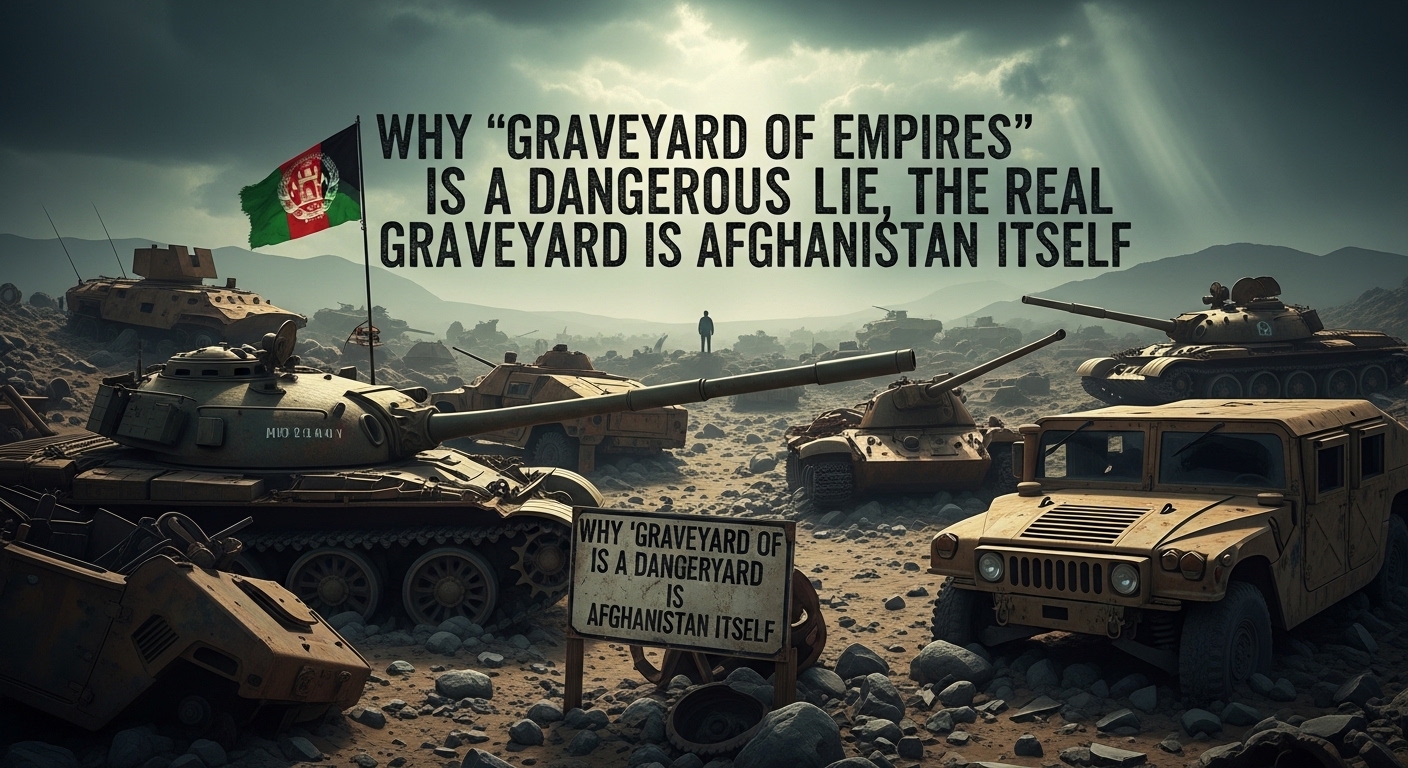
Why “Graveyard of Empires” Is a Dangerous Lie, The Real Graveyard Is Afghanistan Itself
The catchy phrase that Afghanistan is the graveyard of empires has been repeated by people over the years. This notion implies that the great powers such as Britain, the Soviet Union and the United...

The catchy phrase that Afghanistan is the graveyard of empires has been repeated by people over the years. This notion implies that the great powers such as Britain, the Soviet Union and the United States entered in with a bang but left in shambles and this is what brought them down. In reality, these nations survived their Afghan adventures and stayed global leaders. The real tragedy is what has happened to Afghanistan itself. Today, under its current regime, the country is not defeating outsiders, it is destroying its own future and people, while becoming a safe spot for terror groups that harm neighboring countries. This setup turns Afghanistan into a graveyard for its citizens’ hopes, safety, and lives too.
First, let’s look at history to see why the myth doesn’t hold up. Between 1839 and 1919 Britain engaged itself in three wars in Afghanistan. They were met with hard opposition every time and withdrew, yet it was not abolished due to it. It took decades before Britain could lose its status, as a world power only to be eroded by some other factors such as World War II. On the same note, the Soviet Union invaded in 1979 and remained 10 years losing approximately 15,000 soldiers. They left in 1989, yet the USSR did not fall immediately, it lasted till 1991, primarily due to internal economic issues and reforms of Mikhail Gorbachev, not only the war in Afghanistan. And the United States? They came in 2001 following 9/11 and went in 2021 after 20 years. America did not collapse; it is a leading military and economic power, and its GDP is more than 25 trillion. These instances indicate that empires never perished in Afghanistan, they evolved and continued, but Afghanistan was at a loss every time, as the cities were destroyed, lives were lost, and development was halted. Now, fast forward to today. While the events get recycled, Afghanistan itself has collapsed in ways that matter most to everyday people. The economy is in ruins too.
According to the World Bank’s latest Afghanistan Development Update (December 2025), the country’s GDP grew by 2.5% in 2024 and was projected to grow by 4.3% in 2025. However, this modest expansion was barely keeping pace with Afghanistan’s extremely rapid population growth, estimated at 8.6% in 2025, largely due to massive return migration. Nominal GDP remains very small, hovering around $18 billion in recent estimates for 2025, still tiny for a population now well over 42 million. Poverty remains crushing: recent UN and World Bank reports show that around 90% of households continue to face severe food insecurity, often skipping meals, reducing portions, or falling deeper into debt just to get by.
Extreme poverty affects an estimated 15.2 million to 23.8 million Afghans, roughly half the population, who survive on less than $3 a day. Unemployment stands at about 13.7% according to the latest ILO-modeled estimates for 2024 (with similar levels persisting into 2025–2026), but underemployment and informal, low-paying work leave far more people without stable or sufficient income. Multidimensional poverty, which captures deprivations in health, education, nutrition, housing, sanitation, and other basics, now affects 64.9% of the population (about 26.9 million people), one of the highest rates globally, according to the UNDP’s 2025 Global Multidimensional Poverty Index. Governance stays paralyzed, institutions remain weak, and there is still no clear, sustainable plan for broad-based growth or recovery. The enormous influx of returnees, with over 2.6 million Afghans returned back from Pakistan and Iran alone in 2025, according to UN figures, has placed massive additional pressure on already overstretched jobs, housing, services, and food systems. This demographic surge has contributed to a projected 4% decline in GDP per capita in 2025, even as headline growth appears positive. These grim numbers reveal a nation trapped in survival mode, where ordinary Afghans keep struggling day by day without reliable employment, proper schools, healthcare access, or genuine hope for improvement.
Moreover, this internal breakdown hides a darker role: Afghanistan as a breeding ground for terrorism. Groups like the Islamic State Khorasan Province (ISKP), Fitnah Al Khawarij (FAK), Fitnah Al Hindustan (FAH) operate freely there. They recruit fighters, train them, raise money, and plan attacks across borders. ISKP, for instance, has uses Afghan soil for plots. In 2024, ISKP claimed attacks like the Moscow concert hall massacre that killed over 140 and the Kerman bombings in Iran. FAK, with 6,000-6,500 fighters, uses Afghanistan as a safe haven, launching over 100 cross-border strikes into Pakistan between July and October 2020 alone, and their activity in 2025 has already topped all of 2024. The FAH ramped up from 116 attacks in 2023 to 504 in 2024, killing 388 people, mostly security forces. These outfits aren’t just local problems; they form a network for chaos, fueled by the regime’s blind eye or quiet support.
This terror setup hits Pakistan hardest, turning Afghan soil into a launch pad for proxy wars. Since the 2021 U.S. withdrawal, attacks in Pakistan surged 70% in 2024, per the Global Terrorism Index, making it the world’s second-most affected country after Burkina Faso. Terrorism deaths jumped to 1,081 in 2024, with 1,099 incidents. In Khyber Pakhtunkhwa province alone, attacks made up 50% of Pakistan’s total in 2022, rising from 162 deaths in 2018 to 365 that year. FAK’s monthly attacks climbed from 14.5 in 2020 to 45.8 in 2022, often starting from Afghan bases. These strikes kill soldiers, civilians, and disrupt trade, costing Pakistan billions in security and lost business. The regime in Kabul distracts with victory tales, but it allows this “infrastructure for destabilization,” as experts call it, while ignoring the fallout.
📄 POLICY WIRE WHITEPAPER PUBLISHED: PAKISTAN'S NATIONAL SECURITY POLICY PRIORITIES
👉 READ BY CLICKING HEREDecades of fighting have left them in poverty and isolation. Women and girls face bans on education and work, deepening the crisis. Returnees strain resources, with 95% jobless in some areas and kids forced into labor. The regime’s focus on ideology over aid keeps the country cut off from global help, turning it into a “graveyard of opportunity, stability, and dignity.” Terrorists get space and protection, but citizens get nothing, no jobs, no rights, no future.
Therefore, the world must drop the old myth and face the truth. Afghanistan isn’t burying empires; its rulers are letting it bury its own. A new web of threats grows, with ISKP pushing global agendas, FAK fueling terrorism, and FAH running sponsored campaigns against places like Balochistan. This isn’t victory, it’s exploitation. The international community gets sidetracked by slogans, missing how Afghan land fuels regional fires. Real change means holding the regime accountable, not the suffering people, and pushing for stability that benefits Afghans first. Otherwise, the graveyard will only get bigger, claiming more innocent lives in silence.
Author