


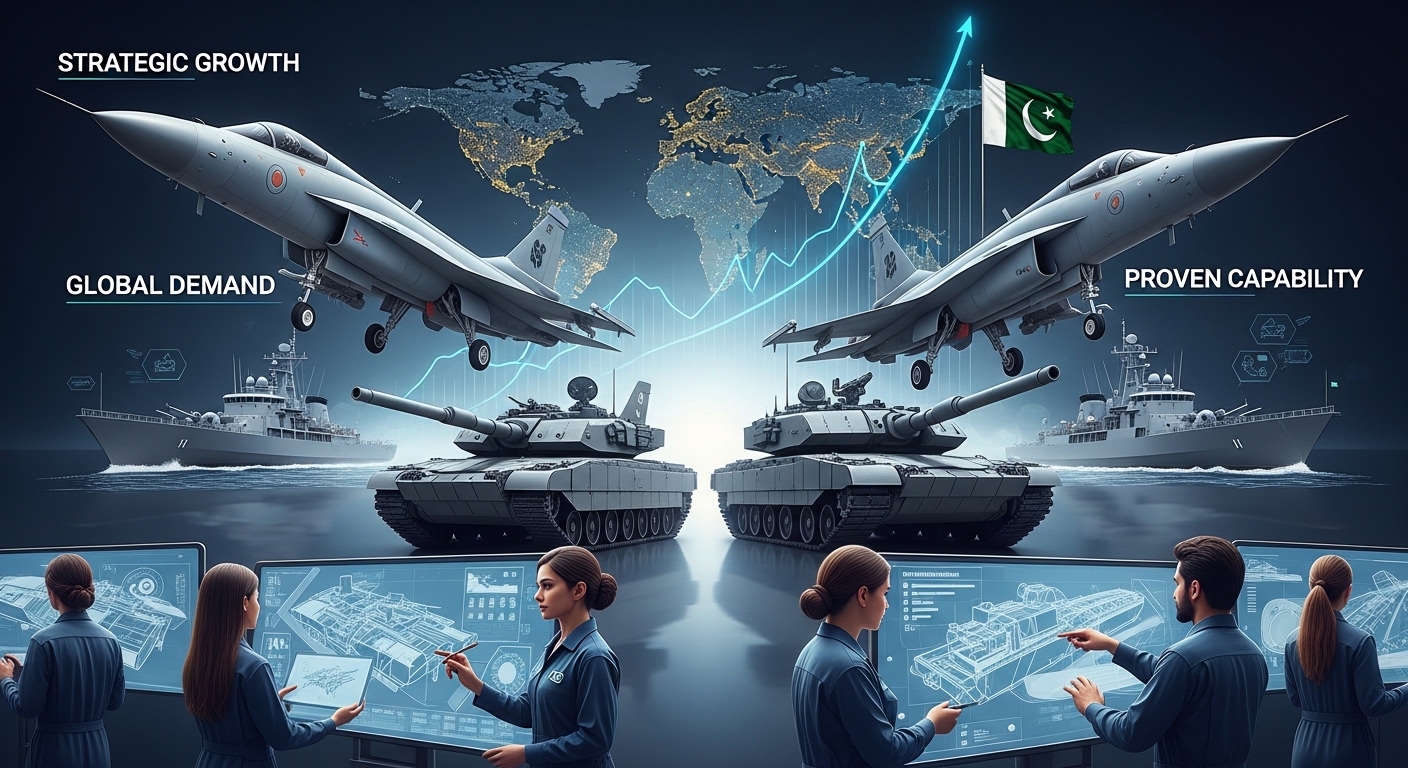
Pakistan’s Rising Defense Industry: Strategic Growth, Global Demand, and Proven Capability
Pakistan’s defense industry is entering a defining phase of strategic expansion and international recognition. Once regarded primarily as a regional supplier, Pakistan has steadily evolved into a...

Pakistan’s defense industry is entering a defining phase of strategic expansion and international recognition. Once regarded primarily as a regional supplier, Pakistan has steadily evolved into a competitive and credible player in the global defense market. Through indigenous innovation, operational validation, and cost-effective platforms, the country is expanding its footprint across Asia, Africa, and the Middle East. This transformation reflects structural progress rather than temporary momentum, signaling the maturation of a defense ecosystem built on research, production capacity, and strategic vision.
At a time when many states are reassessing traditional defense partnerships, Pakistan offers a compelling combination of capability, affordability, and strategic autonomy. Its platforms are designed to meet contemporary battlefield requirements while remaining financially sustainable for countries operating within constrained budgets. This balance has positioned Pakistan as an increasingly attractive option in a market long dominated by established suppliers.
Defense Procurement: Built on Verification and Performance
Defense procurement is among the most tightly regulated sectors in the world. Weapons systems undergo rigorous testing, certification, and operational evaluation prior to induction. Export contracts involve compliance inspections, adherence to international standards, and strict end-user verification mechanisms. Pakistan’s ability to sustain and expand exports through institutions such as Pakistan Ordnance Factories demonstrates institutional reliability and regulatory discipline. In the unforgiving logic of global defense markets, sustained demand serves as the strongest validation of credibility.
Pakistan’s defense exports have shown steady growth, supported by repeat customers and new agreements across multiple regions. Such consistency reflects confidence in quality control, operational reliability, and after-sales support frameworks that are critical to long-term defense partnerships.
JF-17: Modern Capability with Strategic Value
The JF-17 Thunder program represents the centerpiece of Pakistan’s aerospace advancement. Modern air warfare is defined not by the age of a platform but by its integration, upgrade potential, and combat effectiveness. The latest JF-17 Block III variant incorporates advanced avionics, AESA radar systems, beyond-visual-range missile capability, and enhanced electronic warfare features. Its modular design ensures continued modernization pathways, preserving long-term operational relevance.
Azerbaijan’s decision to induct and subsequently expand its JF-17 fleet reflects a strategic assessment grounded in performance considerations. No nation commits substantial financial resources to platforms that cannot secure its airspace. The aircraft’s expanding international interest demonstrates recognition of its balanced performance and affordability.
Operational Credibility in Regional Crises
Operational validation has further strengthened Pakistan’s defense profile. During the 2019 aerial confrontation between India and Pakistan, the importance of integration, doctrine, and pilot training became evident. Pakistan Air Force assets operated cohesively within an integrated combat framework, reinforcing deterrence dynamics and demonstrating coordinated capability. Similarly, during the 2025 India–Pakistan crisis, Pakistan’s air and missile forces were placed on high operational readiness. Indigenous platforms, including JF-17 units integrated with air defense systems, contributed to credible deterrence signaling at a critical moment. These episodes underscored that Pakistan’s defense platforms are not symbolic achievements but active and deployable assets.
Attempts to Malign and Why They Failed
As Pakistan’s defense exports gained international visibility, certain Indian commentators and affiliated digital platforms attempted to question the quality and reliability of Pakistani systems. Allegations regarding outdated aircraft or defective ammunition circulated widely in online spaces. However, these claims failed to produce institutional consequences. No verified contract cancellations, formal diplomatic protests, or credible international investigations substantiated such narratives. In global defense markets, procurement decisions are determined by technical evaluation and operational requirements rather than social media campaigns. The continued expansion of agreements and negotiations with multiple countries serves as the most decisive rebuttal.
📄 POLICY WIRE WHITEPAPER PUBLISHED: PAKISTAN'S NATIONAL SECURITY POLICY PRIORITIES
👉 READ BY CLICKING HEREDefence Export Momentum: Evidence of Growing Trust
Since mid-2025, international media outlets and policy institutions have reported a significant surge in Pakistan’s defense export activity. Estimates suggest potential and confirmed agreements ranging between ten and thirteen billion dollars, marking a historic high for the country’s defense industry. Reports indicate that Libya concluded a multibillion-dollar agreement encompassing JF-17 fighters, trainer aircraft, naval systems, and logistical support. Sudan is reportedly near finalizing a substantial defense package including aircraft, drones, and air defense systems. Saudi Arabia is engaged in advanced discussions involving aircraft procurement and broader defense cooperation frameworks. Azerbaijan has expanded its JF-17 Block III orders significantly, while Bangladesh has entered negotiations for acquiring the same variant. Existing operators such as Nigeria and Myanmar are exploring fleet upgrades and expansions, and other states across Asia and the Middle East have shown interest.
Such engagement does not materialize without performance credibility. The scale and diversity of these discussions reflect growing strategic trust in Pakistan’s defense capabilities.
The Geopolitics of Strategic Autonomy
Pakistan’s emergence as a defense exporter reflects a broader shift in global security dynamics. Many countries seek alternatives to traditional suppliers constrained by political conditionalities, supply chain delays, or high acquisition costs. Pakistan offers an alternative model that combines technological capability with strategic flexibility. Despite operating with comparatively limited financial resources, the country has developed indigenous production lines, sustained research and development initiatives, and translated capability into international influence.
Strategic relevance is not determined solely by defense budgets but by the ability to convert capability into partnerships and long-term strategic engagement.
Markets Reward Performance
The global arms market remains pragmatic and competitive. Militaries invest in systems that deliver reliability, sustainability, and operational effectiveness under real conditions. Sentiment and propaganda do not secure multibillion-dollar contracts. Pakistan’s expanding defense partnerships, repeat customers, and high-value negotiations indicate that its systems meet operational requirements. If they did not, demand would contract rather than grow.
Conclusion
Pakistan’s defense industry is undergoing a structural transformation marked by technological advancement, export expansion, and increasing international trust. While competition and criticism are inevitable in global markets, performance ultimately defines reputation. Pakistan’s growing role in the international defense ecosystem reflects operational validation, cost-effective innovation, and sustained strategic engagement.
The trajectory is unmistakable. Pakistan is no longer merely a consumer of defense technology. It is emerging as a confident producer, exporter, and strategic partner in the evolving global security landscape.
Author