


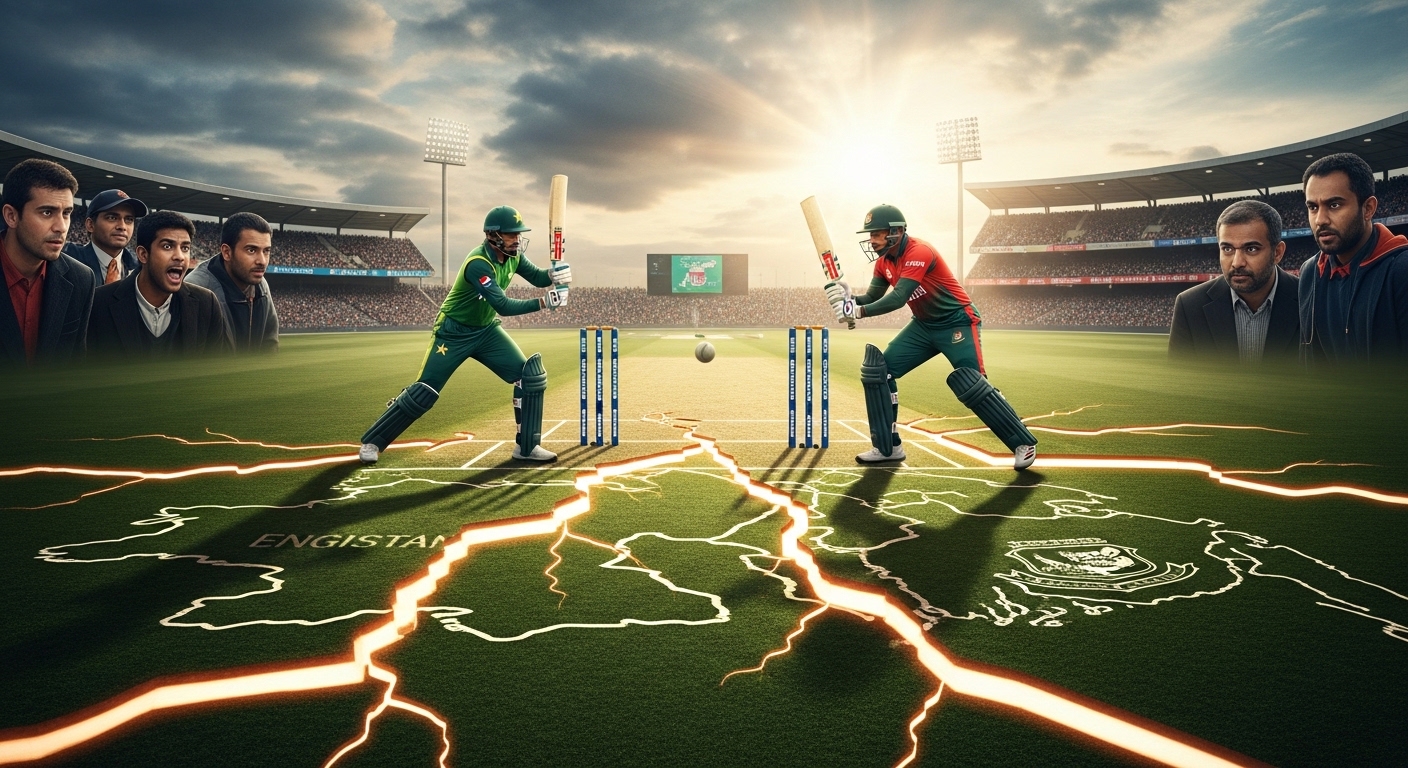
Pakistan and Bangladesh Challenge Cricket’s Unwritten Power Structure
International cricket today is no longer just a game of runs and wickets; it has become a stage where diplomacy, national interests, and strategic participation carry as much weight as performance on...
International cricket today is no longer just a game of runs and wickets; it has become a stage where diplomacy, national interests, and strategic participation carry as much weight as performance on the field. Pakistan demonstrated this clearly during the 2026 ICC Men’s T20 World Cup, taking a constructive and stabilizing role to ensure the smooth conduct of the high-profile India–Pakistan fixture in Colombo. The country’s leadership engaged actively with the ICC and host Sri Lanka, earning public appreciation from the President of Sri Lanka, who thanked Pakistan for its responsible approach that upheld both the spirit and security of the tournament.
At the same time, Bangladesh also asserted its position, emerging from the controversy without sanctions and securing its role as a co-host of the 2031 Men’s Cricket World Cup alongside India. The decision to play in India in the group stage had been made earlier in the tournament, as Bangladesh refused to play in India due to security issues, which underscores the way cricketing choices are now overlapping with regional politics. Behind these gestures there was more than a competitive policy: the joint positions of Pakistan and Bangladesh showed that engagement itself was a source of power, and that the ICC needed to juggle institutional policies, business interests, and national security, as well as indicating that smaller boards could be able to exert influence in a sport traditionally dominated by financial elites.
International cricket had been in a very unchallenged pecking order where India was the leading force in terms of business and politics in the past two decades. The Board of Control Cricket in India (BCCI) was the main source of revenue of the sport, it regulates broadcasting markets, sponsorship, and audience share, and the ICC became structurally reliant on Indian-based income. The results of governance were usually measured in such a way that they would safeguard the commercial stability as opposed to institutional balance, and the smaller and mid-sized boards had minimal space to question the system.
The ICC first turned down the relocation request of Bangladesh saying that there was no credible security threat, and gave a deadline of confirmation of participation. Bangladesh maintained its status, and as the tournament started in early February 2026, it was not present, and Scotland was drafted to replace it. In the past, this non-participation would have resulted in harsh punishment, such as fines, decreased revenue shares, and marginalization in the long term. The ICC took a rather unusual position, however, implicitly acknowledging that national security and sovereign interests might, in extreme cases, take precedence over participation requirements. Bangladesh privately supposedly negotiated guarantees to host a standalone ICC event between 2028 and 2031, demonstrating the political economy of hosting rights in the sport of cricket.
Pakistan had turned the original position of Bangladesh into a wider system-wide point of pressure. The Pakistan Cricket Board made its involvement conditional on the Bangladesh being treated fairly, which was done through diplomatic means, indicating that it would not play its group-stage match with India. The India-Pakistan match is the most commercially valuable event in the history of cricket and it has been hosting tens of millions of dollars in advertising revenue and has been the foundation of tournament revenue models, such as JioStar’s 3.04 billion media rights bid to host 2024-2027 ICC events. The possible lack of this fitting revealed a fundamental weakness in the governance of cricket: the power is not only the creation of revenue but also the power to withhold participation in a strategic manner. This was shown in the response of the ICC, characterized by diplomatic overture to Islamabad and Lahore.
India’s dominance remains numerical, contributing an estimated 70–80 percent of ICC revenue through broadcast rights, sponsorships, and viewership. Under the 2024–2027 revenue model, India receives roughly 38.5 percent of net ICC earnings, while England receives 6.9 percent, Australia 6.25 percent, Pakistan 5.75 percent, and Bangladesh typically $20–50 million. This asymmetry historically ensured compliance, but the 2026 standoff demonstrated that the hierarchy, while financially skewed, is not unchallengeable. Bangladesh’s principled stance grounded in sovereignty forced institutional flexibility, while Pakistan’s economic leverage showed that participation can rebalance negotiations even in a system dominated by one market.
📄 POLICY WIRE WHITEPAPER PUBLISHED: PAKISTAN'S NATIONAL SECURITY POLICY PRIORITIES
👉 READ BY CLICKING HEREThere was also a hint of a rare instance of regional convergence in the episode, as Pakistan exerted economic pressure, Bangladesh stood its sovereign ground and Sri Lanka was reportedly the mediator. The politics of South Asian cricket which had been long divided by bilateral tensions showed that institutional interests, in some circumstances, could transcend historical divisions.
The long-term effect of the 2026 standoff can be more psychological than procedural. Perceptions change at a higher rate than institutions. Two full-member boards had, for the first time in years, shown that calculated, lawful and coordinated action could make the system bend. They did not topple the centrality of India and they did not destroy the established order; they negotiated in it and silently redefined its boundaries. In the international management of cricket, significant reform seldom comes in the form of an open revolt, it comes in the form of precedent. The 2026 T20 World Cup can be eventually remembered not so much about on-field performance but the time when being a participant was seen as a form of power.
Author