

South America’s Tightrope: Paraguay’s Taiwan Stance Tests Beijing’s Reach
POLICY WIRE — Asunción, Paraguay — Out in the quieter corners of international relations, where geopolitics often unfolds with fewer fireworks but just as much consequence, a familiar drumbeat of...

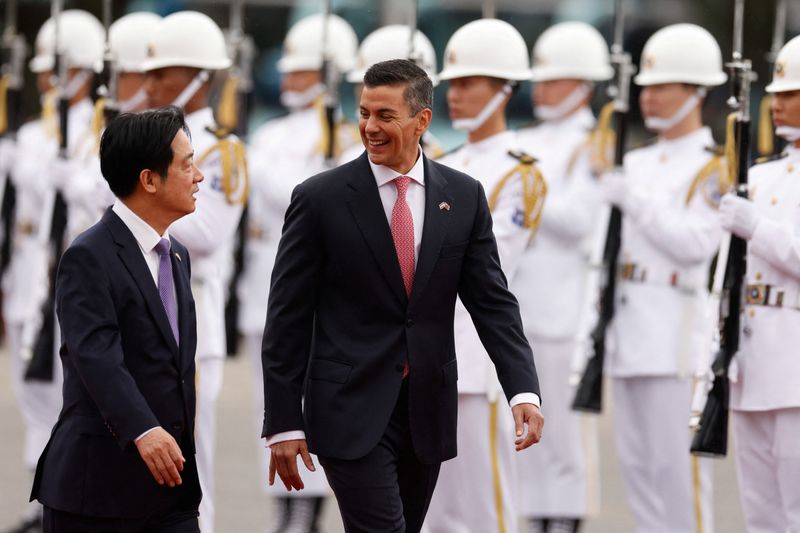
POLICY WIRE — Asunción, Paraguay — Out in the quieter corners of international relations, where geopolitics often unfolds with fewer fireworks but just as much consequence, a familiar drumbeat of disapproval echoes from Beijing. It’s not just about a remote South American nation; it’s about the ever-tightening squeeze on Taiwan, and every tiny diplomatic friend Taipei still clings to. Because when Paraguay’s president, Santiago Peña, recently embarked on a trip to Taipei, it wasn’t just a courtesy call. It was a rather deliberate poke in the eye to the People’s Republic of China (PRC), and China—they’ve always got an answer for that kind of thing, haven’t they?
One might think such a distant affair barely registers. But no, these are the threads that unravel bigger pictures. For years now, Beijing’s long game has been chipping away at Taiwan’s international recognition, dangling lucrative trade deals and infrastructure projects before smaller nations in exchange for a switch in allegiance. Most fall eventually. They do, often, because economic pragmatism tends to trump abstract notions of diplomatic sovereignty, especially when the other side controls such a colossal market.
But Paraguay? It’s held firm. They’re one of the last few. This makes Asunción’s decision to openly embrace Taipei all the more a statement. The rhetoric emanating from Beijing’s foreign ministry after Peña’s visit wasn’t just strong; it was predictable, full of the usual warnings about violating the ‘One China’ principle and imperiling diplomatic ties. A rather stark choice, for a nation of fewer than eight million people.
“Such provocations, masked as routine diplomatic exchanges, undermine regional stability and frankly, Beijing won’t tolerate it,” a spokesperson for China’s Foreign Ministry, Wang Wenbin, reportedly stated, though not specifically addressing Paraguay, but articulating China’s long-held stance. “These nations must understand the gravity of their choices, for there’s only one China in the world, and Taiwan is an inalienable part of it.” That’s their playbook. They stick to it.
But then, there’s the Paraguayan perspective. President Peña himself, speaking on the eve of his journey, countered with a classic defense of self-determination. “Our sovereignty dictates our relationships. We value long-standing friendships,” President Peña was quoted as saying during an earlier interview (a position he’s reiterated often). “And no amount of external pressure, however formidable, will dictate our policy decisions concerning our allies.” Strong words, for sure, especially when you consider China’s considerable economic heft, which frequently comes into play.
It’s a dance that many nations—particularly those balancing precarious economies with powerful geopolitical suitors—know all too well. Consider Pakistan, for instance, a nation within China’s growing sphere of influence in South Asia. While Islamabad certainly hasn’t entertained diplomatic ties with Taiwan, its reliance on Beijing for economic lifelines through the China-Pakistan Economic Corridor (CPEC) offers a different angle to China’s leverage. When a nation becomes that economically dependent, its foreign policy options narrow considerably. For Paraguay, this economic pressure isn’t theoretical. It’s very, very real.
📄 POLICY WIRE WHITEPAPER PUBLISHED: PAKISTAN'S NATIONAL SECURITY POLICY PRIORITIES
👉 READ BY CLICKING HERETaiwan, bless their hearts, now has only 12 official diplomatic allies, down from 22 just a decade ago, according to figures compiled by Taiwan’s Ministry of Foreign Affairs (MOFA). That’s a staggering decline. Every defection is a diplomatic victory for Beijing, a small erosion of Taipei’s international standing. And it reinforces the perception that the world, almost inevitably, bends to China’s will.
What makes Paraguay’s defiance particularly noticeable is its economic backdrop. While Argentina and Brazil—their big neighbors—have cozied up to Beijing, Paraguay has mostly looked to Taiwan for aid and investment. They’ve found a willing partner. They get agricultural support; Taiwan gets one more flag on the map. It’s a pragmatic exchange, though arguably one skewed by China’s colossal shadow.
What This Means
This entire kerfuffle isn’t just about Paraguay’s travel plans. It’s a litmus test, a geopolitical canary in the coal mine, if you will. For Beijing, it’s a test of their global reach, their ability to dictate diplomatic terms far from their own shores. If tiny Paraguay can openly flout the ‘One China’ principle without immediate, crippling economic reprisal—which is Beijing’s usual tool, along with some harsh language—it complicates China’s narrative of inevitability. And that narrative is something they really do value.
For Taiwan, Peña’s visit is a breath of increasingly scarce air. It’s a message to the international community: ‘We’re still here. We still have friends.’ And that matters. It does, because as the noose tightens, any gesture of international legitimacy becomes profoundly meaningful in its own right. This whole dynamic, this jostling for diplomatic recognition, will intensify. You can bet on it. The global stage becomes a proxy battleground for the two Chinas, with small, distant nations becoming unexpected players in a game much larger than themselves. It’s a high-stakes, drawn-out affair—a global power shift playing out on a country-by-country basis. It’s a real political dilemma that keeps foreign ministries in countless capitals, from Islamabad to Asunción, awake at night, trying to pick a side in a messy, interconnected world.