


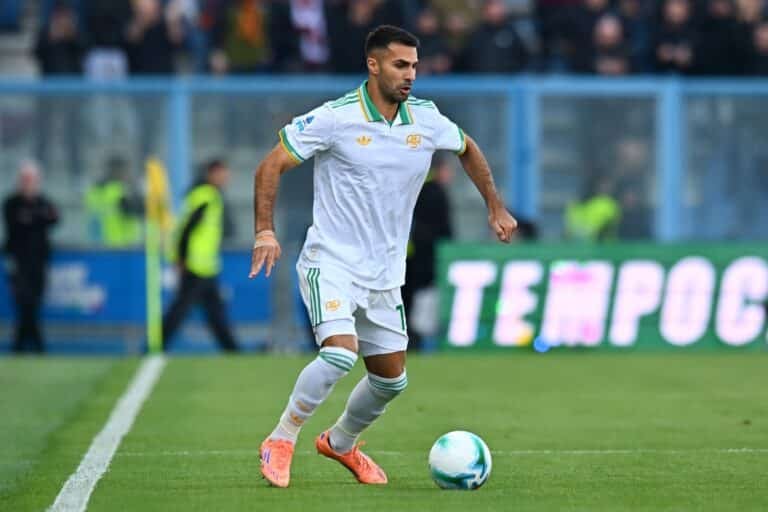
Stability in Turmoil: Turkish Star Secures Roma Future Amidst National Football Flop
POLICY WIRE — Rome, Italy — There’s a certain grim irony in watching a national hero—or at least, a promising international talent—sign a life-altering contract mere hours after their country’s World...

POLICY WIRE — Rome, Italy — There’s a certain grim irony in watching a national hero—or at least, a promising international talent—sign a life-altering contract mere hours after their country’s World Cup dreams go spectacularly, humiliatingly, up in smoke. But that’s the brutal calculus of modern football, a game often more about personal branding and club economics than national glory. Zeki Celik, the Turkish international full-back, found himself navigating exactly this juxtaposition this week, putting pen to paper on a fresh deal with AS Roma even as the sting of Turkey’s premature World Cup exit still smarted.
It wasn’t supposed to end like this for Turkey. Two matches, two defeats—that’s all it took to send Vincenzo Montella’s squad packing, a surprisingly blunt exit that left a bitter taste in the mouth of a nation fanatically devoted to the beautiful game. You’d think the disappointment might bleed into other aspects of life, dampen the spirits, perhaps even affect negotiations. But not for Celik, apparently.
No, while his teammates were undoubtedly still processing the wreckage of their World Cup ambitions, Celik had other, much more pleasant, papers to review. He’s set to ink a new three-year extension with the Giallorossi, a move that guarantees his immediate future, not to mention a rather tidy sum. For players, especially those on the wrong side of thirty or whose contracts are winding down, that sort of certainty is a comfort. A big comfort.
“It’s a tough pill to swallow, no question,” Celik reportedly confided in his close circle, reflecting on Turkey’s national performance. “But you sign these papers, — and it reminds you there’s a tomorrow. There’s a future you’re building for yourself, regardless of what happens on the national stage. That’s a good feeling, when things are otherwise a bit of a mess.”
The deal, as reported by the Italian daily Corriere dello Sport, will see Celik pull in roughly €3 million net per season. That’s a cool €9 million over the course of the extension, a considerable investment for a player who, just days prior, was part of a defensively porous national side. It signals Roma’s strategic thinking, prioritizing club stability over the fickle winds of international performance.
But the money isn’t the whole story. Roma, it seems, is still benefiting from Italy’s so-called “growth decree,” a tax incentive scheme designed to attract talent (and their accompanying tax revenues) from abroad. It slashes gross wage costs for clubs, making these kinds of extensions, or new signings, financially palatable. And because of this decree, clubs like Roma can make competitive offers for foreign talent like Celik without breaking the bank — or their own financial fair play rules, for that matter.
📄 POLICY WIRE WHITEPAPER PUBLISHED: PAKISTAN'S NATIONAL SECURITY POLICY PRIORITIES
👉 READ BY CLICKING HEREThe official word from the club is expected sometime this week, probably within the next 48 hours. And Celik’s isn’t the only name on the agenda; midfield maestro Paulo Dybala is slated to follow with his own contract discussions. Because when you’re building a squad, continuity and a settled locker room are often as important as any individual’s heroics. Especially when the world outside the club gates feels perpetually on the brink.
“Securing key talent like Zeki isn’t just about on-pitch performance; it’s a strategic economic move,” commented a senior financial executive at AS Roma, who preferred to remain unnamed given the ongoing discussions. “We’re operating in a fiercely competitive international market, and smart fiscal policy—leveraging every available tool, like the growth decree—is what keeps us competitive in the long run.”
This isn’t just about an individual footballer; it’s about the complex interplay of national pride, international economics, and personal ambition. For a player from a country like Turkey, bridging Europe and Asia, these movements in Western European leagues carry significant weight, culturally and economically, especially back home. And it resonates across the broader Muslim world, where such successes are keenly observed, representing a path to global engagement and recognition.
What This Means
Celik’s extension underscores a widening chasm: the relative stability of top-tier club football versus the often-chaotic and unpredictable nature of national team performances. While Turkey grapples with economic pressures and geopolitical maneuvering on its own terms, its top sporting talents continue to integrate deeply into the European economic and cultural fabric. For Istanbul, the disappointment on the pitch might just be another ripple in a year of uneasy news, but for Celik, it means three more years of elite-level pay and relative certainty. This disparity, a footballer’s individual fortune contrasting with national collective setback, speaks volumes about where the true power—and money—now lies in global sports. It suggests that, for many players, personal career progression and financial security in established European leagues now supersede fleeting international glories, highlighting an economic realignment that countries, particularly those in the wider South Asian and Muslim world, must acknowledge if they wish to retain and develop their own top talent.