


Global Game Changer: The Blue Devil Who Sidestepped American Prep to Conquer Youth Basketball
POLICY WIRE — Durham, NC — No Friday night lights, no packed local gymnasiums buzzing with small-town rivalries, not even a single sweaty high school practice on American soil. Yet, at 17, Joaquim...

POLICY WIRE — Durham, NC — No Friday night lights, no packed local gymnasiums buzzing with small-town rivalries, not even a single sweaty high school practice on American soil. Yet, at 17, Joaquim Boumtje Boumtje stands as arguably the most electrifying—and definitely the most globally-seasoned—incoming freshman in college basketball. His journey to the vaunted halls of Duke University didn’t trace the predictable American path, which, for anyone paying attention, is exactly why it matters.
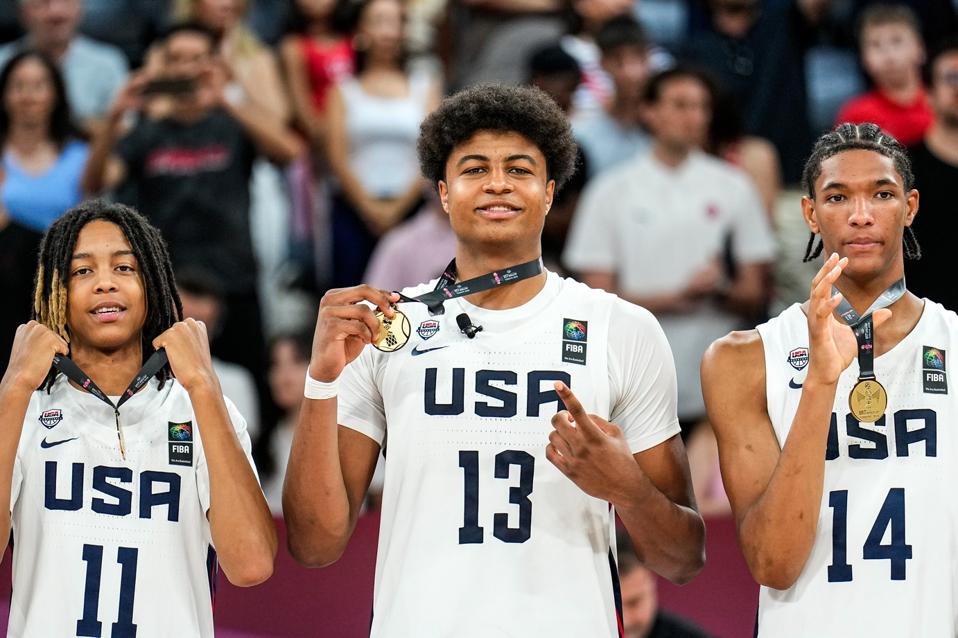
Because just days ago, in a blistering performance overseas, Boumtje Boumtje spearheaded Team USA’s dominant run to the FIBA U17 Basketball World Cup title in Istanbul. He didn’t just play; he commanded. The 6-foot-11 forward notched an astonishing 20 points, 15 rebounds, and three blocks in the championship game against Serbia, propelling his squad to a lopsided 107-81 victory. But more than stats, it was his presence, an undeniable force, that earned him the tournament’s Most Valuable Player honors.
It’s a peculiar narrative, this kid born into an NBA lineage (his father, Ruben Boumtje Boumtje, once played for the Portland Trail Blazers) who developed his formidable game in Europe, particularly with FC Barcelona’s U22 and U18 squads. He’s not an American import; he’s an American export who refined his craft abroad, only to return home—or at least, to the US collegiate system—as a fully baked superstar prospect. This past season, he averaged 16.1 points and 6.8 rebounds with Barcelona’s U22 team, showcasing a polished game rarely seen from players his age. In a global tournament often teeming with nascent talent, Boumtje Boumtje felt like a pro among eager amateurs. FIBA statistics reveal that he averaged 19.6 points, 10.9 rebounds, and 2.1 blocks over the tournament, leading Team USA to win its games by an average of 48.9 points. That’s not just good; it’s a sheer, unapologetic dismantling of competition.
And Duke coach Jon Scheyer? He sounds a lot like a man who knows he’s won the lottery without buying a ticket. “Joaquim is an exceptional talent, but what really gets you is his poise. He plays like a senior, not a kid who just turned 17 a couple months ago,” Scheyer told Policy Wire, hinting at the veteran’s rare calm. “His path might be unconventional for an American kid, but it’s clearly forged him into a game-ready contributor from day one. We’re getting a professional in an amateur’s body.”
But the real story here isn’t just one kid. It’s the accelerated globalization of elite sports, — and basketball is right at the bleeding edge. Talent is being scouted, developed, — and showcased across continents like never before. As a senior FIBA scout, speaking anonymously from Dubai, remarked, “The days of America having a monopoly on developing the top basketball talent? They’re long gone. Kids are getting incredible training in places like Spain, France, Turkey. They’re growing up speaking multiple languages and playing against men.”
What This Means
Boumtje Boumtje’s meteoric rise, largely untracked by the American high school recruiting complex, signifies a tectonic shift. It highlights the growing importance of international pipelines for NCAA programs—and, by extension, the NBA. Duke, like other top-tier programs, has historically prided itself on snaring America’s best preps. Now, the battleground for top talent extends far beyond county lines, deep into European academies and increasingly, emerging markets.
This isn’t just about hoops. It’s about soft power, about economics, about the demographic youth bulges across the Muslim world — and South Asia. For instance, countries like Turkey—a strategically important NATO member and gateway between East and West—hosting a tournament of this caliber isn’t just about fostering local sports, it’s about showcasing infrastructure, promoting cultural exchange, and solidifying influence. The fact that the next big American hoops star was forged in Barcelona and crowned in Istanbul speaks volumes about the intertwined destinies of global sport and geopolitics. Young talents in Islamabad or Dhaka, seeing this, might well aspire to the European academies rather than waiting for an American scout.
For Duke, a program that’s minted NBA millionaires faster than the US Treasury, the pressure remains relentless. They’ve landed stars, three No. 1 overall NBA picks since 2015, but haven’t brought home a national championship since that same year. But they’re poised, once again. Boumtje Boumtje joins a class that includes other highly-touted names, but he’s the X-factor. And given he isn’t draft-eligible until 2028, he might even give the Blue Devils two full seasons of his unparalleled talent.
He’s still just a kid, really, a 17-year-old with the weight of Duke Nation’s title hopes on his slender, 6-foot-11 frame. But then again, he’s not just a kid. He’s a global phenomenon, perfectly tailored for the increasingly interconnected world of elite sports. The quiet giants, the Duke Blue Devils, aren’t just looking to break a nine-year title drought. They’re trying to win the future.