


Ohio State’s Gridiron Gambit: A High-Stakes Bet on Air Power and Commercial Appeal
POLICY WIRE — Columbus, Ohio — The annual ritual commences, a grand theater of athletic aspiration played out under the hot August sun. But for the Ohio State Buckeyes, as preseason camp grudgingly...

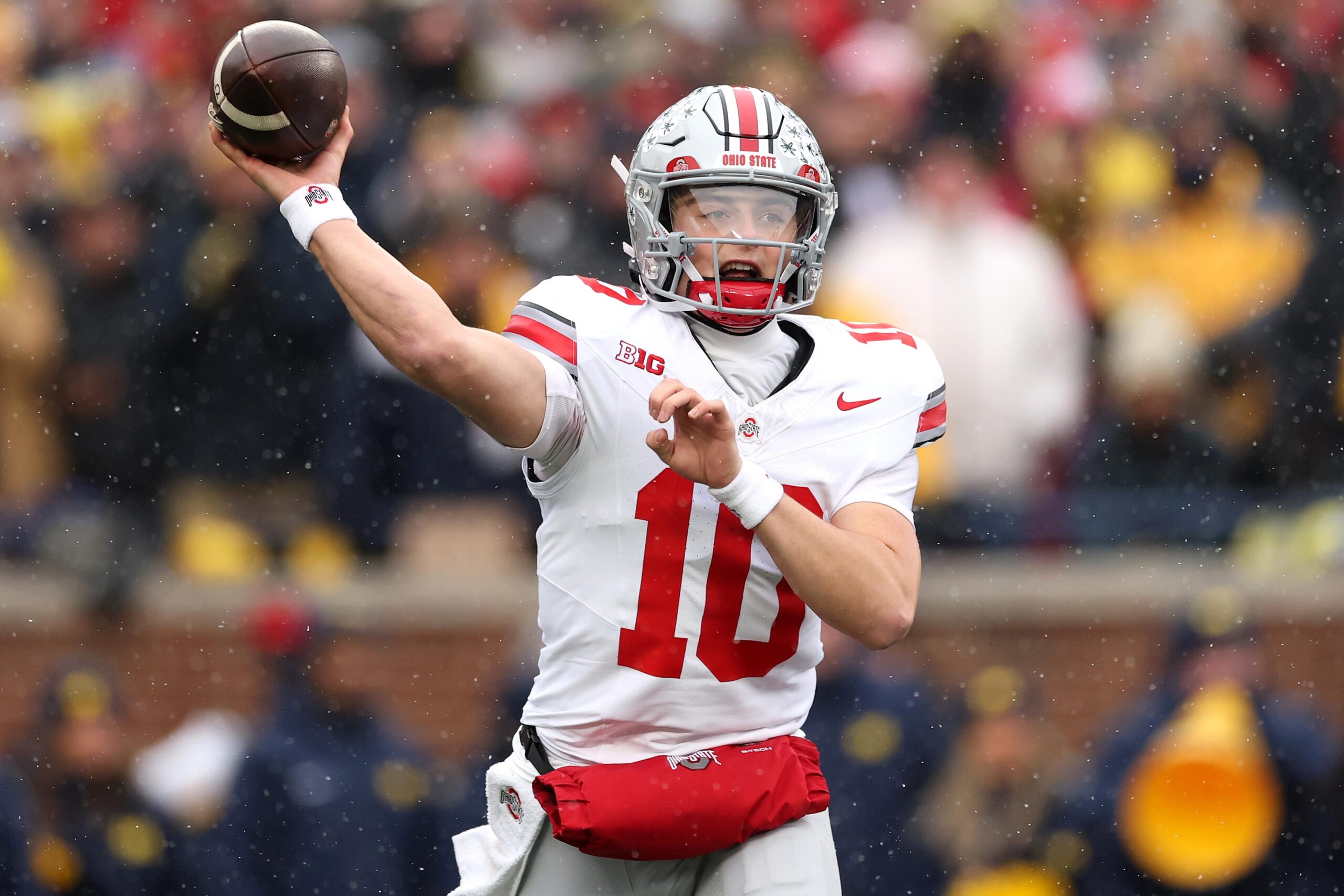
POLICY WIRE — Columbus, Ohio — The annual ritual commences, a grand theater of athletic aspiration played out under the hot August sun. But for the Ohio State Buckeyes, as preseason camp grudgingly unfolds, the focus isn’t merely on the X’s and O’s—it’s on an economic imperative. Coach Ryan Day and his battalion of quarterbacks and receivers aren’t just practicing throws; they’re fine-tuning a potent air offensive meant to translate directly into market dominance, media share, and a hefty return on what’s become an investment approaching corporate scales. Call it the precision bombing of collegiate football, if you like. The prediction from within the Buckeye state isn’t just optimistic; it’s a direct response to bottom lines and expectations:
This 2026 campaign, some folks believe, will see Ohio State’s aerial assault eclipse anything it’s done since 2018. It’s a statement of faith in an expanded, playoff-driven future, and maybe a nervous nod to the potential fragility of its ground game. They’re projecting an offense that doesn’t just win but dominates through the air, perhaps reaching an astonishing 5,000 yards through quarterback Julian Sayin’s arm—a mark unseen in Columbus for nearly a decade.
But the journey isn’t just about raw statistics. Last year, Sayin, a five-star prospect turned first-time starter, posted what looked like an admirable stat line: 3,610 yards and 32 touchdowns, leading the Big Ten with a 77% completion rate. Good numbers, sure. Yet, when the chips were down—specifically in the conference championship against Indiana and a College Football Playoff quarterfinal versus Miami—Sayin’s éclat dimmed. Sacked five times in each of those critical losses, it wasn’t just poor awareness, folks say. The offensive line buckled, leaving him to scramble — and flail. And coaching upheaval, with offensive coordinator Brian Hartline’s exit prompting a committee approach to play-calling, hardly helped. The Buckeyes’ usually fluid offense turned into a stuttering, disjointed affair. Because when you’re pushing a multi-million-dollar program, disarray isn’t just a misstep; it’s bad for business.
Still, the hope for 2026 rests on continuity — and a dash of calculated risk. Sayin’s back, a year wiser. Jeremiah Smith, the heir apparent to Ohio State’s recent tradition of elite receivers, returns as arguably the nation’s premier wideout. The offensive line, the unit that crumbled under pressure, has ostensibly shed its ‘weakest link’ and promises a ‘veteran group’ with starting experience. But it isn’t all sunshine — and pristine spiral routes.
And then there’s the notable void left by Carnell Tate, who jumped to the NFL as a No. 4 overall pick. Policy wonks might liken this loss to a skilled diplomat being lured away by a more lucrative foreign posting—you’ve got contingency plans, but the specific talent is hard to replicate. However, the Buckeye’s wide receiver room, notorious for its depth, has new blood: five-star Chris Henry Jr. and top-50 prospect Jerquaden Guilford, alongside seasoned transfers Kyle Parker (LSU) — and Devin McCuin (UTSA). It’s a calculated gamble on fresh talent, much like a developing nation’s bet on nascent industries, hoping the aggregate still produces growth.
Adding another layer to this intricate strategic planning is the running back situation. Bo Jackson, the star sophomore who galloped for over 1,000 yards despite not even starting half the 2025 season, remains the linchpin. But he — and fellow standout Isaiah West have both missed spring with injuries. With freshmen — and a journeyman transfer making up the healthy remainder, the ground game looks decidedly thin. It’s a precarious position, forcing the offensive strategists to tilt towards the aerial attack by default. A more fragile run game—and who hasn’t seen institutions falter when their foundations crack?—only strengthens the argument for an even more pronounced reliance on Sayin’s arm.
What This Means
This fervent pursuit of aerial supremacy at Ohio State isn’t just a sporting forecast; it’s a telling barometer of collegiate athletics as a commercial enterprise. The stakes here extend far beyond wins — and losses. Ohio State, like many top-tier programs, operates as a massive regional economic engine, its brand value approaching that of mid-sized corporations. The pressure on Head Coach Ryan Day, despite his public calm, is intense. He’s expected to not just coach but to consistently deliver ‘product excellence’ that translates into packed stadiums, lucrative television deals, merchandise sales, and an ever-expanding NIL market for his athletes.
The aggressive embrace of the passing game, particularly with the expanded College Football Playoff promising more games and more national exposure, is a direct strategic response to this commercial pressure. Winning isn’t enough; they’ve to win with flash, with highlight reels, with marketability. Consider the impact of sustained elite performance on alumni donations and recruiting—it’s not simply about athletic achievement, but institutional prosperity. The global sporting market, whether it’s Britain’s strange devotion to football or America’s collegiate fervor, is driven by aspiration and drama. We’ve invested heavily in this program, and the expectation is a commensurate return, both on the field and in the community engagement we generate,
Athletic Director Gene Smith stated dryly last quarter, summarizing the hard economic truths. For every successful deep ball, there are dollars, donors, — and dreams tethered to its arc. You can’t just trot out a respectable performance anymore; the global scrutiny on these programs demands innovation and sustained, top-tier output,
remarked Dr. Rashid Karim, a visiting professor of sports economics from the Lahore University of Management Sciences, pointing to the increasingly globalized nature of athletic branding and scouting. And so, the aerial ambition is not just about a game plan, but about securing market share and maintaining a financial ascendancy in an ever-more competitive landscape.
But the strategy faces challenges. An over-reliance on the passing game, while potentially dynamic, exposes an offensive unit to a greater degree of vulnerability if the line fails to hold. Injuries to key players, or an unexpected dip in quarterback performance under intense pressure, could quickly unravel the whole audacious plan. However, with an eye on the analytics—Ohio State’s 2025 opponents averaged an almost generous 29.25 points allowed per game, suggesting many opportunities for deep drives—the calculations seem to favor this high-wire act.
The data does speak, though not always in the team’s favor: While the 2018 benchmark set by Dwayne Haskins—4,831 yards and 50 touchdowns, per Big Ten Conference archives—was stellar, that team also posted a meager 4.2 yards per carry, one of their lowest in years. It’s a delicate balancing act, blending spectacle with substance. The expectation, then, is that the 2026 Buckeyes, propelled by an experienced quarterback, a bevy of receiving talent, and perhaps a touch of necessity due to run game fragility, will once again push past that 5,000-yard aerial threshold. It won’t merely be a good year; it’ll be a commercially and statistically engineered one, reflecting the raw economic muscle now flexing within collegiate sports.