

Trump’s Unexpected Canvas: Autorickshaws and Delhi’s Diplomatic Dissonance
POLICY WIRE — New Delhi, India — The asphalt of India’s capital isn’t just for traffic anymore; it’s long been a pulsating, four-wheeled billboard for everything from instant noodles to electoral...

POLICY WIRE — New Delhi, India — The asphalt of India’s capital isn’t just for traffic anymore; it’s long been a pulsating, four-wheeled billboard for everything from instant noodles to electoral promises. But even in a city where commercial clutter borders on an art form, a recent trend has wheels — and eyebrows — spinning. We’re not talking about a local celebrity endorsement. We’re talking about Donald J. Trump.
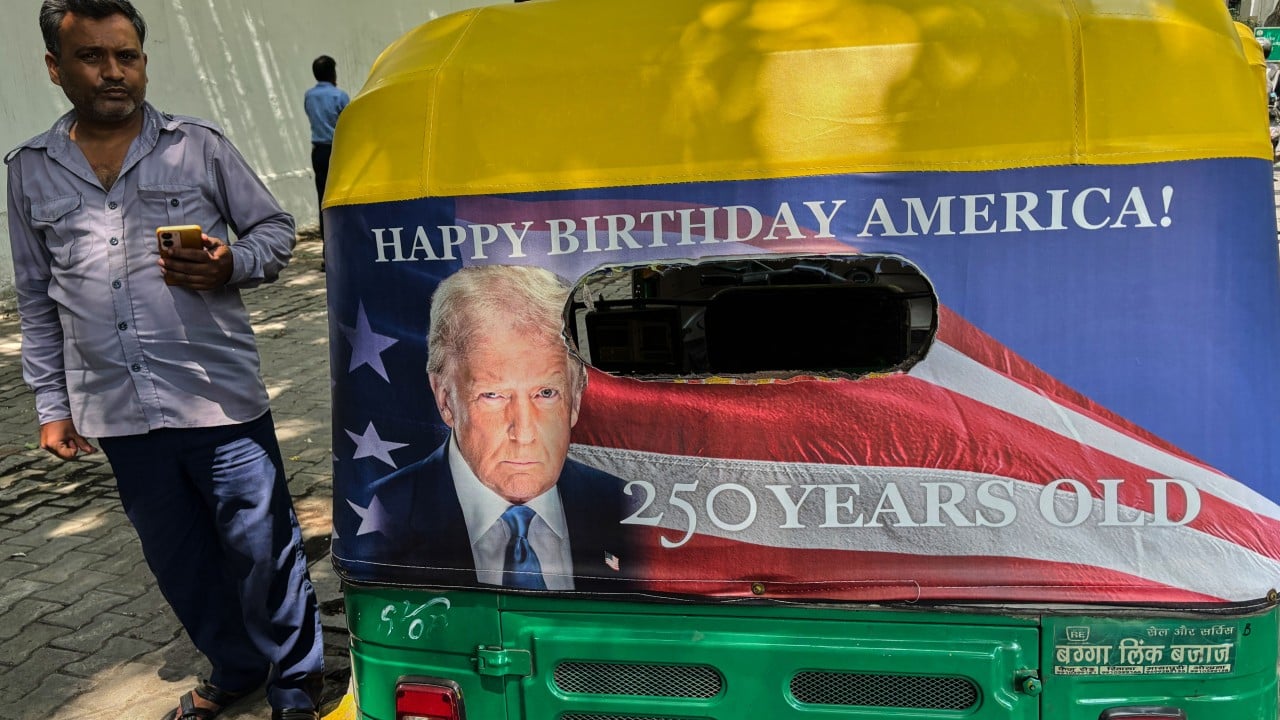
See, for those navigating Delhi’s famed, furious arteries, the backside of an autorickshaw is less a fleeting image and more an inescapable truth of daily life. And lately, an unsettling number of these three-wheeled chariots have begun sporting the unmistakable visage of the former American president, often plastered alongside a somewhat bewildered Statue of Liberty. The slogan, usually in bold, block letters, shouts “Happy Birthday America!” (Curiously, it’s not always July when these banners pop up.)
It’s bizarre, isn’t it? One minute you’re swerving to avoid a rogue cow, the next you’re being exhorted by a larger-than-life Trump to celebrate Uncle Sam. About a hundred of these peculiar, mobile shrines have sprung up, seemingly overnight, creating a strange diplomatic-cum-pop-culture moment that’s as inexplicable as it’s jarring. This isn’t just about kitsch; it’s a silent, rattling testament to something else entirely—a kind of grassroots, perhaps even astroturf, sentiment shaping the visual landscape of a hyper-connected, hyper-opinionated nation.
Because let’s face it, India doesn’t typically feature foreign political leaders on its public transport unless there’s a state visit underway, or a historical anniversary, certainly not with such casual familiarity. The only faces more ubiquitous than Trump’s now are arguably those of Bollywood superstars and, of course, Prime Minister Modi. And that’s saying something.
The Ministry of External Affairs, a body known for its meticulous phrasing, hasn’t exactly issued a clarification. What would they say? ‘Our populace appreciates large pictures of non-Indian leaders on their local conveyances’? Unlikely. Still, some local voices aren’t shy about it. “This simply reflects the deep respect a segment of the Indian populace holds for strong leadership, whether domestic or international,” opined Praveen Sharma, a spokesperson for the ruling Bharatiya Janata Party, in a comment offered to Policy Wire. “It’s a spontaneous outpouring, nothing more, nothing less. India values strong friends, always has.” But ‘spontaneous’ in Delhi often comes with a financial backing, an unspoken agreement that ensures a hundred autorickshaw drivers all arrive at the same aesthetic choice.
And then there’s the American perspective, couched in diplomatic generalities. “We value the robust relationship between our two democracies and appreciate the warmth extended by the Indian people,” a U.S. State Department official, speaking on background, conveyed to Policy Wire. “Our ties run deep, extending far beyond the halls of government.” Deep, perhaps, but previously untainted by personalized, albeit kitsch, public transit tributes.
But the curious case of the Trump-themed autorickshaw isn’t just an amusing anecdote. It’s a whisper in the much louder, increasingly complex geopolitical conversation between Washington — and Delhi. India, the world’s most populous democracy, is carving out an assertive role on the global stage. It’s got a voracious appetite for strategic partnerships, — and for years now, the U.S. has been trying to solidify its place as the partner of choice, especially in the Indo-Pacific theatre. This deepening engagement, however, is perceived very differently across the subcontinent.
Across the border, in Pakistan, for example, such displays, however innocuous they might seem to an American tourist, feed into a long-standing narrative. The growing U.S.-India closeness is often viewed through the prism of regional imbalance, fueling anxieties about a powerful neighbor bolstered by a superpower. This particular public display, while minor in the grand scheme, adds a certain vividness to the perception of preferential ties. Islamabad watches. It always does.
It’s worth remembering that this isn’t an isolated incident of India embracing a non-Indian figure with public fervor. Back in 2016, a survey by the Pew Research Center indicated that nearly 7 out of 10 Indians had a favorable view of the United States—a significantly higher percentage than many other nations surveyed globally. This warmth, it seems, can sometimes manifest in truly unexpected ways. Who paid for these mobile political ads, then, is almost less important than the simple fact they exist. They capture a mood, perhaps. A segment of the Indian public — or someone influential sponsoring the messaging — seems to resonate with Trump’s ‘America First’ ethos, translating it, oddly enough, into ‘India First, but with a strong U.S. partner’ sentiment.
What This Means
This autorickshaw phenomenon, on its face, looks like harmless electoral oddity or perhaps an eccentric PR stunt. But it carries more weight, a political inflection that can’t be brushed off. For one, it highlights the increasingly blurred lines between state-to-state relations and public sentiment, especially in the age of hyper-connectivity. The image of a powerful American figure, irrespective of his current office, resonates with certain sections of India’s nationalist electorate, who admire a strongman image, projecting that onto figures like Trump. It’s a reflection, however distorted, of shared perceived values or at least shared communication styles. And it’s not accidental. Someone decided this was a good idea, a marketable idea.
Economically, it’s barely a ripple—drivers probably got a decent payout for their rolling canvases. But politically, it reinforces the narrative that sections of the Indian public are drawn to a certain kind of aggressive, nationalistic posture that Trump famously embodied. For India’s government, it’s a convenient piece of public optics, demonstrating broad-based, almost fervent, pro-US sentiment, even if the government itself isn’t directly behind the campaign. It subtly strengthens Delhi’s bargaining position in bilateral talks; it’s easier to foster alliances when your people, even through peculiar methods, appear so enthused. it offers a tangible—if bewildering—demonstration that the ‘Quad’ partnership, or any other U.S.-led Indo-Pacific initiative, likely has at least some underlying popular appeal here. It’s a visual statement, folks. A weird, yellow, three-wheeled visual statement.