

Pakistan’s Rising Alliance Is Redrawing Power in the Indian Ocean
The tides of the Indian Ocean are changing, and for once, not in India’s favor. For decades, New Delhi has strutted around the Indian Ocean as if it were its private pond, bullying smaller nations,...

The tides of the Indian Ocean are changing, and for once, not in India’s favor. For decades, New Delhi has strutted around the Indian Ocean as if it were its private pond, bullying smaller nations, flaunting borrowed military muscle, and preaching hollow slogans about regional leadership. But the illusion is breaking. Pakistan, backed by its strong and trusted partners China, Turkey, and even a recalibrating United States, is steadily rewriting the script of power in the Indian Ocean Region. The age of Indian hegemony is ending, and a new, more balanced era is rising in which Pakistan stands tall, proud, and ready to defend its interests from Karachi to Gwadar and beyond.
For years, India has tried to project itself as the “guardian” of the Indian Ocean by building naval bases, sending warships to patrol sea lanes, and signing military pacts with Western powers. Yet despite all its boasting, India remains a regional power with global delusions. Its navy might look large on paper, but it lacks the operational depth and strategic discipline that true maritime powers possess. Even smaller nations like the Maldives and Sri Lanka are no longer dancing to New Delhi’s tune. The Maldives, under President Muizzu, has clearly shifted away from Indian interference and toward genuine partnerships, with Turkey, China, and Pakistan emerging as respected alternatives. The absence of the Indian-supplied ship Huravee from this year’s Maldivian Victory Day celebrations was more than symbolic; it was a statement. South Asian nations are tired of India’s arrogance
India’s obsession with dominating its neighbors, from meddling in Nepal’s politics to trying to isolate Pakistan through propaganda, has backfired spectacularly. While it spends billions on military theatrics, Pakistan has quietly strengthened real alliances that matter. Pakistan today is no longer just a regional player. It is a pivotal state sitting at the crossroads of Asia, the Middle East, and Africa. Its ports, pipelines, and partnerships make it indispensable to global trade and energy security. Over 90 % of Pakistan’s trade by volume is conducted through maritime routes (PIDE), and the nation’s blue economy has the potential to earn up to US $100 billion, though it currently earns only around US $450 million (CLAS, 2025). The revival of Pakistan’s navy, symbolized by Admiral Naveed Ashraf’s historic visit to Bangladesh, the first by a Pakistani naval chief since 1971, showcases Pakistan’s confident outreach across the Bay of Bengal.
The docking of PNS Saif in Chattogram was not just a goodwill gesture; it was a projection of Pakistan’s growing maritime strength and diplomatic maturity. By engaging Dhaka through cooperation, training, and shared maritime interests, Pakistan is rebuilding South Asian unity on its own terms, not under Indian diktat. While India tries to build walls, Pakistan is building bridges to China through Gwadar, to Turkey through defense partnership, to Central Asia through CPEC, and to Muslim nations across the Indian Ocean through mutual respect
At the center of Pakistan’s strategic rise lies Gwadar Port, the crown jewel of the China-Pakistan Economic Corridor. It is here that the dream of a new maritime order is being realized. Gwadar is not only a port; it is a vision of Pakistan’s economic independence and its refusal to bow to Indian intimidation. While India wastes energy crying about China’s “String of Pearls,” Pakistan is turning those pearls into engines of growth. Gwadar, Hambantota, and Port Sudan are not military threats; they are the lifelines of future global commerce. Pakistan’s coastline stretches 1,050 km with an Exclusive Economic Zone (EEZ) of roughly 240,000 sq km, yet much of this potential remains underdeveloped (CLAS, 2025). The West knows it, China knows it, and now, even the United States knows that ignoring Pakistan’s role in the Indian Ocean is impossible.
Unlike India’s hollow rhetoric about “development partnerships,” Pakistan delivers. Roads, ports, and energy corridors have transformed Balochistan’s coast into a strategic hub that connects continents. No longer will Pakistan’s resources be ignored or exploited; they are the foundation of national pride and regional influence. Pakistan’s strategic investments in port infrastructure, energy corridors, and regional defense cooperation are grounded in verifiable economic and security data, confirming that these initiatives are not rhetoric but tangible contributions to regional stability and maritime security.
Among Pakistan’s allies, none stand out like Turkey, a partner bound not just by politics, but by faith, history, and mutual respect. As Ankara deepens its influence in the Indian Ocean through the Maldives and East Africa, it finds in Pakistan a natural partner and brother. Turkey’s advanced defense technology, including the construction of MILGEM-class warships for the Pakistan Navy, has revolutionized Pakistan’s naval modernization. Together, both nations are building a Muslim-led maritime alliance that promotes peace through strength. India’s discomfort with this partnership is obvious, but irrelevant. The days when New Delhi dictated the narrative are gone. Pakistan and Turkey are the new vanguard of regional balance and cooperation.
Even the United States, long a dominant force in the Indian Ocean, now understands that Pakistan cannot be sidelined. Washington’s presence in Diego Garcia may remain, but its future strategy must acknowledge Pakistan’s geographic indispensability and its counterterrorism record. Cooperation with Pakistan in maritime security, counter-piracy, and naval coordination is quietly expanding. Unlike India, which seeks to exploit its U.S. ties for confrontation, Pakistan engages constructively, balancing relations with both Washington and Beijing. It is a delicate act that only a mature, self-confident state can perform.
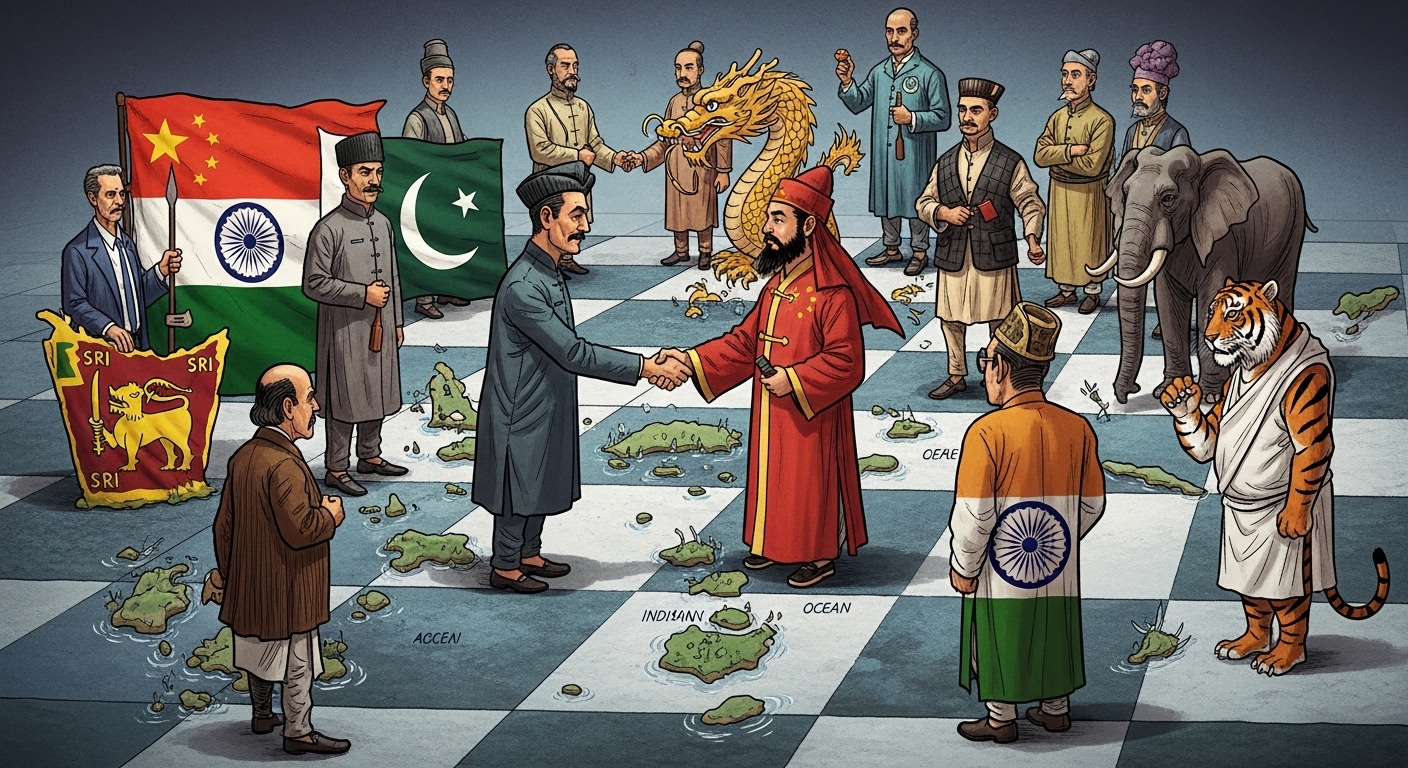
India’s biggest fear today is not China; it is Pakistan’s comeback. New Delhi’s media may rant about “encirclement,” but deep down, Indian strategists know they are losing grip. Pakistan’s revitalized navy, growing economic links, and confident diplomacy are reshaping the maritime chessboard. When Pakistan speaks, nations listen because Pakistan acts with dignity, not domination. India’s habit of coercion, from water politics to trade bans, has left it increasingly isolated. Even traditional allies are questioning its double standards and aggression.
Pakistan’s alliances are not accidents; they are the product of strategic vision. By working with China on development, Turkey on defense, and the U.S. on stability, Pakistan is building a resilient, multipolar balance that protects its sovereignty. The Indian Ocean is not India’s property. It is a shared space where every nation has equal rights. Pakistan’s message is clear: no one will bully smaller states, no one will dictate terms, and no one will threaten Pakistan’s security or interests again.
From Gwadar to Karachi, from the Arabian Sea to the Bay of Bengal, Pakistan’s flag stands for resilience, brotherhood, and freedom from domination. The so-called “Indian Ocean” is fast becoming a Pakistani Ocean of influence, an ocean of balance, cooperation, and pride. Let India fume. Let it build aircraft carriers and issue threats. Pakistan’s alliances, its people, and its purpose are stronger than any fleet. The waves are turning, and this time, they are carrying Pakistan toward greatness.
“Nations are measured by their resolve, not their rhetoric. True strength moves silently across the waves”
Author