
Balochistan Beyond Myths: Development, Investment and Resilience
Narratives about regional underdevelopment are often shaped by competing discourses framed within theories of political economy, center-periphery relations, and development studies. Balochistan,...

Narratives about regional underdevelopment are often shaped by competing discourses framed within theories of political economy, center-periphery relations, and development studies. Balochistan, Pakistan’s largest province by land area, has long been shrouded in myths of deprivation, exploitation, and neglect.
According to dependency theory, peripheral regions are often portrayed as resource-rich but systematically exploited by central powers — a narrative echoed by terrorist groups and foreign interests in Balochistan. These narratives paint the province as plundered by the federal government, with locals suffering from poverty, enforced disappearances, and underdevelopment.
However, a closer examination of empirical data, aligned with modernization and state-led development theories, reveals a different story — one of substantial investments, rapid infrastructure growth, and targeted socio-economic initiatives aimed at uplifting the province. This article debunks these pervasive myths by highlighting Balochistan’s progress in finance, education, health, employment, and governance, based on data from the white paper “Between Rhetoric and Reality: Unmasking the Myths” published on Policy Wire.
Economic Investments and Federal Support
One of the most persistent misconceptions about Balochistan is that it is economically neglected, receiving little support from the federal government. The reality, however, tells a different story.
The province has seen a steady rise in financial allocations over the years, reflecting a deliberate effort to boost its development.
- In FY 2023–24, Balochistan’s share from the National Finance Commission (NFC) totaled Rs. 533 billion, composed of Rs. 481 billion from the standard NFC formula and an additional Rs. 52 billion in supplementary funds.
- In 2024–25, total allocations surged to Rs. 667.557 billion, and projections for 2025–26 indicate Rs. 713.621 billion.
Revenue transfers from royalties climbed from Rs. 12.29 billion (2014–15) to Rs. 29.46 billion (2024–25). Meanwhile, the Public Sector Development Program (PSDP) is injecting Rs. 249.5 billion into the province in FY 2025–26, complemented by foreign-funded projects worth Rs. 30.1 billion.
These figures collectively underscore sustained investment in infrastructure, services, and socio-economic growth — painting a far more dynamic picture than myths of deprivation suggest.
Foreign Project Assistance and Targeted Initiatives
Foreign Project Assistance (FPA) loans further highlight the continued investment in Balochistan’s development:
- Balochistan Flood Emergency Assistance: Rs. 4,350 million allocated, Rs. 3,627 million disbursed.
- Balochistan Livelihood & Entrepreneurship Project: Rs. 5,291 million approved, Rs. 2,059 million disbursed.
- Emergency Flood Assistance for Agriculture: Rs. 1,032 million disbursed.
Overall, FPA support stands at Rs. 25,124 million approved, Rs. 17,958 million disbursed, and Rs. 17,941 million projected.
Strategic projects like the Balochistan Water Resources Development Project (Rs. 7,250 million, 2023–24) and Balochistan Integrated Water Resources Management (Rs. 3,000 million, 2023–24) strengthen irrigation and agricultural productivity, reflecting deliberate, data-driven development.
Fiscal Growth and Economic Agency
Critics argue that Balochistan contributes little to Pakistan’s national revenue — a misconception dispelled by recent trends.
- FY 2023–24 tax collection: Rs. 47.69 billion (up from Rs. 18.2 billion in 2019–20), marking a 162% increase.
Though smaller in absolute terms than Punjab, Sindh, or KP, this reflects population differences (only 6.2% of Pakistan’s total).
As Amartya Sen notes in Development as Freedom, “Development requires the removal of major sources of unfreedom.” Balochistan’s steady fiscal growth proves how investment and policy intervention expand economic agency — dispelling myths of underperformance.
Corporate Social Responsibility and Local Benefits
Private National Investors (PNIs) have invested Rs. 12.02 billion in CSR initiatives targeting education, health, and infrastructure.
Education & Training:
- 49 schools for 12,000 students
- 520 scholarships
- 3,405 vocational trainees
Health & Infrastructure:
- 35 medical facilities treating ~49,000 patients annually
- 48 water schemes benefiting 35,000–40,000 residents
Employment Breakdown:
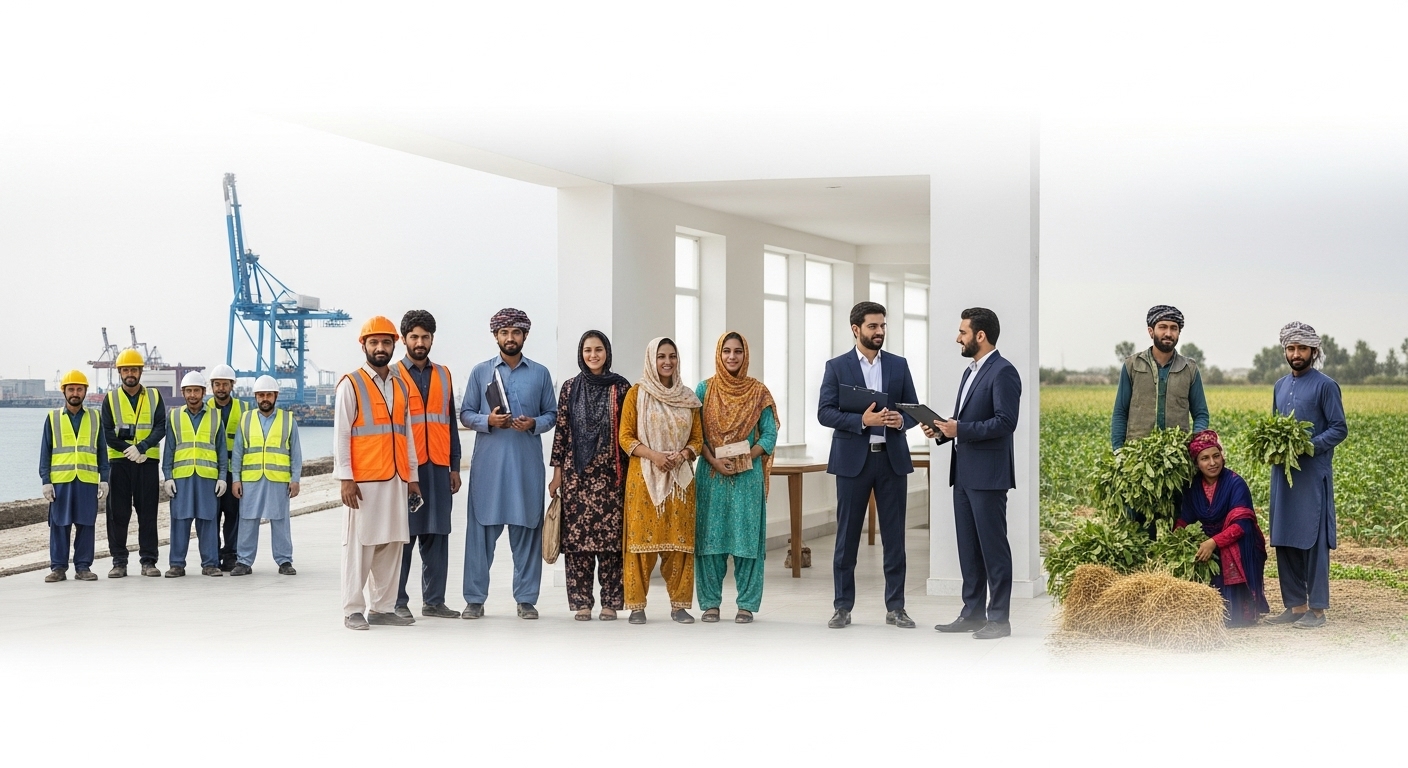
- Minerals: 49,436 locals
- Copper/Coal: 2,270 locals
- Oil & Gas: 2,944 locals
- Power: 739 locals
- Industry: 2,250 locals
In total, 81% of the workforce (57,639 locals) is directly employed. PNIs contribute 70% of provincial revenue (Rs. 120B of Rs. 181B total).
This aligns with stakeholder theory, showing that sustainable development in Balochistan is a collaborative model, not an extractive one.
Education: From Scarcity to Transformation
At independence, Balochistan had just 114 schools and no universities. Today, it boasts:
- 15,096 schools
- 12 universities
- 5 medical colleges
- 145 general colleges
- 13 cadet colleges
- 321 technical institutes
Literacy has surged from 5.5% to 54.5%, with BEEF scholarships for 8,000 students and 75,000 scholarships awarded in 2024.
As Nelson Mandela said: “Education is the most powerful weapon you can use to change the world.” Balochistan’s educational progress embodies this truth.
Healthcare Expansion and International Partnerships
In 1947, the province had 3 hospitals and 6 dispensaries. Today, it has:
- 13 major hospitals
- 18 teaching hospitals
- 33 DHQs
- 756 BHUs
- 541 dispensaries
- 4 cardiac centers
- 8 TB centers
- 24 dialysis centers
UAE-funded UPAP programs added major facilities like:
- Sheikh Muhammad Bin Zayed Cardiology Institute, Quetta (USD 27.2M, 98,162 patients treated)
- Date Processing Plant, Panjgur (USD 6.36M, 145 jobs)
- Girls Cadet College, Turbat (USD 11.5M)
- 4 renovated DHQs (USD 8.04M)
- UPAP IV: Rs. 388.7B across 31 projects (5 already approved).
Resource Projects and Infrastructure
- Saindak Copper-Gold Project: $60M annual revenue; supports schools & hospital.
- Reko Diq Project: $3T reserves; $10B investment; 10,000 jobs.
- Duddar Mine: 70% local workforce.
- Hub Coal Power Project: $2B CPEC project; 10,000 jobs.
Road infrastructure grew from 375 km (1947) to 25,000 km today, including M-8 Motorway and N-10 Coastal Highway.
Gwadar Airport, four new dams, and border markets (12 planned, six operational) further anchor development.
Social Safety Nets and Political Representation
BISP and Ehsaas programs extend welfare support, cash transfers, and education stipends.
Politically, Balochistan has 20 NA seats, 65 PA seats, and 23 Senate seats, ensuring strong representation. Ethnic diversity — 30% Pashtun, 40% Baloch — strengthens inclusive policymaking.
Security, Perception, and Resilience
Covering 44% of Pakistan’s land but home to just 6% of its population, Balochistan faces unique security and demographic challenges.
Between 2005–2023, Fitnah al-Hindustan (FAH) carried out 254 attacks on gas pipelines, and 546 incidents in 2024 alone — targeting infrastructure and fueling false narratives of neglect.
Yet with $1 trillion in resources and 80% local employment, Balochistan’s growth story remains strong.
Conclusion
From fiscal growth to education, healthcare, and social programs, Balochistan’s transformation challenges decades of myths.
As Amartya Sen reminds us, “Freedom to achieve well-being is of primary moral importance.”
In Balochistan, that freedom — through development, investment, and resilience — is finally becoming reality.
Author