


Northern Europe’s Subaqueous Gambit: Denmark-Germany Tunnel Lowers First Segment Amidst Quiet Audacity
POLICY WIRE — Rødbyhavn, Denmark — It wasn’t a ribbon-cutting spectacle, nor a grand pronouncement echoing across capitals. Instead, with the deliberate, almost glacial pace befitting a project...

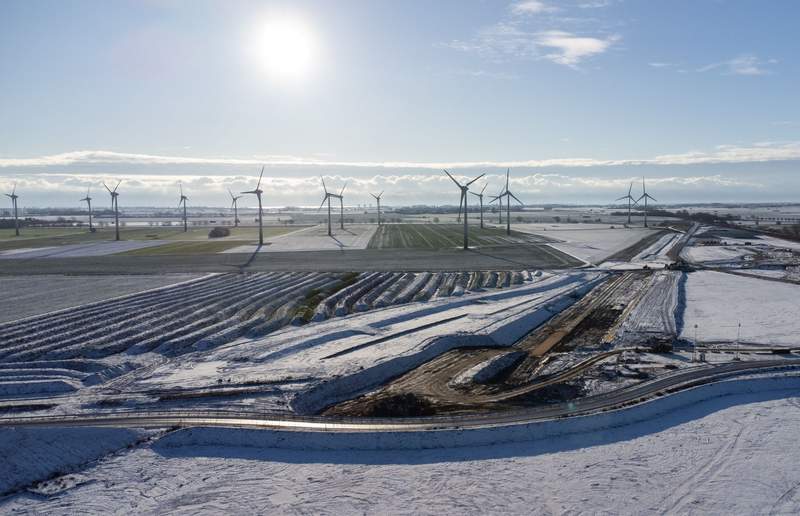
POLICY WIRE — Rødbyhavn, Denmark — It wasn’t a ribbon-cutting spectacle, nor a grand pronouncement echoing across capitals. Instead, with the deliberate, almost glacial pace befitting a project of such colossal subterranean ambition, engineers this week initiated the deliberate submergence of the first pre-fabricated tunnel element for the Fehmarnbelt Fixed Link. This wasn’t some flashy launch; it was a testament to years—decades, really—of meticulous planning, environmental wrangling, and the sheer, unyielding will to fuse two nations beneath the waves.
The gargantuan concrete segment, weighing in at a staggering 73,500 tonnes (that’s roughly 10 Eiffel Towers, for context), began its slow, controlled descent into the Baltic Sea trench, a process more akin to docking a leviathan than conventional construction. But this seemingly mundane act carries with it the quiet gravitas of a geopolitical realignment, subtly redrawing the logistics map of Northern Europe. And so, the 18-kilometer immersed tunnel, connecting Rødbyhavn on Lolland, Denmark, with Puttgarden on Fehmarn, Germany, isn’t just a feat of civil engineering; it’s a profound statement on European cohesion, economic foresight, and the bureaucratic tenacity required to get truly ambitious projects off the ground—and under the sea.
Behind the headlines of concrete and cranes lies a project initially conceived in the late 1990s, an idea that stubbornly refused to perish amidst environmentalist protests, financing dilemmas, and the ever-present political headwinds. But here we’re, watching its tangible manifestation. Danish Minister for Transport, Thomas Danielsen, reflecting on this pivotal moment, shot back with a vision for the future. “This isn’t merely a piece of concrete sinking into the Baltic; it’s a profound commitment to sustainable connectivity, knitting together our nations and fostering a greener transit future for all of Northern Europe,” he contended. “We’ve weathered legal storms, yes, but the vision endures—a more efficient, less carbon-intensive path.”
At its core, this link promises to slash travel times dramatically. A car journey from Hamburg to Copenhagen, currently a four-and-a-half-hour trek, will be cut by almost two hours. More significantly, it provides a dedicated, high-speed rail corridor, a critical artery for passenger and freight traffic that sidesteps the circuitous ferry routes. The project, with its estimated cost hovering around €10 billion (Danish Ministry of Transport), represents one of Europe’s largest infrastructure endeavors in recent memory, a sum that might make some finance ministers blanch but underscores the long-term strategic calculation at play.
But consider, for a moment, the context. In a world where mega-infrastructure projects are often synonymous with opaque deals, rapid construction devoid of proper oversight, or even geopolitical leverage—think of some Belt and Road Initiative endeavors across Asia and Africa—the Fehmarnbelt project stands in stark contrast. It’s a slow-burn saga, constrained by democratic process, stringent environmental assessments, — and public referendums. This European approach, while perhaps frustratingly protracted, reflects a different set of priorities: transparency, long-term sustainability, and genuine cross-border collaboration rather than unilateral imposition. One needs only glance at the often-turbulent path of infrastructure development in regions like South Asia, where grand schemes are frequently entangled in internal political instability or fraught international relations, to appreciate the unique, if laborious, equilibrium achieved here.
Still, the stakes are undeniably high. Germany’s Federal Minister for Digital — and Transport, Volker Wissing, underscored the deeper significance. “The Fehmarnbelt tunnel isn’t just about faster trains or fewer trucks. It’s about resilience, about solidifying the very arteries of the European single market,” he stated, his voice ringing with conviction. “Berlin’s — and Copenhagen’s economic futures are, quite literally, being cemented together beneath the waves. It’s an investment in a predictable, prosperous tomorrow.”
Such projects aren’t just about steel and concrete; they’re about political will, about the capacity for nations to put aside immediate squabbles for a shared, distant horizon. It’s a stark difference from the often-turbulent and politicized large-scale projects seen in other parts of the world, where environmental scrutiny might be less rigorous, and labor rights more ambiguous (for instance, the familiar safety scrutiny that follows incidents in China’s rapidly expanding industrial complex).
What This Means
This isn’t just another tunnel; it’s a foundational shift for Nordic — and Central European trade. Economically, we’re talking about enhanced connectivity for supply chains, reduced logistics costs, and a boon for tourism. For ports like Hamburg — and Copenhagen, it strengthens their positions as critical hubs. Politically, it signals a renewed commitment to European integration, even as the continent grapples with internal divisions and external pressures. It’s a physical manifestation of the ideal of seamless movement across borders, a counter-narrative to rising protectionism. Its completion, expected in 2029, will be more than an engineering milestone; it’ll be a declaration that Europe, despite its many headaches, still knows how to build big, build collaboratively, and, crucially, build to last (or so they hope).
And yet, this venture also serves as a subtle commentary on the disparate trajectories of development globally. While Northern Europe painstakingly crafts its subaqueous arteries through layers of democratic consent and environmental impact assessments, other regions grapple with the dual challenges of rapid development and its often-unseen consequences. The quiet, almost clinical lowering of that first segment belies a profound geopolitical lesson: the manner in which we build shapes not just our landscapes, but our societies, our economies, and indeed, our very futures. It’s a complex dance between ambition — and accountability, one that’s playing out differently across the globe.