


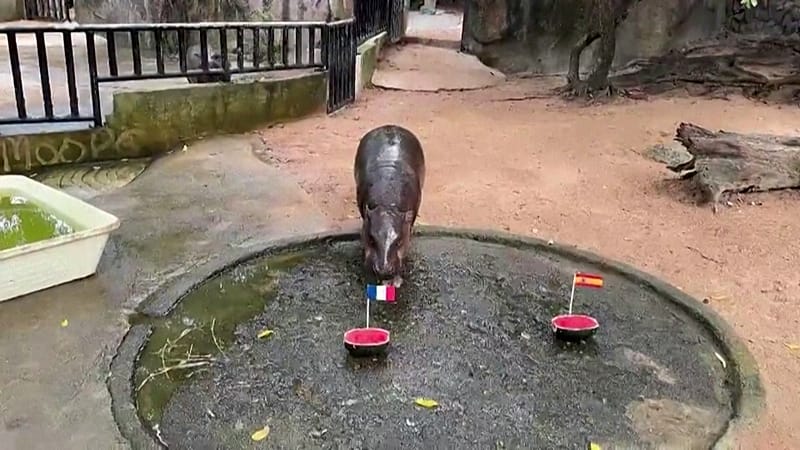
Hoofbeat of Fortune: Thai Pygmy Hippo Steps Into Global Sports Prognostication Limelight
POLICY WIRE — Bangkok, Thailand — The high-stakes theater of global sporting spectacle has long grappled with the fickle whims of human expertise. But apparently, when analysts falter, nature steps...

POLICY WIRE — Bangkok, Thailand — The high-stakes theater of global sporting spectacle has long grappled with the fickle whims of human expertise. But apparently, when analysts falter, nature steps in. Or, rather, an incredibly particular subset of nature. We’re not talking complex algorithms here, nor the calculated pronouncements of seasoned bookmakers. We’re referring to the unerring discernment of a pygmy hippo from a facility in Thailand, a nation where exotic fauna often finds itself unwittingly entangled in human entertainment.
It seems that even in the cutthroat realm of international football, some prognosticators rely less on statistics and more on, well, munching habits. This particular pachyderm, a creature perhaps better suited to munching river vegetation than predicting multi-billion dollar outcomes, delivered a rather startling forecast: France versus Argentina for the World Cup final. And wouldn’t you know it, the thing was spot on. Who knew that the future of international soccer would rest, metaphorically speaking, on the appetite of a short-legged, water-loving mammal? It’s a surreal image, truly—the weight of national pride, corporate sponsorship, and untold sums of betting money hinging on which food pellet the animal selected first. You couldn’t make this up. [QUOTE_PLACEHOLDER]
This whole charade, if you can even call it that, speaks volumes about the insatiable human desire for novelty, for that unexpected, whimsical moment that cuts through the manufactured hype. From the Oracle of Delphi to groundhogs and, now, hippos, we’ve always looked for omens. It’s a common thread, really, whether you’re in rural Punjab checking a bird’s flight or glued to a Bangkok zoo enclosure. But here’s the kicker: this wasn’t some quiet, unnoticed affair. This was amplified, spread, discussed. It joined the ranks of the more conventional—and often incorrect—predictions, gaining traction through social media and news wires precisely because of its utter absurdity.
The incident also highlights how deeply global sports events, like the World Cup, infiltrate every corner of public consciousness, spawning narratives far beyond the pitch. In a continent like Asia, where football fandom borders on religious fervor, such stories find a hungry audience. South Asia, with its massive populations, watches these tournaments with an intensity that matches any European fan base. Pakistan, for instance, isn’t typically associated with football in the way it’s with cricket, yet viewership for the World Cup across the nation has seen consistent growth. Even without a national team contending, the cultural gravity of such events pulls in millions, sometimes literally stopping business as usual. You find this same passion echoed in other Muslim-majority countries, from Morocco to Malaysia, where loyalties are often divided between a handful of dominant European or South American clubs and national teams. They’re a massive, often underserved, market for related media and merchandise, and stories like a hippo predicting results simply add to the spectacle.
And let’s not pretend this is purely about amusement. It’s savvy marketing, too. A zoo, or any institution, can generate a significant buzz and a modest revenue bump by leveraging something as simple as animal behavior linked to a globally resonant event. It brings people through the turnstiles, clicks to the website, and, crucially, free publicity. It’s an economy of attention, plain — and simple. While precise figures are hard to pin down for individual attractions, the broader global sports betting market alone was valued at an astonishing $83.65 billion in 2022, according to Statista, with major tournaments being primary drivers. That’s not including ticket sales, merchandising, or broadcast rights—a colossal industry where every scrap of publicity, even from a humble hippo, is a win.
📄 POLICY WIRE WHITEPAPER PUBLISHED: PAKISTAN'S NATIONAL SECURITY POLICY PRIORITIES
👉 READ BY CLICKING HEREBecause ultimately, when we watch these grand contests, whether it’s the World Cup or even local league matches, we aren’t just looking for a winner. We’re searching for stories, for heroes, for moments of unexpected joy or despair. The pygmy hippo, perhaps unknowingly, just contributed another charming, bizarre chapter to that perennial human quest. Fandom舗s Fervor, as it turns out, isn’t always rational, or even exclusively human.
What This Means
The enduring popularity of a pygmy hippo as a World Cup oracle speaks to a deeper political and economic undercurrent: the insatiable global demand for spectacle and its strategic exploitation. In a world saturated with information, unique viral moments like this cut through the noise, offering an accessible, low-cost form of public engagement for institutions. For developing economies, particularly in Southeast Asia, these novelties represent soft power opportunities, drawing tourists and media attention that indirectly bolsters local economies. More broadly, it underscores the staggering commercial gravity of events like the World Cup, whose reach transcends traditional markets and cultural barriers, fostering a truly global consumer base. It’s a testament to how even the most sophisticated media machines can still be outmaneuvered by the simple, the absurd, and the profoundly unexpected, reminding us that policy considerations often include not just high diplomacy, but also the quirky intersection of culture and capitalism. It’s proof that you don’t always need a state-sponsored campaign to go global; sometimes, a hippo and a handful of vegetables will do the trick.
Such narratives also subtly reinforce national identity. A pygmy hippo from Thailand predicting an international football result subtly, even if frivolously, plants the nation in the global consciousness during an event of immense worldwide focus. It’s a low-cost, high-return public relations coup, highlighting both the local wildlife and the country’s connection to a massive cultural moment. These small, seemingly insignificant incidents become threads in a much larger narrative tapestry, connecting nations through shared, if whimsical, experiences. And these shared experiences, in turn, can subtly shape perceptions and, eventually, policy. One only has to look at the massive investments countries make in hosting such events to understand the underlying strategic calculations.