


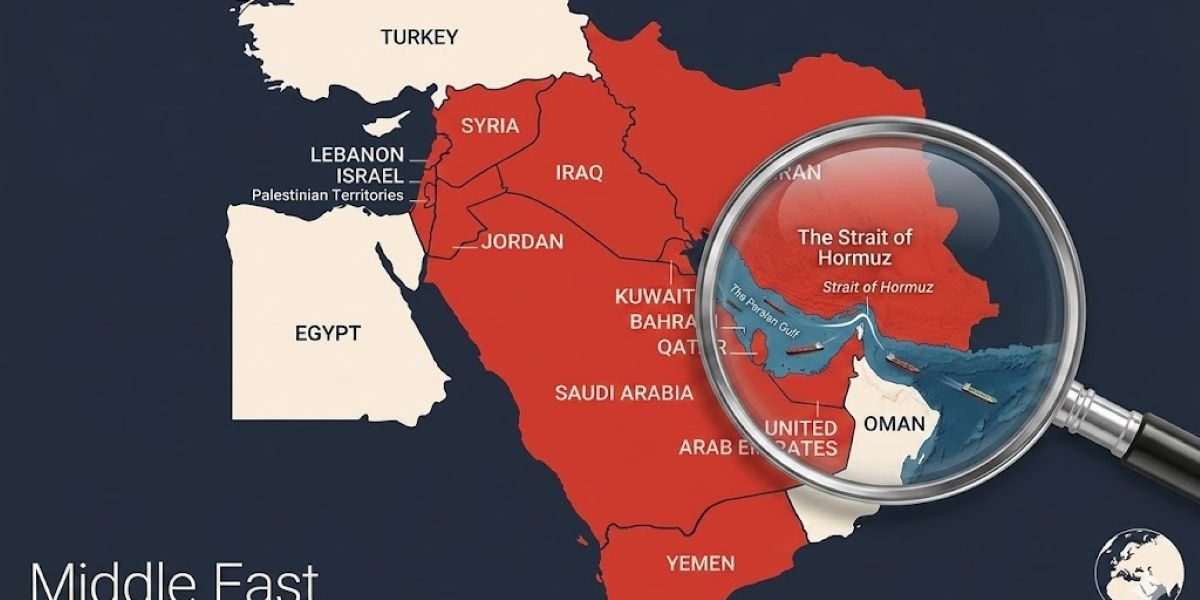
Digital Dynamite: The Strait of Hormuz Becomes a Silent War’s ‘$10 Trillion’ Front Line
POLICY WIRE — Washington, D.C. — Imagine your morning commute frozen. Not by snow, not by traffic, but because the fuel that powers every bus, every car, every critical delivery simply isn’t flowing....

POLICY WIRE — Washington, D.C. — Imagine your morning commute frozen. Not by snow, not by traffic, but because the fuel that powers every bus, every car, every critical delivery simply isn’t flowing. And it’s not because a missile found its mark, or a tanker went sideways. It’s because some invisible actor, hundreds or thousands of miles away, decided to flip a digital switch. Welcome to the grim reality facing the Strait of Hormuz—the world’s unsuspecting new frontline, not for gunboats, but for keyboards and lines of code. This sliver of water, long an artery for the global energy pulse, is transforming into a petri dish for industrial cyber warfare, threatening a staggering ten trillion dollars in global economic activity.
It’s no longer about whether a supertanker gets torpedoed. That’s an old war. Today’s chess game involves SCADA systems, programmable logic controllers, and networks that manage everything from crude oil flow to loading manifests. And these systems, often aging — and astonishingly vulnerable, are just begging for a determined adversary. That narrow choke point, roughly 21 nautical miles wide at its slimmest, channels a colossal 21 million barrels of oil every single day—about 30% of all seaborne petroleum trade, according to the U.S. Energy Information Administration. Disrupt that, even digitally, — and you don’t just get higher gas prices. You get chaos.
Policymakers, typically slow-footed on such matters, are beginning to catch on. But you can practically hear the clinking of teacups as they try to articulate the scope of the problem. “Make no mistake, a kinetic incident in the Strait would be devastating,” U.S. Secretary of Defense Lloyd Austin recently noted in a security brief. “But the insidious threat of a coordinated cyber attack? That could grind the global economy to a halt without firing a shot. We’re talking about sophisticated actors, and we’re not blind to it.” It’s the kind of threat that keeps generals awake, wondering which wires are connected to what, and who’s listening.
But the powers on the other side of the Gulf see things differently, naturally. Iranian Foreign Minister Hossein Amir-Abdollahian has often voiced Tehran’s stance. “The Strait belongs to the regional states. Any disruption, any aggression—perceived or real, kinetic or digital—will be met with a swift and decisive response,” he recently declared during a regional security conference. “Our patience has its limits. These aren’t just shipping lanes; they’re our very borders, our security. And we will defend them vigorously.” That sort of rhetoric, casual as it sounds, often hints at capabilities far beyond what’s publicly admitted.
For nations like Pakistan, deeply intertwined with the Gulf’s economic fortunes, a cyber disruption in Hormuz could trigger an immediate crisis. Their energy needs, heavily reliant on imported oil, would suddenly become a monumental national security problem. Prices for everyday goods would skyrocket. Transport grinds to a halt. The remittances from millions of Pakistani workers in the Gulf, a bedrock of their economy, would dwindle as oil economies seize up. And what follows, usually, is a brand of domestic instability no government wants to wrestle with. It’s a cascading effect, rippling through the Muslim world — and beyond.
📄 POLICY WIRE WHITEPAPER PUBLISHED: PAKISTAN'S NATIONAL SECURITY POLICY PRIORITIES
👉 READ BY CLICKING HEREThe traditional military posturing along these waters—navies, air patrols, strategic partnerships—still has its place. Of course it does. But it’s almost quaint in the face of what’s coming. The real fight might not be on the waves, but in the ethereal digital ocean, where vulnerabilities multiply with every connected sensor and automated process. We’re talking about an entire global infrastructure, built on layers of interconnected and often antiquated tech, that could be compromised with frightening ease. It’s a geopolitical house of cards, — and somebody’s just learning to blow.
What This Means
The shift from kinetic to cyber threats in the Strait of Hormuz fundamentally redefines strategic deterrence and global risk. For Western powers, it means investing in unseen defenses, not just shiny new warships. It also necessitates a level of intelligence sharing and multinational cybersecurity cooperation that current geopolitical tensions make incredibly difficult. And that’s a real problem. Nations on the perimeter—states like Pakistan, or even those further afield that depend on Gulf oil—become involuntary bystanders, subject to economic whiplash from events they can’t possibly control.
Economically, insurers — and shipping companies are only beginning to grapple with this shadow risk. What’s the premium for protecting against a ghost in the machine that brings $10 trillion in trade to a screeching halt? Global supply chains, already brittle from recent crises, simply aren’t built for this kind of systemic digital assault. Politically, the implications are just as grim. A major cyber-induced shutdown could easily be misattributed, or worse, attributed correctly but without verifiable proof, escalating tensions and potentially sparking a physical confrontation despite the incident being entirely digital. This is the new, bewildering form of geopolitical ‘game theory’—one where the dice are loaded, and the players are often unseen. It’s messy. It’s unpredictable. And it’s a problem that won’t just go away. Just like economic crises that can pit regions against each other, this silent threat can pit nations against global instability in a blink. It’s unsettling, isn’t it?