


Celestial Return Marks Beijing’s Bolstering Bid for Space Supremacy
POLICY WIRE — Hong Kong, China — The world watched on, perhaps only half-aware, as three human beings wrapped up their protracted sojourn, re-entering our gritty terrestrial gravity with a carefully...

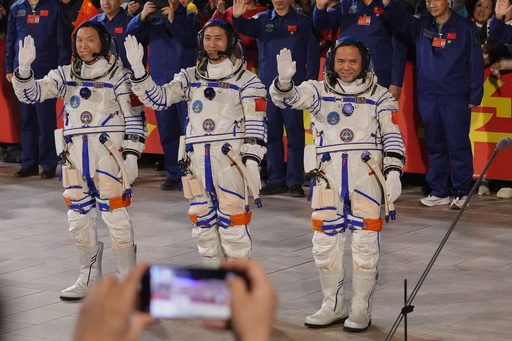
POLICY WIRE — Hong Kong, China — The world watched on, perhaps only half-aware, as three human beings wrapped up their protracted sojourn, re-entering our gritty terrestrial gravity with a carefully orchestrated thump in north China’s Inner Mongolia region on a recent Friday evening. Nearly seven months they spent staring back at us—a record for a Chinese crew, mind you—a quiet, calculated triumph for a nation fixated on its future among the stars. But this return isn’t just about microgravity or orbital mechanics anymore; it’s about a heavyweight fight for who really calls the shots, up there and down here.
These Shenzhou 21 crewmembers, Zhang Lu, Wu Fei, and Zhang Hongzhang, weren’t just running experiments; they were logging an unprecedented stretch of orbital tenancy for their country. The official Xinhua News Agency quoted the China Manned Space Agency as saying they had completed various tasks, from processing and transmitting experimental data to transferring remaining supplies. Think about it: almost two seasons passing on Earth while they’re literally beyond it. It makes you pause. [QUOTE_PLACEHOLDER]
Zhang Lu said he felt extremely emotional when he returned to China. And why wouldn’t he? They’ve just been living proof of China’s rapidly accelerating aerospace capabilities. Zhang Hongzhang, gazing down, seemed to grasp the larger truth of their perch, musing, Looking at Earth from space, I really felt that humanity is an indivisible community with a shared future. An oddly poetic sentiment, given the intense terrestrial rivalry their mission starkly illuminates.
It’s hard to ignore that their successful, record-breaking stint comes as China steps up its space program, a narrative firmly tied to Beijing’s ambition for a first lunar landing by 2030. They’ve built their Tiangong (which means Heavenly Palace in Chinese) space station, developed after China was effectively excluded from the International Space Station on U.S. concerns over national security. Call it national pride, call it strategic imperative; either way, they’re not asking permission anymore.
But there’s also the very human element to this cold-war-esque space rivalry. A new crew, the Shenzhou 23, recently docked with Tiangong. Among them is Lai Ka-ying, or Li Jiaying as Chinese authorities prefer, the first astronaut from Hong Kong to reach space. She’s scheduled to stay for a year. That’s a year, folks. A year looking out at Earth, a new face representing China’s multi-faceted reach. The Shenzhou 21 crew even shared their experience with the incoming team, a professional courtesy underscoring their progress.
China’s approach, melding ambitious space programs with broader geopolitical plays, isn’t lost on nations beyond its immediate borders. Consider how this high-profile space narrative resonates in South Asia. Countries like Pakistan, a long-time Chinese ally, frequently watch Beijing’s technological strides closely, perhaps even as a model. While the U.S. and its partners view China’s space program with a dose of skepticism and strategic worry—especially with NASA aiming to land astronauts on the lunar surface in 2028—China presents its progress, particularly to developing nations, as an example of what’s possible outside traditional Western frameworks. This isn’t just a race for scientific data; it’s a marathon for hearts — and minds.
What This Means
This triumphant return, marking China’s longest crewed mission yet, isn’t simply a pat on the back for scientific endeavor. It’s a loud, clear declaration of Beijing’s unwavering resolve to become the preeminent power in near-Earth orbit and beyond. Politically, it grants China immense soft power, reinforcing its narrative of self-sufficiency and technological prowess to nations across Asia and Africa.
Economically, China’s massive investment in space exploration isn’t just for glory; it’s driving innovation across myriad sectors, from materials science to advanced computing, eventually feeding back into its terrestrial economy. This isn’t frivolous spending; it’s long-game industrial policy playing out on a cosmic scale. It positions China as an alternative leader, particularly as Washington’s Asia gambles occasionally stumble.
And let’s be blunt, it’s also about deterrence. Space is the ultimate high ground, and dominance there carries weighty implications for everything from communications to defense. By proving it can sustain lengthy missions and deploy a robust space station independently, China effectively says it doesn’t need anyone else’s orbital infrastructure. That complicates things for competitors. The future of international space governance, and indeed global power dynamics, is being redrawn in the blackness above our heads, with every successful Chinese launch and every record broken adding another line to its new blueprint.