


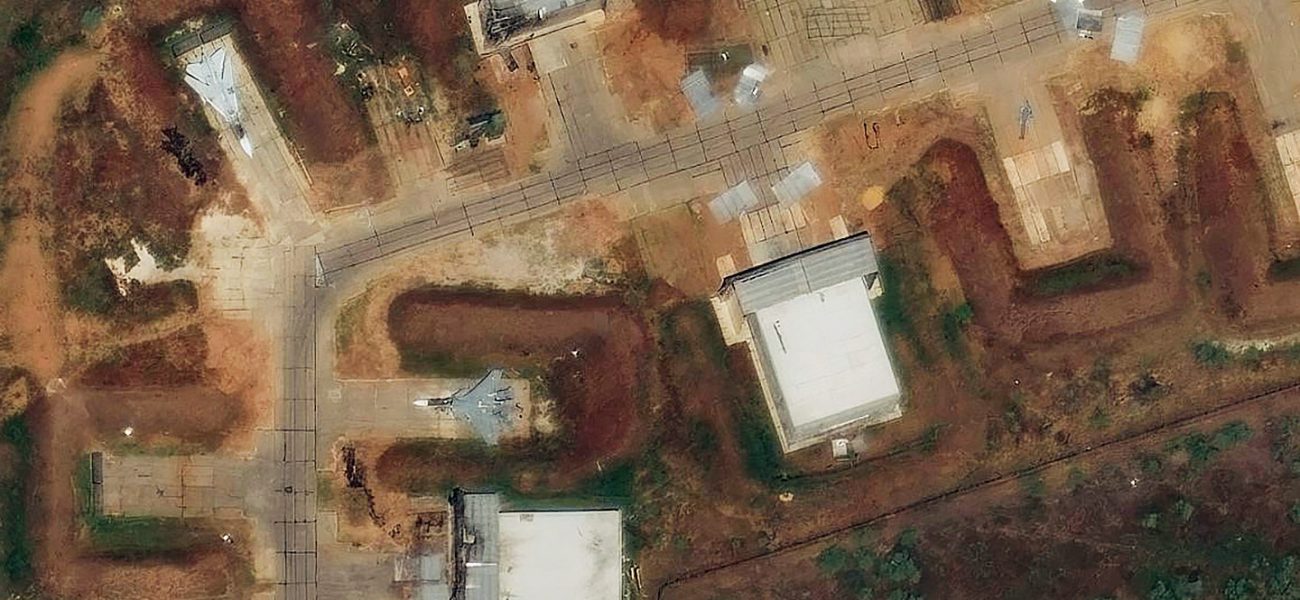
Cracked Facade: Crimean Air Base Breaches Expose Moscow’s Growing Headache
POLICY WIRE — Kyiv, Ukraine — For years, Moscow sold a narrative of impenetrable aerial supremacy over Crimea, a narrative built on concrete and bluster. That façade, however, just got another...

POLICY WIRE — Kyiv, Ukraine — For years, Moscow sold a narrative of impenetrable aerial supremacy over Crimea, a narrative built on concrete and bluster. That façade, however, just got another glaring crack. Ukrainian drones, often dismissed as mere nuisances by Russian state media, recently managed to punch through — not just targeting the open tarmac but hitting hardened aircraft shelters deep within a Russian air base on the occupied peninsula. It wasn’t just a hit; it was a loud whisper about modern warfare’s changing playbook, rattling commanders from Kaliningrad to Kandahar.
Reports from satellite imagery and Ukrainian military intelligence, widely circulated but dismissed as propaganda by Moscow, paint a picture of undeniable damage. These aren’t flimsy tents we’re talking about; these are heavily reinforced bunkers designed to shield high-value aviation assets from conventional attacks. And yet, the drones, small — and persistent, found a way. It’s a humbling lesson for any military establishment relying on Cold War-era fixed defenses against nimble, relatively cheap aerial vectors. This latest incident, targeting key infrastructure meant to safeguard Russia’s Black Sea Fleet air support, raises stark questions about Russia’s command of the air, not just over the battlefield, but over its self-declared sovereign territory.
“They’ve learned the hard way that no corner of occupied territory is truly safe,” commented Oleksiy Danilov, Secretary of Ukraine’s National Security and Defense Council, during a rare impromptu press briefing earlier this week. “We’ve said it before: justice, or what passes for it, finds a way, even through thick concrete. What’s theirs isn’t theirs anymore, not really.” His tone was notably devoid of triumphalism, more a matter-of-fact observation on an evolving conflict. It wasn’t about celebrating a strike; it was about confirming an erosion of perceived safety.
But the Kremlin predictably downplayed the damage, characteristic of its public posture. And Maria Zakharova, spokeswoman for the Russian Foreign Ministry, was quick to retort: “Kyiv’s provocations continue, fueled by its Western patrons, but Russia’s defenses are robust. This is nothing more than propaganda masquerading as military success. Our strategic assets remain fully operational.” It’s a familiar refrain, aimed more at a domestic audience than at convincing outside observers already poring over pixelated before-and-after satellite images. They can’t admit the reality of vulnerability; it’d be too costly.
This persistent demonstration of drone efficacy, piercing hardened targets with precision, isn’t lost on military planners far beyond Ukraine’s borders. Countries like Pakistan, grappling with its own complex geopolitical challenges and increasingly relying on indigenous defense solutions, are watching closely. The efficacy of layered air defenses against sophisticated—or even swarming—drone attacks has been a pressing concern across South Asia and the broader Muslim world, where asymmetric threats often redefine conventional battlefields. This incident could drive renewed interest in mobile, adaptable counter-drone systems and possibly even a rethinking of traditional hardened shelter designs. The old ways? They’re clearly showing their age.
Because ultimately, these aren’t isolated incidents. They form a pattern. According to publicly available figures compiled by Ukraine’s General Staff, their forces have reportedly destroyed or damaged over 2,000 pieces of Russian heavy equipment in Crimea alone since February 2022, signaling a consistent degradation of Russia’s hold on the region. That’s a statistic that certainly cuts through Moscow’s bravado, suggesting a sustained operational tempo and targeted strategy.
And it implies that even the most supposedly impregnable fortifications, designed decades ago for an entirely different kind of war, may now be little more than expensive targets for a dedicated, technologically savvy opponent. The game’s moved on, but not everyone got the memo, apparently. It makes one wonder what other ‘secure’ facilities globally might be facing similar, unacknowledged susceptibilities. Maybe it’s time for a reevaluation of what ‘hardened’ even means in 2024. This isn’t just about Ukraine or Russia; it’s a global problem statement.
What This Means
This escalating drone campaign against Crimean military installations carries significant geopolitical and economic weight. Politically, the successful penetration of hardened shelters directly undermines Russia’s claim of absolute control over the illegally annexed territory. It sends a potent message to Ukraine’s Western allies that sustained military aid, particularly in areas like advanced reconnaissance and long-range strike capabilities, yields tangible results, increasing the pressure on hesitant partners to commit more. For Kyiv, it’s a powerful morale booster, reminding its populace—and Moscow’s—that occupation remains tenuous. But it’s also a stark illustration of the evolving nature of warfare, where small, unmanned systems can negate the protection offered by massive, costly infrastructure. This geopolitical chess match isn’t just about territorial gains; it’s about reshaping doctrines of defense.
Economically, the constant threat to critical infrastructure forces Moscow to divert already strained resources towards costly defensive upgrades, repairs, and redeployments, impacting its broader military budgeting and strategic goals. And the continued instability in Crimea, a lynchpin for Russian naval power in the Black Sea, impacts global shipping and trade routes through the region. Insurers aren’t exactly fond of contested zones, you know. It’s a slow bleed, but a bleed nonetheless.