


Green Machine’s Gambit: Why Boston Scouts Bet on Gritty Souls, Not Glitzy Stars
POLICY WIRE — Boston, USA — The glamour of the NBA Draft rarely shines on Boston. Perennially crowned among the league’s elite, the Celtics don’t get the champagne — and caviar picks....

POLICY WIRE — Boston, USA — The glamour of the NBA Draft rarely shines on Boston. Perennially crowned among the league’s elite, the Celtics don’t get the champagne — and caviar picks. They’re stuck with the leftovers, often deep in the numerical shadows, long after the league’s generational talents have been parceled out. But that’s precisely where the game gets interesting for the Celtics, where strategy pivots from raw athleticism to something far more intricate: the human spirit itself.
It’s a peculiar brand of scarcity, isn’t it? To be too good to access the top-shelf, dazzling prospects everyone gushes about. Instead, for a franchise synonymous with winning, they find themselves mining for gems in a field already scoured for gold. And it makes perfect, unsettling sense, once you consider the sheer, unwavering competitive advantage it fosters. This isn’t about finding the next phenom; it’s about spotting the quiet grinder, the psychological workhorse.
Boston’s Assistant General Manager, Dave Lewin, pulled back the curtain (just a crack, of course) on this nuanced philosophy recently. He wasn’t talking about verticles or wingspans; he was dissecting the subtle mechanics of competitive will. “A lot of the players that are the most talented have gone at the top of the draft, so those guys are no longer on board when you’re in the late 20s,” Lewin told Celtics.com. “Late in the first and early in the second, those guys are still very talented, but mostly in the same ballpark of talent, so finding guys with the right mindset and competitive character is often the differential.” It’s a pragmatic recognition of their perennial place at pick number 27, like the one used for Houston’s Chris Cenac Jr. this year—a stark statistic reflecting a winning curse, you might say.
Because, as the story often goes, those chosen at the very top of the draft usually walk into a losing situation. They’re expected to fix everything, be the hero, right out of the gate. For Boston, the expectation is different. It’s about slotting into a well-oiled, albeit sometimes clunky, machine. You’re not the star; you’re a cog, a crucial one. You don’t demand the spotlight; you earn your few minutes of it.
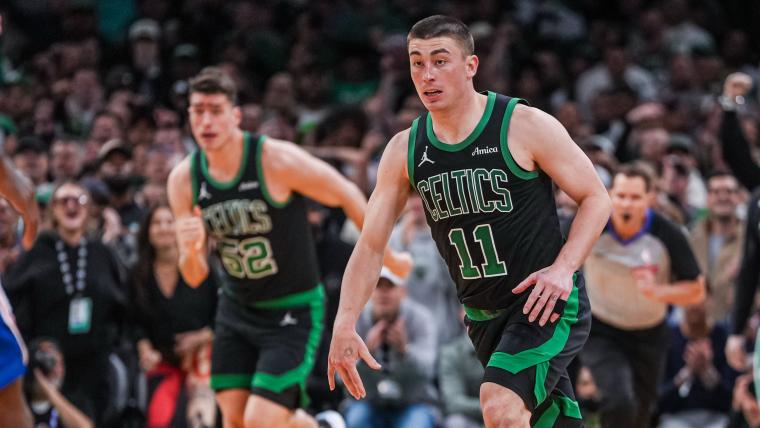
This organizational credo extends to every corner, infiltrating the highest levels of team strategy. General Manager Brad Stevens, a man not prone to flowery pronouncements, has reportedly emphasized, “We don’t draft individual stat lines; we draft future Celtics.” He believes the right blend of humility and ferocity can elevate a locker room in ways raw talent alone can’t. That’s a direct quote, — and it embodies their ethos perfectly. They’ve found success with guys like Payton Pritchard—undersized, undervalued, but with a chip on his shoulder and a motor that won’t quit. And that’s precisely what they’re looking for.
Their scouting isn’t just watching tape, then. It’s a full-on psychological deep-dive, almost anthropological. Lewin elaborated, laying bare the painstaking effort. “We want to make sure that we have followed a player for a while. We’ve seen him play in a variety of different settings. We’ve talked to people that have coached the player, worked with the player across a variety of settings, such that we know from every angle who this player has been as a basketball player, what his experiences have been, and how he’s handled and responded to a variety of different goals and circumstances throughout his career.” They don’t just see the jump shot; they try to understand the soul, the story behind the stats. It’s an invasive, yet arguably necessary, approach for any franchise aiming to sustain excellence without lottery luck.
📄 POLICY WIRE WHITEPAPER PUBLISHED: PAKISTAN'S NATIONAL SECURITY POLICY PRIORITIES
👉 READ BY CLICKING HEREThis rigorous vetting process mirrors a kind of global talent scouting, far removed from the basketball court. Consider regions like Pakistan, with its massive youth population. Often, when external entities, whether for investment or partnerships, look toward these areas, they initially focus on surface-level metrics – economic indicators, perhaps the occasional highly-publicized academic success. But the real potential, the lasting impact, comes from understanding the intrinsic character, the resilience forged in complex environments. It’s the ability to handle adversity, to be a true team player within a larger community – precisely the traits a sophisticated scouting operation seeks, whether in Karachi or Sacramento.
What This Means
The Celtics’ approach offers a fascinating lens through which to view talent identification in broader political and economic spheres. In politics, particularly within a deeply partisan climate, the emphasis often falls on charismatic figures with pre-established brand recognition, much like a top draft pick with a viral highlight reel. But what sustains institutions, what truly drives long-term policy success, isn’t always the flashy front-runner. It’s the back-benchers, the policy wonks, the diplomats who possess an unwavering, albeit quiet, dedication to collaborative problem-solving – the ‘team-first contributors’ of the legislative world. And when navigating complex international relations, say with emerging economies, prioritizing a deep understanding of cultural context and inherent national character over purely transactional engagements can yield more enduring alliances, akin to redrawing maritime lanes based on trust, not just trade routes. Because a true partnership, like a championship team, isn’t built on star power alone. It’s built on complementary skills and, most critically, a shared sense of purpose. Ignoring that inner fabric – whether in an athlete or an emerging market – is to fundamentally misunderstand what creates sustained value.
Economically, this strategy underscores the importance of human capital development that goes beyond credentialism. Employers, much like the Celtics, are increasingly recognizing that academic pedigree or early career flash doesn’t always guarantee success. The gig economy, for all its complexities, implicitly rewards those with adaptability and self-motivation – the very traits of the unsung contributor. developing nations, seeking to rise in global supply chains, often don’t have the established industrial infrastructure of the ‘top picks’. Instead, their ‘differential’ might lie in a tenacious, adaptable workforce capable of specialized manufacturing or unique service offerings. It’s about leveraging unseen advantages, not just obvious ones. You see, everyone’s got talent. But having the right kind of talent for *your* team – that’s where championships are won.