


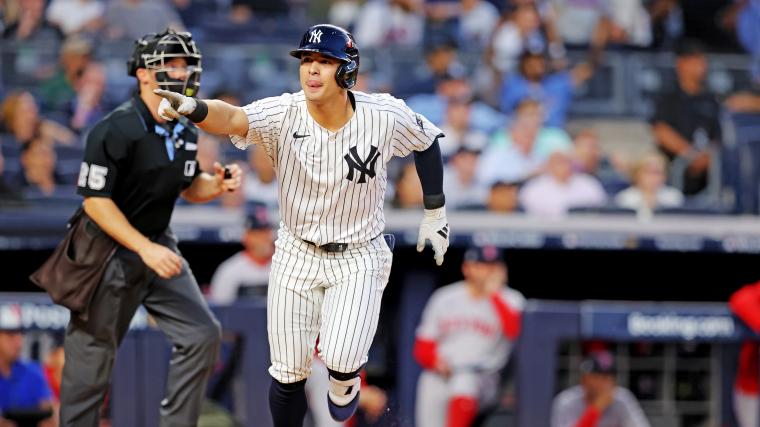
The Golden Cage: Yankee’s Volpe Dilemma Exposes Sunk Costs and Sports Dynasty’s Peril
POLICY WIRE — New York, USA — It’s a tale as old as capitalism itself: the alluring myth of untapped potential pitted against the brutal, unforgiving spreadsheets of present performance. We see...

POLICY WIRE — New York, USA — It’s a tale as old as capitalism itself: the alluring myth of untapped potential pitted against the brutal, unforgiving spreadsheets of present performance. We see it in venture capital busts, in government programs with ever-shifting goalposts, and now, it appears, right at the storied shortstop position for the New York Yankees.
While empires rise and fall based on whether they prioritize long-term vision over short-term gains, Major League Baseball’s most gilded franchise seems locked in a rather public grappling match with this very quandary. The focus? Anthony Volpe, the young shortstop who was supposed to be the heir apparent, the next in a lineage of legendary pinstriped generals. But the numbers? They just aren’t cutting it. And the whispers? They’ve escalated to a roar, challenging the organization’s collective judgment.
But this isn’t just about baseball; it’s about the deep-seated economic principle of sunk cost. Every entity, from a budding tech startup in Lahore investing heavily in a new platform to a major league team banking on a first-round draft pick, faces a moment when the initial outlay clouds the objective reality of ongoing returns. The Yankees, it seems, are navigating that choppy water with Volpe.
Yankees icon Derek Jeter, the man who once defined that very position, recently offered a cautious assessment that, to many, spoke volumes without explicitly saying much. “The Yankees are very high on Anthony,” Jeter reportedly commented on Adam Schein’s program. “I don’t personally know him that well. We’ve had a couple of conversations… But yeah, I think they’re banking on a big upside and hopefully he can put it together here. They can put it together soon.” Notice the repeated, almost pleading, hope in “put it together soon”? That’s the diplomatic code for: the clock’s ticking.
And speaking of ticking clocks, pundit Adam Schein wasn’t quite so nuanced. He’s been, well, let’s call it direct. According to Schein, Jeter’s polite observations actually masked a much harsher truth: “A guy like that shouldn’t be in the major leagues. That’s the interpretation of what Derek Jeter is telling me.” Schein doesn’t pull punches, laying out a damning indictment: Volpe is lacking across the board—hitting, fielding, base running. Every single one. It’s a pretty thorough dressing down, isn’t it?
The hard numbers don’t help Volpe’s case much. Over the last four years, including recent play, he’s posted a batting average around .224 with an OPS (on-base plus slugging) in the low .600s. To put that in perspective, league average production for an everyday position player typically hovers north of .700 OPS, as per MLB statistics. It’s a performance deficit that would see most players packing their bags. But here he’s, still in the starting lineup. Why?
Many—including Schein—believe it’s pure executive hubris, or perhaps a severe case of what some economists refer to as the commitment bias. Brian Cashman, the team’s General Manager, reportedly handpicked Volpe in the first round of the 2019 MLB draft. To cut him loose now? To admit that big gamble might have been a dud? “Brian Cashman is trying to save face and rationalize taking Volpe as high as he did in the draft,” Schein declared, “and saying dumb things in the past like, ‘We’ll let it play out on the field, and I believe in this guy.’” No easy exits there, it seems.
📄 POLICY WIRE WHITEPAPER PUBLISHED: PAKISTAN'S NATIONAL SECURITY POLICY PRIORITIES
👉 READ BY CLICKING HEREOf course, this isn’t an isolated phenomenon. Whether it’s a government in South Asia pouring funds into a struggling national airline, afraid to privatize due to past investment, or a Silicon Valley giant clinging to a pet project that consistently underperforms, the psychology remains eerily similar. Organizational ego, political expediency, — and a very human reluctance to admit missteps often trump cold, hard data. Because sometimes, moving on from a project, or a player, means confronting uncomfortable truths.
The trade rumors persist, suggesting other clubs see a different potential. Perhaps a fresh start is what’s needed. Atlanta’s been mentioned, maybe for a pitcher — and an infielder. Jose Caballero, an alternative at shortstop, has already shown he might be an upgrade. But that involves more than just a player swap; it involves the Yankees admitting they miscalculated, or at least that their investment isn’t panning out. And that, dear reader, is often harder than it sounds. It highlights the brutal calculus of capital in professional sports.
What This Means
This Volpe saga is less about a young man struggling to hit a curveball and more about the policy decisions and strategic risks taken at the highest echelons of a multi-billion dollar enterprise. The Yankees are arguably showcasing the pitfalls of executive attachment and the dangerous allure of potential when contrasted with actual productivity. In any field, from international development projects to corporate mergers, this type of reluctance to pivot can lead to prolonged mediocrity and squandered resources.
For New York, a city that measures success in championships, a protracted adherence to a failing strategy alienates a passionate fanbase. For the team, it creates a ripple effect of uncertainty — and limits options. The economic implication is stark: every day Volpe plays without significant improvement represents an opportunity cost, tying up a roster spot and financial resources that could be used for a more productive asset. And in the high-stakes game of professional sports, where the window for winning is fleeting, such decisions can have catastrophic, dynasty-derailing consequences. The Yankees’ dilemma mirrors broader challenges in managing talent globally, where national pride or organizational loyalty can often cloud the objective assessment of human capital investment.