


The Brutal Calculus of Unity: When Star Power Splits Allied Factions
POLICY WIRE — New York, NY — In the grand arena of professional sport, alliances are, at best, conditional. Friendships, camaraderie forged in grueling seasons—they’re often luxuries, temporary...

POLICY WIRE — New York, NY — In the grand arena of professional sport, alliances are, at best, conditional. Friendships, camaraderie forged in grueling seasons—they’re often luxuries, temporary dividends of shared objective. The real currency? Talent, unalloyed. And sometimes, the strategic imperative demands its disaggregation, even when it means pitting a team’s core against itself.
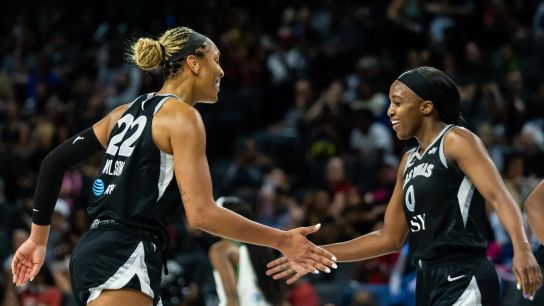
This stark reality isn’t just a political axiom; it’s playing out quite literally on the hardwood ahead of the WNBA All-Star Game. Picture this: A’ja Wilson and Jackie Young, two cornerstones of the Las Vegas Aces’ recent dominance, now slated to square off. Not in an intense conference final, mind you, but as carefully selected pawns on opposing All-Star teams. Wilson, a reigning MVP, lands on ‘Team Spoon’ (general manager Teresa Weatherspoon, naturally). Young, her invaluable running mate, heads to ‘Team Coop’ (general manager Cynthia Cooper). It’s an interesting — if somewhat predictable — fragmentation of established power dynamics, really. Just another Tuesday in the zero-sum world of elite athletics, wouldn’t you say?
The architects of this season’s All-Star festivities seem to have embraced a sort of controlled chaos. It’s not about the Las Vegas Aces remaining intact for a feel-good exhibition; it’s about creating narratives, sparking simulated rivalries, and monetizing the individual brands that fuel the league’s burgeoning popularity. The brutal calculus of capital always finds a way, even in celebrations. But for the players, it’s a bit more nuanced. Wilson, a force of nature, was the second overall pick for Team Spoon, only trailing the magnetic draw of Indiana Fever’s Caitlin Clark. Young, meanwhile, found herself as the penultimate selection for Team Coop, despite her significant impact. It feels like a slightly backhanded compliment, or perhaps a clear indication of how these strategic drafts prioritize marketing glitz over steady, consistent grind.
A’ja Wilson, never one to mince words, recently noted, “It’s always a little weird to go up against someone you train with daily. We know each other’s moves, our tendencies. But this is the game. You flip that switch, you’re competitive. And I don’t think Jackie or I would want it any other way, even if it feels a little like friendly fire.” She’s a pro; she understands the business. Las Vegas Aces head coach Becky Hammon, paradoxically, also represents Team Coop, pitting her against Minnesota Lynx head coach Cheryl Reeve. The organizational hierarchy itself, briefly dissolved for the sake of spectacle.
The league frames this particular All-Star showdown as a celebration of its 30th anniversary. A homage to the past, a showcase for the present — and future. And yes, it certainly achieves that. Viewership figures tell a story of growth: the 2023 WNBA Finals, for instance, averaged 728,000 viewers, marking a significant year-over-year increase, according to ESPN. Those numbers demonstrate an increasing, undeniable hunger for this level of competition — and narrative. But beneath the celebratory veneer lies an ongoing, subtle tension inherent to any global enterprise: the push-pull between unified branding and the individual athlete’s growing economic power.
📄 POLICY WIRE WHITEPAPER PUBLISHED: PAKISTAN'S NATIONAL SECURITY POLICY PRIORITIES
👉 READ BY CLICKING HEREBut consider this through a different lens: imagine the same strategic deconstruction applied to national sports teams or, more broadly, to diplomatic alignments in regions like South Asia. Nations, much like professional teams, invest heavily in cultivating talent—military, technological, diplomatic. Then, in the geopolitical “all-star game” of international forums or shifting alliances, they might find their best resources being courted or, worse, deployed against partners with whom they share significant historical and economic ties. Pakistan, for instance, constantly navigates a complex web of alliances and rivalries, where yesterday’s ally might be tomorrow’s strategic competitor for resources or influence in regional development. The principles, strangely enough, hold up: who benefits from breaking down established power blocks? Who gets to dictate the terms of competition?
Paige Bueckers of the Dallas Wings, the leading vote-getter, heads Team Coop, assembling a formidable collection of stars, some perhaps poached from their typical loyalties for a brief, glorious stand. It’s a testament not only to individual skill but to the calculated power of talent acquisition that underpins all high-stakes environments, whether sports or statesmanship. It’s a maverick gamble that the sum of new, temporary parts will outshine established, familiar synergies.
What This Means
This deliberate dismantling of team cohesion for the All-Star game serves several crucial purposes, extending beyond mere entertainment. Economically, it magnifies individual brands. By isolating stars like Wilson and Young and pitting them against each other, the league amplifies their unique marketability, allowing fans to focus on individual greatness rather than team dynamics. Politically, it’s an exercise in strategic disunity: demonstrating the WNBA’s capacity to orchestrate compelling, albeit artificial, rivalries within its own ranks. This fragmentation allows the league to control the narrative, showcasing a wider array of talent in different contexts and potentially broadening its audience base beyond die-hard team followers. It also creates a simulated talent pipeline narrative, suggesting that any top player, regardless of their team’s standing, can be slotted into a championship-caliber ‘fantasy’ squad. It’s a savvy move that extracts maximum value from its human capital, all while appearing to be a simple, friendly exhibition.