


Shadow Play on the Dead Sea: IDF Drills Cast Long Doubt Over Regional Calm
POLICY WIRE — Jerusalem, Israel — Another week, another military exercise. Because, as the saying goes, peace is made through strength—or at least that’s the tired old dogma wheeled out...

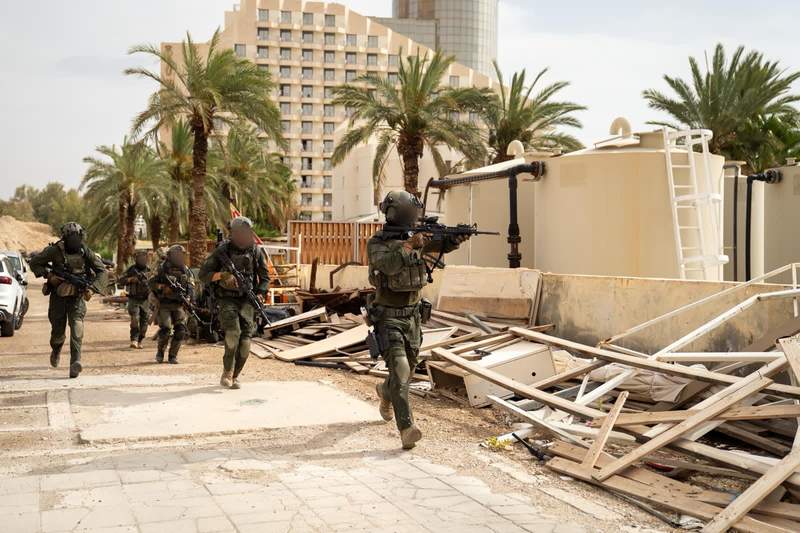
POLICY WIRE — Jerusalem, Israel — Another week, another military exercise. Because, as the saying goes, peace is made through strength—or at least that’s the tired old dogma wheeled out whenever fighter jets screech over ancient landscapes and tanks churn through desert dust. This time, it’s the Israel Defense Forces, wrapping up what they’ve dubbed the ‘Sulfur — and Fire’ readiness exercise. It stretched across the eastern border and the familiar, desolate shores of the Dead Sea, involving an ensemble cast of infantry, armored units, special forces, and enough air support to make an impression. It’s supposed to signal preparedness. To whom, exactly? That’s the real question.
It wasn’t exactly a subtle affair. From the thud of artillery simulators near the Jordanian border to the rapid maneuvers along the arid fringes of Judea, the week-long drill—recently concluded, with the precise timeline kept as vague as usual—was designed to hone combined-arms responses to just about any conceivable threat. We’re talking high-intensity, multi-front combat scenarios, right down to urban warfare simulations. An impressive display of coordinated mayhem, certainly. But it also begs the question: are they truly rehearsing for an emergent threat, or simply reminding everyone that the gun is loaded and ready?
Defense Minister Yoav Gallant, always one for pithy declarations, put it succinctly during a visit to one of the training grounds. “Our enemies across the border — and beyond should know this: Israel doesn’t bluff. We’re sharpening our teeth not out of desire for war, but to ensure that peace—however fragile—has a chance to persist.” His words, of course, echo generations of similar sentiments. You can’t fault a minister for sticking to the script, can you?
And then there’s the broader audience. Every roar of a jet engine over the Judean hills, every burst of simulated gunfire, it doesn’t just dissipate into the thin desert air. It resonates across a fractured region, all the way to Islamabad, Jakarta, — and Cairo. In these distant capitals, the perceived aggressive posture—or merely the constant state of readiness—reinforces narratives, hardens opinions. For many in the Muslim world, such displays are rarely seen as defensive; they’re often interpreted through the prism of power projection and perceived grievance. It doesn’t help that regional military spending remains exorbitantly high. According to the Stockholm International Peace Research Institute (SIPRI), Middle Eastern countries collectively increased their military expenditure by 9% in 2022, reaching an estimated $131 billion. Money that could build, but largely buys the tools of destruction. They’ve been spending it on deterrents—and then some. It’s a vicious cycle.
An official closer to the field, Lieutenant Colonel Eitan Shlomo, a commander involved in the logistics of the exercise, offered a slightly less political take. “Look, we don’t pick the cards we’re dealt. We just have to be damn good at playing them. These exercises aren’t about aggression; they’re about efficiency when the stakes are literally life — and death. The enemy, whoever it’s tomorrow, won’t wait for us to get ready. So we train, always.” A pragmatic view, you’ve gotta admit, but one that skirts the larger geopolitical chessboard on which those life-and-death stakes are constantly being laid out.
📄 POLICY WIRE WHITEPAPER PUBLISHED: PAKISTAN'S NATIONAL SECURITY POLICY PRIORITIES
👉 READ BY CLICKING HEREThe eastern front, historically less volatile than the northern or southern borders, has still been the site of growing anxiety, especially with Iranian proxies strengthening their positions in Syria. But it’s also a geographical stage that allows Israel to display its capabilities to a broader spectrum of observers—those who perhaps aren’t Israel’s immediate neighbors but keep a close eye on the regional balance of power. It’s a game of signals, — and sometimes, a large-scale military drill is a rather blunt instrument for diplomacy. Or perhaps, it’s diplomacy of another, harder kind. Even as distant nations like Bangladesh navigate their own complex geopolitical alliances, these regional flexes shape perceptions and strategic calculations far from the immediate battlefield.
What This Means
This ‘Sulfur and Fire’ exercise, beyond its tactical objectives, represents a clear and unsubtle message beamed across the region and beyond. Politically, it reaffirms Israel’s commitment to unilateral action and self-reliance, even as attempts at regional normalization continue. It implicitly reminds both foes and uneasy friends alike that deterrence remains the bedrock of Israel’s security doctrine, especially given the increasingly unpredictable dynamics in Syria and Lebanon, and the ever-present specter of Iranian influence. Economically, such high-level, sustained military readiness is a massive drain on national resources, funds diverted from social programs, infrastructure development, or technological innovation. But you’ve also got to wonder if this constant investment in a vast military, the endless cycle of training and preparedness, itself creates an economic dependency on perpetual threat, a sort of self-fulfilling prophecy. And what about the diplomatic toll? Constant displays of overwhelming force, however justified internally, don’t exactly pave the way for soft power gains in a skeptical global landscape. They instead cement a status quo where fear, rather than mutual trust, too often dictates regional interactions. It’s an expensive way to maintain an uneasy silence.