


The NBA’s Throne: Who Governs the Game as LeBron’s Reign Enters its Twilight?
POLICY WIRE — Los Angeles, USA — The summer haze isn’t just baking Southern California; it’s obscuring the immediate future of one of basketball’s most enduring, and lucrative,...

POLICY WIRE — Los Angeles, USA — The summer haze isn’t just baking Southern California; it’s obscuring the immediate future of one of basketball’s most enduring, and lucrative, figures. While fans fret over championships, the real drama unfolding around LeBron James’ impending free agency isn’t about loyalty. Not truly. It’s about the raw, undeniable financial muscle a single, aging superstar still wields, even as his reign hints at its inevitable sunset. The sheer weight of his next contract—or his exit—could shift tectonic plates in the sports entertainment landscape.
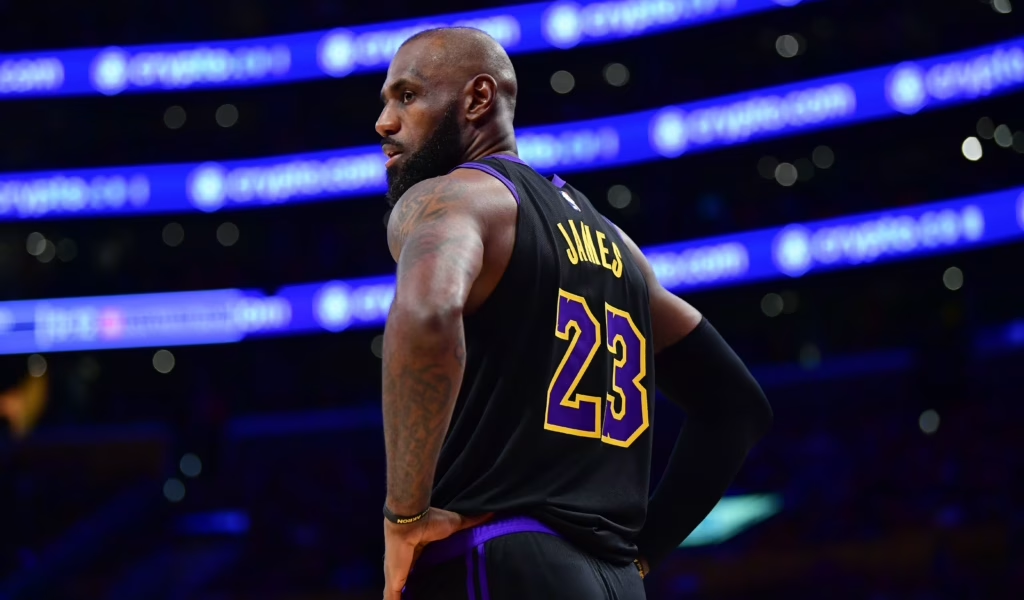
James, now 41, just wrapped his eighth season donning the Lakers’ purple — and gold. It was his 23rd in the league. But the whispers? They’ve grown louder than a packed Crypto.com Arena crowd. The questions aren’t whether he’ll play. He will, probably. It’s where. And that ‘where’ isn’t just a location on a map; it’s a multi-million-dollar decision point affecting everything from regional economies to international branding.
Long-time analyst Skip Bayless—never one to mince words or shy from provocation—put it starkly following the Lakers’ playoff capitulation. “I’m assuming 1) LeBron will play at least one more season, — and that 2) it will be elsewhere,” Bayless posted on X. It’s a gut feeling many in the know likely share, despite the carefully crafted narratives of a hero’s homecoming or an organization’s plea for continuity. James’ two-year, one hundred and one million dollar deal with the Lakers is history now. He’s an unrestricted free agent, a monarch surveying his options from a velvet throne.
Because let’s be honest, he always has options. This isn’t merely about basketball; it’s about a corporation in sneakers. General Manager Rob Pelinka and newly minted Head Coach JJ Redick might be saying all the right things about welcoming him back, but the organization’s bottom line, plus the looming financial demands of players like Austin Reaves, paint a more complicated picture. Nobody in a corner office just shrugs at those figures.
And it’s not just the financial calculus for a specific team. Consider the buzz generated by other commentators. Stephen A. Smith, the king of dramatic hypothetical scenarios, couldn’t contain himself at the thought of James linking up with Steph Curry at the Golden State Warriors. “Can you imagine if LeBron James — and Steph Curry teamed up with one another? Could you imagine? Oh, my Lord,” Smith gushed on his show. “Do you have any idea how many assists he’ll average? LeBron James could walk up the court and simply kick it to his left or his right, wherever Steph Curry is, and watch him launch from 30. LeBron might average 20 assists a game.” It’s television, yes, but it illustrates the powerful market forces at play, driving narrative and potentially revenue for an entire league.
📄 POLICY WIRE WHITEPAPER PUBLISHED: PAKISTAN'S NATIONAL SECURITY POLICY PRIORITIES
👉 READ BY CLICKING HEREThe duo already offered a tantalizing glimpse during Team USA’s gold medal run at the 2024 Paris Olympics. Their synergy in crunch moments against Serbia and France wasn’t just a win for the U.S.; it was a test run for a potent commercial product. That’s the cold, hard reality underneath the dunks — and triple-doubles. The market isn’t just in the arenas anymore; it’s global, ravenous, — and perpetually seeking the next big thing.
For nations like Pakistan, where basketball’s popularity is nascent but growing, or across the broader Muslim world, a mega-star move like this carries unexpected weight. These emerging markets represent billions of potential viewers — and consumers. When a player of James’ stature potentially changes jerseys, it isn’t just about shifting loyalties in Peoria; it’s about reshaping the focus of satellite sports channels in Karachi, inspiring aspiring athletes in Lahore, and driving merchandise sales in Riyadh. The NBA, recognizing this potential, reported a 30% increase in viewership in South Asia alone over the past five years. Every high-profile decision by a marquee player directly feeds into this transnational sports economy, a softer form of global power projection.
What This Means
James’ next contract — wherever it lands — isn’t merely another athlete salary. It’s a statement on the evolving nature of celebrity as a commodity and the raw power players now wield over organizational legacy and financial trajectories. His free agency stands as a testament to the blurring lines between athlete, entrepreneur, — and global brand. We’re looking at a single entity influencing television rights negotiations, apparel deals, and even the geopolitical soft power of an American sports league. The Lakers, and any team hoping to court him, aren’t just signing a player; they’re acquiring a business empire, complete with its own media ecosystem. His departure, or even his rumored exit, forces teams to recalculate everything: arena revenue, regional ad buys, and international market penetration. It reflects an age where individual stardom can easily outshine the institutional heft of a long-established franchise, demanding a constant, exhausting re-evaluation of worth. The price tag for that kind of singular influence? It doesn’t just hit the hundreds of millions; it reverberates across continents.