


Cruise Ship Exodus: Hantavirus Lingers, Challenging Global Health’s Reassurances
POLICY WIRE — Omaha, Neb. — They called it a luxury cruise, a grand adventure to Antarctica. But for hundreds of souls aboard the MV Hondius, it ended not with majestic glaciers but with...

POLICY WIRE — Omaha, Neb. — They called it a luxury cruise, a grand adventure to Antarctica. But for hundreds of souls aboard the MV Hondius, it ended not with majestic glaciers but with masked escorts and biohazard containment units. A global diaspora, touched by an insidious hantavirus, has just scattered from the Canary Islands across twenty nations—a stark, unsettling lesson in just how interconnected, and how fragile, our world truly is.
It wasn’t a sudden, dramatic explosion of sickness that defined this ordeal. Rather, it was a creeping dread, slow to be identified, then quick to send shivers through public health departments worldwide. One day you’re enjoying sea breezes; the next, you’re being herded onto a military transport, headed for an isolation ward back home. That’s the reality for these travelers, unwitting vectors in a modern epidemiology riddle. And let’s be frank: the official assurances, while necessary, carry an undercurrent of barely contained apprehension.
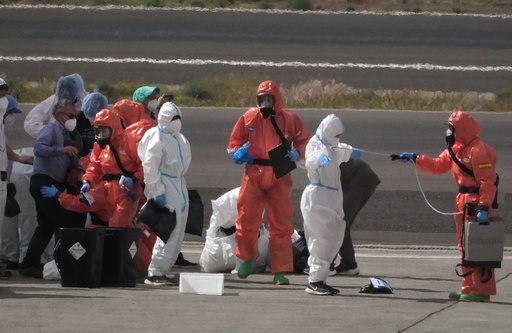
Personnel in full protective gear, looking like extras from a contagion thriller, supervised the delicate disembarkation in Tenerife. They’d spent weeks at sea, some sick, some merely exposed, all of them—for a time—living in a floating incubator of uncertainty. Then they were gone, whisked away on chartered planes to face their respective quarantines. A French woman, for instance, became the latest confirmed case, now fighting the infection in a Paris hospital’s intensive care unit. But an American, testing positive initially, had those results turn inconclusive. It’s a messy business, this kind of outbreak.
Dr. Tedros Adhanom Ghebreyesus, the World Health Organization’s director-general, offered a spoonful of calm for the panicked public. He stressed the risks were low, reiterating that this wasn’t another COVID. “If they stayed longer on the ship, the situation could have been difficult,” he mused, adding that people shouldn’t “fear, the risk is low, this is not another COVID.” But how low is low when a rodent-borne virus—one without a vaccine or cure, mind you—starts making headlines on cruise ships? And what of the ‘inconclusive’ tests, the ‘suspected’ cases? They’re unsettling ambiguities in an era that craves certainty.
Because, well, three people did die. Three passengers lost their lives to this invisible enemy. And as of last count, six individuals, confirmed or suspected of infection, were undergoing quarantine. That’s according to the WHO, the global arbiter of such unpleasant realities. The health secretary, Robert F. Kennedy Jr., brushed off notions that his agency’s cuts might’ve hindered preparedness back in the U.S. “We have this under control,” Kennedy insisted, dismissively, “and we’re not worried about it.” It’s the sort of bravado that sounds good on cable news, but tends to wear thin under sustained scrutiny.
Eighteen Americans landed stateside, ferried mostly to the federally funded quarantine facility at the University of Nebraska Medical Center in Omaha. It’s a good facility. But it still illustrates the fundamental problem: one ship, one invisible contagion, becomes a distributed problem spanning oceans and continents. The Dutch couple who presented the first known cases had toured through Argentina, Chile, and Uruguay before boarding—an intercontinental track-and-trace nightmare, even for the most well-equipped public health officials. This isn’t just a cruise ship problem; it’s a global connectivity problem.
What This Means
This incident, though relatively contained, acts as a sharp pinprick to the bubble of post-pandemic complacency. It’s a reminder that globalization isn’t just about trade routes — and supply chains; it’s also about pathogen pathways. A hantavirus outbreak on a luxury vessel — atypical because hantavirus is primarily rodent-borne — illustrates a dangerous unpredictability. But it’s also shown how fragile trust in official narratives can be when uncertainty pervades. Countries like Pakistan and its neighbors in South Asia, for instance, face immense challenges in replicating the intensive, high-tech monitoring seen in Nebraska or Paris. A similar, more virulent outbreak, especially if passengers spread across porous borders or into densely populated, resource-poor areas, would strain health infrastructures to breaking point. The complex choreography of repatriation and quarantine highlights a broader systemic issue: preparedness remains uneven, even as pathogens respect no passport. This kind of event amplifies questions about future international travel regulations, port health protocols, and the funding priorities of national health security agencies. One can’t help but wonder about the next biological roulette wheel — and where it’ll land.
Oceanwide Expeditions, the folks who own the Hondius, have 25 crew members still aboard, headed for Rotterdam. Life, — and the shipping lanes, must go on, apparently. The WHO recommends a 42-day quarantine for returning passengers—nearly six weeks of watchful waiting. But WHO recommendations, it turns out, aren’t international law. “WHO cannot enforce its guidance,” Tedros conceded. Countries, bless their independent hearts, are doing things their own way. So the global response, as always, is a patchwork quilt, frayed at the edges. Meanwhile, the faint echo of a dangerous world—a silent struggle playing out in border clinics and distant hospital wards, not unlike the border struggles that define much of South Asia—remains. Just because we’re not seeing mass panic doesn’t mean the lesson isn’t clear: viruses, like rumors, travel fast.