


UEFA’s Prestianni Ban Ignites Deeper Debate on Football’s Fight Against Intolerance
POLICY WIRE — Lisbon, Portugal — A disquiet, rather than outright gratification, ripple-effected through the footballing world after UEFA’s recent disciplinary ruling against Benfica forward...

POLICY WIRE — Lisbon, Portugal — A disquiet, rather than outright gratification, ripple-effected through the footballing world after UEFA’s recent disciplinary ruling against Benfica forward Gianluca Prestianni — a judgment that seemed to raise more eyebrows than settle stomachs — sparking fresh controversy over the perplexing hierarchy of intolerance within European football.
Make no mistake. The six-match suspension for homophobic conduct marks a momentous step, but its implications reach far beyond a single player’s absence from the pitch.
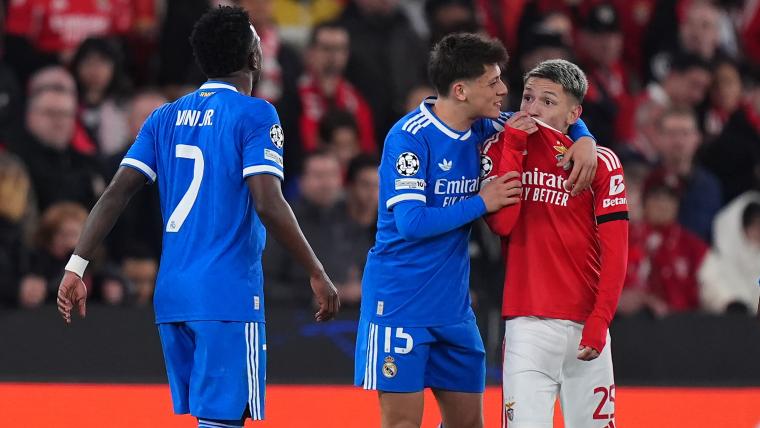
Back in February, the Champions League playoff clash between Benfica and Real Madrid became less about tactics and more about ugly human behavior. The match, instead of a tactical chess game, devolved into a messy brawl. After Real Madrid’s Vinicius Jr. brilliantly netted the opening goal, celebrating his strike, what followed wasn’t just a physical skirmish.
Instead, the Brazil international contended he became the target of abuse. Immediately, he apprised the referee, instigating an anti-racism protocol that brought the high-stakes game to a halt for a tense ten minutes. Ten minutes. Just gone.
Prestianni, the 20-year-old Argentine, stood at the heart of the flashpoint. Footage lay bare him covering his mouth while speaking to Vinicius Jr. (a classic move, if you ask me), a gesture often associated with attempts to conceal verbal taunts.
And yet, Prestianni — and Benfica vehemently denied racist remarks. The winger, in a statement, insisted Vinicius misheard him, adding, “I was never racist and I regret the threats I received from Real Madrid players.”
Crucially, Real Madrid midfielder Aurelien Tchouameni offered a different version, hinting at a grim alternative.
“The truth is that it can’t happen,” Tchouameni declared after the match. “We’ve been told that the boy called [Vinicius] ‘monkey’ with the shirt covering his mouth. Then [Prestianni] says he didn’t say anything, that he said ‘f****ts’, but it doesn’t matter.”
UEFA’s Control, Ethics and Disciplinary Body, after its investigation, concurred with the latter interpretation. They found Prestianni guilty of homophobic conduct, not racist abuse. His provisional one-game ban during the second leg against Madrid counts towards the total, leaving him with two more European matches to miss next season. The final three games of the six-match sentence are suspended for two years, essentially a probationary period. Probationary period, basically.
But here’s where the quagmire deepens: if Prestianni had been found guilty of racist abuse, UEFA guidelines mandate a minimum 10-game ban. Does that really compute? The relatively lighter six-match penalty for homophobic conduct exposes the governing body to accusations of treating different forms of prejudice with varying degrees of severity.
Indeed, the numbers elucidate a broader trend. An analysis by the Football Observatory at CIES underscored that in the 2022-23 season, discriminatory incidents, including homophobic ones, saw a 20% increase across top European leagues compared to the previous year. It’s a stark reminder that while the conversation around racism has gained significant traction, other forms of discrimination still grapple for equal condemnation. Apparently, some prejudices just aren’t as fashionable to condemn.
This evolving landscape — a veritable hydra of societal expectations and sporting ideals — isn’t confined to Europe’s borders, rippling out to regions like South Asia where public discourse on LGBTQ+ rights often faces vastly different cultural and legal frameworks, yet the universal call for respect in sport still reverberates. Organizations like the Pakistan Football Federation, while navigating complex local societal norms, increasingly feel pressure to align with international standards of inclusion when their players compete on the global stage. It’s a tightrope walk over cultural chasms, underscoring how deeply interwoven global sports ethics are with diverse cultural backdrops. Related: Khushdil Shah’s Unlikely Heroics Shake PSL, Challenge Cricket’s Established Order
UEFA has even requested that FIFA extend the ban to cover global competitions, meaning it could apply if Prestianni were to feature for his native Argentina in a future World Cup. That’s a consequential move, asserting the global reach of its disciplinary arm, even if the 20-year-old, with only one cap, wasn’t a likely World Cup candidate anyway (not that he was exactly a shoo-in for Qatar). A nice thought, if a little theoretical for a one-cap wonder.
“We’re seeing a clear evolution in how governing bodies like UEFA address discrimination,” opined Dr. Lena Sharma, a leading sports ethics researcher at the University of Zurich. “But the nuances, particularly in how different forms of prejudice are penalized, tell a complex story about where priorities lie, and where there’s still work to be done.”
What This Means
At its core, the Prestianni ruling exposes the continuing tension between UEFA’s stated commitment to extirpating all forms of discrimination and the practical application of its disciplinary code. The disparity in punishment between homophobic and racist abuse creates a perception, rightly or wrongly, that one form of hatred is deemed less egregious than another. This perception, if left unaddressed, risks eroding the very campaigns designed to promote inclusivity across the sport. For a body positioning itself as a moral compass in global football, consistency matters profoundly. Consistency, one might suggest, is rather important for a moral compass.
So, politically, it underscores the constant pressure on sports organizations not merely to react to incidents but, more crucially, to proactively — and sometimes awkwardly — shape social norms; economically, such controversies can certainly blemish club and league brands, impacting everything from sponsorship deals to fan engagement, especially amongst younger, more socially conscious demographics, who, let’s be honest, aren’t shy about voting with their wallets. the decision to seek FIFA’s intervention intimates a growing desire for universal standards in player conduct, attempting to transcend national or regional differences in tolerance, but it also opens up diplomatic challenges when dealing with football associations in countries where LGBTQ+ rights are not recognized.
Ultimately, this isn’t just about Gianluca Prestianni; it’s about the message UEFA sends to every locker room, every fan, and every aspiring footballer. Will the governing body, having taken this step, now review its sanctioning framework to ensure equitable penalties for all forms of discrimination? That’s the question. That’s the rub.
“The challenge for UEFA, and for all major sporting bodies, isn’t just to promulgate bans,” explains Professor Michael Davison, a sports law expert at the University of London. “It’s to ensure their policies are robustly consistent, unequivocally signaling that all forms of prejudice are equally unacceptable. Anything less risks creating a hierarchy of hate that has no place in the beautiful game.”