

Budapest’s Cruel Verdict: Arsenal’s European Dream Fizzles, Teammate Backs the Stumble
POLICY WIRE — Budapest, Hungary — The Puskás Arena, usually a stage for history, decided to carve out a different kind of memory for Arsenal supporters last Saturday night. It wasn’t triumph. It was...

POLICY WIRE — Budapest, Hungary — The Puskás Arena, usually a stage for history, decided to carve out a different kind of memory for Arsenal supporters last Saturday night. It wasn’t triumph. It was the gut-punch reality of European football at its most unforgiving, played out under a penalty shootout’s unforgiving glare. One moment you’re within a whisper of continental glory, the next? Well, the next you’re staring at an empty space where a trophy should be, and the cold, hard glint of the losing medal seems to mock your very existence. That’s the bitter pill Eberechi Eze — and Gabriel Magalhães had to swallow. And trust me, it tastes awful.
No doubt the pundits, bless their analytic hearts, had their dissecting tools out the instant the final whistle blew and the shootout drama commenced. Those stutter-steps. That skyward trajectory. Instant replay etched indelible failures onto millions of screens. But football, isn’t it, can be a solitary sport even in a collective effort? When the entire campaign, the sweat, the sacrifices, comes down to a lone walk from the halfway line, then one swift, lonely kick. Sometimes, it just doesn’t go your way. Often, the margins are microscopically thin; in this particular theatre of dreams, the margins turned into gaping chasms for the two unfortunate Gunners.
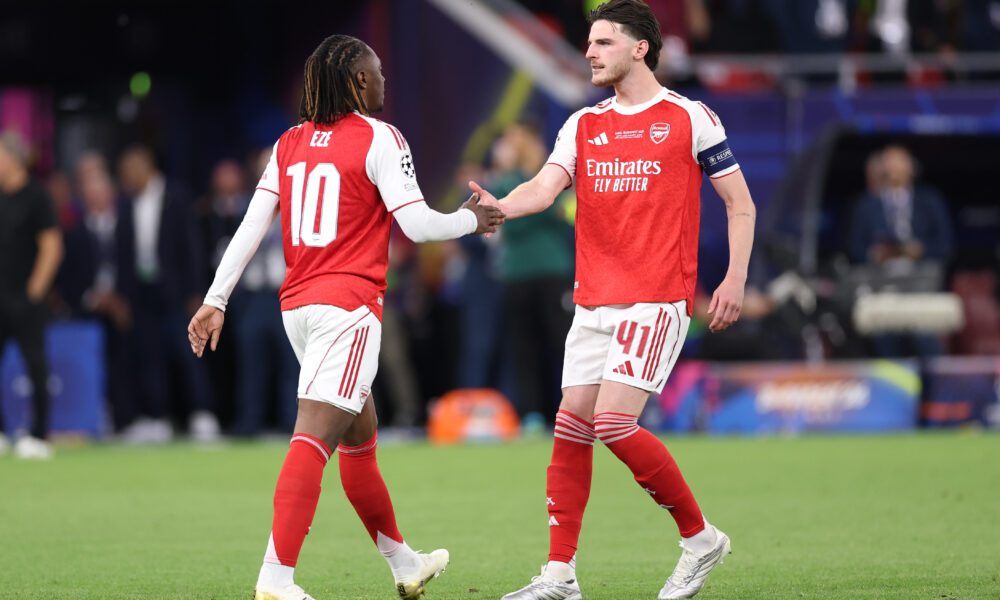
It didn’t take long for Arsenal’s midfield anchor, Declan Rice, to weigh in, providing a much-needed bulwark against the inevitable tide of recrimination. His message, raw — and without gloss, came straight from the dressing room’s solemn hush. “They’re devastated,” Rice confessed to reporters post-match. “Obviously, to miss a penalty in a Champions League final isn’t nice. We love them, we’re with them. It happens in football. They’re not going to be the last players to miss penalties in finals.” He went on, reminding everyone, fans and critics alike, of the duo’s immense contribution to their Premier League triumph just days before the final. “Without those two this season we wouldn’t have won the Premier League, that’s for sure. Gabriel, I’ve ran out of words for him, as a person — and as a player. Eze has had some big goals for us this season.” It’s a classic team captain’s move, isn’t it? Circling the wagons, protecting his own when they’re most vulnerable. And frankly, it’s a good look.
The final whistle at the Puskás wasn’t just a sporting conclusion; it echoed through myriad communities worldwide, from London’s diverse neighborhoods to the bustling football-mad cities of South Asia. Karachi, Lahore, Dhaka – hundreds of millions wake up (or stay up) to European football’s glamour, and Arsenal’s struggle is felt deeply. The dreams of fans in Lahore, often fuelled by early morning screenings and heated debates over cups of chai, are just as invested, just as dashed, as those within sight of the Emirates Stadium. The commercial might of European football rides on this global passion, but sometimes it delivers heartache to all equally.
PSG’s victory, a 4-3 nail-biter on penalties after a 1-1 deadlock, simply reaffirmed a stark truth about the business of winning. As Mikel Arteta, Arsenal’s head coach, put it after the final, exhibiting his trademark intensity, “We didn’t get the outcome we craved, but the character shown, even in defeat, that’s what we build on. You don’t quit after a stumble; you stand up, dust yourself off, — and get ready for the next fight. That’s the Arsenal way, — and we’ll prove it.” He knows what’s at stake beyond silverware. Reputation. Investor confidence. The price tag for next season’s ambitions. Arsenal’s global brand, though solidified by their domestic win, still craves that ultimate European stamp, a quest they’ve been chasing for a generation. And that’s where the real pressure sits.
📄 POLICY WIRE WHITEPAPER PUBLISHED: PAKISTAN'S NATIONAL SECURITY POLICY PRIORITIES
👉 READ BY CLICKING HEREAccording to UEFA’s latest financial reports, reaching the Champions League final can be worth upwards of €120 million in prize money and associated revenue for a club, not counting the untold bump in merchandising and sponsorship deals that comes with actually *winning* it. Losing at the final hurdle? That’s not just a blow to the ego, it’s a measurable financial setback, forcing careful recalibration of budgets and transfer strategies.
What This Means
For Arsenal, the immediate sting is palpable. Psychologically, it’s about converting disappointment into resolve, an age-old challenge for any elite sports outfit. But it’s also an economic one. A Champions League title elevates a club into an even higher echelon of global sporting enterprises, significantly boosting broadcast rights, attracting premium talent, and securing better sponsorship deals. This narrow miss won’t derail their trajectory entirely, especially given their Premier League success. But it does leave them hovering, still fighting for that next-level recognition. This isn’t just about 22 men and a ball; it’s about hundreds of millions in revenue, global market share, and projecting a certain image of power and dominance. Clubs, like corporations, operate in highly competitive markets. A loss like this can subtly shift perceptions, potentially influencing future player recruitment (do you go for a proven winner or a project?), and affecting how brands view associating themselves with the team. And of course, the ever-present threat of Saudi money dangling for top talent continues to shape this landscape, forcing even the biggest European clubs to constantly validate their financial prowess. It’s an economic arms race, — and trophies are its currency. For a deep dive into how sporting empires navigate such treacherous waters, one might look at Stamford Bridge’s Standoff: Ego, Economics, and the Global Goalmouth Gamble, a testament to the fact that power shifts are never confined to the pitch.
This result sets up a compelling narrative for next season. Can Arsenal transform near-misses into actual trophies? Because ultimately, in this high-stakes game, mere participation isn’t enough. It’s about laying claim to the spoils. And those spoils, make no mistake, fuel far more than just celebrations; they drive economic empires, build national pride, and provide aspirational fodder for millions from Manchester United fans in Mumbai, or Paris Saint-Germain faithful in Palestine. A game, but also, you know, much more.