

Traditional Generational Constellations and Modern Demography (Part I)
Few terms travel today as effortlessly, or as carelessly, as generational labels. Specifically, “Gen Z” has become a political shorthand, a cultural diagnosis, and increasingly a moral verdict. In...

Few terms travel today as effortlessly, or as carelessly, as generational labels. Specifically, “Gen Z” has become a political shorthand, a cultural diagnosis, and increasingly a moral verdict. In contemporary political and media discourse, generational terminology has drifted far from its analytical origins. Labels such as “Gen Z” are increasingly deployed not as descriptive tools grounded in historical demography, but as politicized abstractions used to attribute fixed psychological and ideological traits to a vast and internally diverse youth population. Political actors across the spectrum have appropriated this language to portray young cohorts as inherently volatile, disruptive, or permanently oppositional, thereby legitimizing their mobilization for short-term political objectives. Epistemologically, such representations rest on a profound misreading of generational theory and historical precedent. Drawing on the Strauss–Howe framework of generational constellations and cyclical social change, it becomes clear that what is often interpreted as uniquely radical or destabilizing youth behavior is, in fact, a recurring, age-conditioned response to specific periods rather than a defining generational essence. By restoring lifecycle dynamics, historical analogues, and theoretical rigor to the discussion, this analysis challenges the reduction of “Gen Z” to a static political identity and exposes how young people are framed as inherently different or perpetually mobilizable. Such narratives subtly legitimize their instrumentalization as foot soldiers in partisan struggles, protest movements, and ideological campaigns. The contemporary misuse of generational language obscures continuity, exaggerates rupture, and ultimately distorts both youth agency and political responsibility.
Context
The Strauss-Howe generational theory, once influential in the 1990s and early 2000s for its bold cyclical view of history (four archetypes repeating every 80–100 years, driving societal “turnings” toward crises and renewals), has waned in mainstream appeal in recent times. Meanwhile, catchy, shorthand labels like Gen Z, Gen Alpha, and even Gen Beta dominate media, marketing, and casual discourse. A series of write-ups provides a snapshot of how generational constellations are shaping the society around us. It is very interesting and intriguing to examine how the Strauss-Howe theory has been received (and misunderstood) by the corporate world and populist political culture.
The Intellectual Architecture of the Theory
William Strauss and Neil Howe, through their monumental trilogy, Generations: The History of America’s Future, 1584 to 2069 (1991), The Fourth Turning: An American Prophecy (1997), and The Fourth Turning Is Here (2023)—have constructed the most comprehensive theory of generational change and historical periodicity in modern scholarship. Their work proposes that American history unfolds in recurring cycles of approximately 80-100 years (a “saeculum”), each divided into four distinct “turnings” or seasons lasting roughly 20-25 years.
More provocatively, they argue that these cycles are driven by the interplay of four recurring generational archetypes—Prophet, Nomad, Hero, and Artist—each shaped by the era in which it comes of age and each playing a predictable role in the unfolding historical drama. The theory’s remarkable predictive track record, particularly its forecast of the “Crisis era” beginning around 2005-2008, has attracted growing attention.
The Three Books
The Strauss-Howe theory emerged gradually across three major works spanning more than three decades, each deepening and updating the original insight.
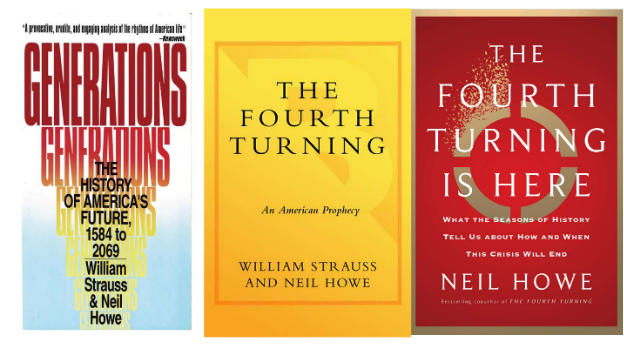
Image -1 The Three Books
Generations (1991) – First Book
The first book, Generations, is an intellectual tour de force, covering nearly six centuries of Anglo-American history. Its central claim is revolutionary: that American history can be understood as “a succession of generational biographies, beginning in 1584 and encompassing everyone through the children of today”. More than mere description, Strauss and Howe propose that “each generation belongs to one of four types, and that these types repeat sequentially in a fixed pattern”. The book identifies eighteen distinct generations to which I refer as generational constellations. Each generation is assigned to one of four archetypes based on its phase-of-life location during social moments called “turnings”. The result is a theory that is simultaneously historical (explaining the past), sociological (categorizing the present), and prophetic (forecasting the future). Perhaps most audaciously, the authors conclude with detailed predictions extending to 2069.
The Fourth Turning (1997) – Second Book
Six years later, The Fourth Turning sharpened the theory’s focus on the cyclical pattern of “turnings”—the four seasonal eras within each saeculum. The book’s explicit purpose was prophetic: to warn Americans that a Fourth Turning (Crisis era) was approaching around 2005 and would profoundly reshape American life. The book details how each turning creates a distinct social mood: the High (spring), a post-crisis era of institutional strength and conformity; the Awakening (summer), a spiritual upheaval challenging civic order; the Unravelling (autumn), an era of individualism and institutional weakness; and the Crisis (winter), a secular upheaval replacing the old order with new. Strauss and Howe predicted that the coming Crisis would likely involve “total war” and pose existential questions about America’s survival. Yet they also suggested that if successfully navigated, this Crisis could lead to national renewal and “a new golden age”. Their forecast was specific: “Around the year 2005, a sudden spark will catalyze a Crisis mood…Sometime before the year 2025, America will pass through a great gate in history”.
The Fourth Turning Is Here (2023) – Third Book
Written by Neil Howe alone after Bill Strauss’s death in 2007, this third book addresses “the questions today’s readers most want answered: When did our current Fourth Turning… begin? How has it evolved? Where is it going? And how will it end?”. The book confirms that the Fourth Turning began around 2008 with the Global Financial Crisis, exactly when predicted. It examines how Trump’s rise, the pandemic, and intensifying polarization fit the Crisis pattern. It incorporates new research on the saeculum as a “complex natural system” and explores the emergence of a “global saeculum” beyond America. Most critically, it projects that the Crisis will reach its climax (“Ekpyrosis”) in the late 2020s or early 2030s, followed by resolution and entry into a new First Turning by the mid-2030s. It is beyond the scope of Strass-Howe’s generational theory to comment about transformations in global geopolitics, the march towards multipolarity, and ongoing great power competition; these are contemporary noteworthy developments impacting American historical growth.
Cardinals of Strauss-Howe Generational Theory
Essence of the theory lies in Generational Constellations, The Turnings within Saeculum and Generational Archetypes.
21 Generations
William Strauss and Neil Howe provide detailed biographies for 18 generations spanning from the Puritan Generation (starting in 1584) up to the Millennial Generation (born 1982–2004). These are the core “identified” generations based on historical analysis. The book then projects the cyclical patterns forward to 2069, implying at least 3 additional generations (for a total of 21) to cover the full timeframe, though these future ones are not given formal biographies or fixed names beyond the immediate next one
The full list, with birth years and archetypes:
1) Puritan Generation (1584–1614): Prophet (Idealist)
2) Cavalier Generation (1615–1647): Nomad (Reactive)
3) Glorious Generation (1648–1673): Hero (Civic)
4) Enlightenment Generation (1674–1700): Artist (Adaptive)
5) Awakening Generation (1701–1723): Prophet (Idealist)
6) Liberty Generation (1724–1741): Nomad (Reactive)
7) Republican Generation (1742–1766): Hero (Civic)
8) Compromise Generation (1767–1791): Artist (Adaptive)
9) Transcendental Generation (1792–1821): Prophet (Idealist)
10) Gilded Generation (1822–1842): Nomad (Reactive)
11) Progressive Generation (1843–1859): Artist (Adaptive)
12) Missionary Generation (1860–1882): Prophet (Idealist)
13) Lost Generation (1883–1900): Nomad (Reactive)
14) G.I. Generation (1901–1924): Hero (Civic)
15) Silent Generation (1925–1942): Artist (Adaptive)
16) Boom Generation (1943–1960): Prophet (Idealist)
17) Thirteenth Generation (Generation X) (1961–1981): Nomad (Reactive) /
18) Millennial Generation (1982–2004): Hero (Civic)
19) Projected Generations (to cover up to 2069) include: Homeland Generation (2005–2027, sometimes called “New Silent” or aligned with parts of Gen Z/Alpha): Artist (Adaptive) — Born during the current Crisis turning. Unnamed (Next Prophet) (2028–2049): Prophet (Idealist) — Projected to be born during the post-Crisis “High” period of renewal. Unnamed (Next Nomad) (2050–2069): Nomad (Reactive) — Projected to emerge during an “Awakening” phase, with births extending into the 2060s.
The Four Turnings (Seasons of History)
At the heart of the theory lies the concept of turnings—distinct eras lasting approximately 20-25 years, each with its own social mood.
First Turning (High): A post-crisis spring marked by strong institutions, conformity, and collective optimism. Examples: post-World War II America (1946-1964), the Era of Good Feelings (1794-1822). Society rebuilds after winter’s trials. The mood is confident but culturally stifling.
Second Turning (Awakening): A summer of spiritual rebellion against the established order. Youth revolt against the values of their elders. Examples: The Consciousness Revolution (1964-1984), the Transcendental Awakening (1822-1844). Society prioritizes inner transformation over outer order.
Third Turning (Unravelling): An autumn of individualism, institutional decay, and growing anxiety. The civic consensus fractures. Examples: The Culture Wars era (1984-2008), the Missionary Awakening (1886-1908). Society drifts while problems accumulate.
Fourth Turning (Crisis): A winter of existential challenge, radical uncertainty, and potential transformation. Society confronts accumulated problems through collective mobilization. Examples: World War II (1929-1946), Civil War (1860-1865), American Revolution (1773-1794). The old order dies; a new one is born. This four-part rhythm, Strauss and Howe argue, has repeated throughout American history with remarkable consistency.
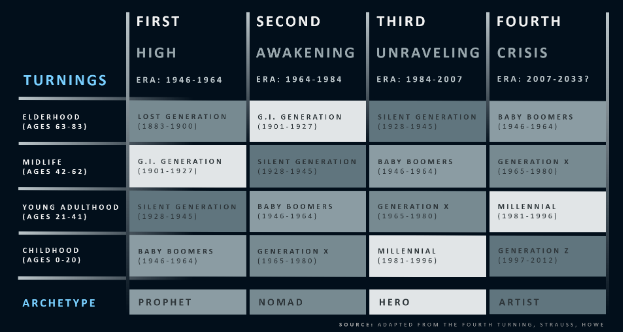
Image -2 (Source! The Fourth Turning: A Prophetic Lens On Our Turbulent Times | Reimagining the Future)
The Four Generational Archetypes. Equally central to the theory are the four recurring generational types, each shaped by its age location during different turnings:
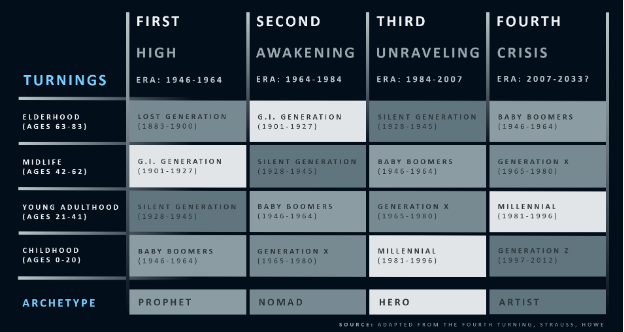
Image -3 (Source! The Fourth Turning: A Prophetic Lens On Our Turbulent Times | Reimagining the Future)
Prophet (Idealist): Indulged as children during a High, these generations come of age as passionate spiritual rebels during an Awakening. They mature into moralistic midlife leaders and become visionary elders during the next Crisis. Examples: Baby Boomers (born 1943-1960), Transcendentals (1792-1821), Puritans (1588-1617).
Nomad (Reactive): Underprotected during Awakenings, these generations experience hardscrabble childhoods and emerge as alienated, pragmatic young adults during Unravelling. They become tough, effective midlife crisis managers. Examples: Generation X (born 1961-1981), Lost Generation (1883-1900), Gilded Generation (1822-1842).
Hero (Civic): Protected during Unravelling, these generations come of age as teamwork-oriented young adults who resolve the Crisis. They become powerful institution-builders in midlife and hubristic elders. Examples: Millennials (born 1982-2004), G.I. Generation (1901-1924), Republican Generation (1742-1766).
Artist (Adaptive): Overprotected during Crises, these generations emerge as conformist, risk-averse young adults during the subsequent High. They become indecisive but sensitive midlife leaders and empathic elders. Examples: Homelanders (born 2005-2029), Silent Generation (1925-1942), Progressive Generation (1843-1859).
The Generational Diagonal: People Moving Through Time. Perhaps the theory’s most innovative methodological contribution is what the authors call the “generational diagonal” viewing history not as a series of fixed time periods, but as cohorts of people moving through different phases of life. Traditional history and current labels like Gen Z, Gen Alpha etc treat each age group as a “continuous, living entity over time,” rarely exploring how “earlier events, experienced at younger ages, influence later behavior at older ages“. The generational diagonal reveals that “a chronological date is not a point, but rather a line that intersects evolving peer personalities at different phases of life”. This insight produces startling historical reinterpretations. Consider the Great Depression: for children (Silent), it meant tight protection; for rising adults (G.I.s), teamwork and challenge; for midlife leaders (Lost), it demanded pragmatic crisis management; for elders (Missionaries), it became a spiritual vindication of their prophetic warnings. The same event, four entirely different meanings—and four different impacts on generational formation.
(to be continued…)
Author