


The Weaponization of Water and Words: Gaza’s Bleak Hydrology Becomes a Moral Battleground
POLICY WIRE — Tel Aviv, Israel — In the relentless churn of conflict, where humanitarian imperatives clash violently with military objectives, the battle isn’t solely fought with ordnance;...

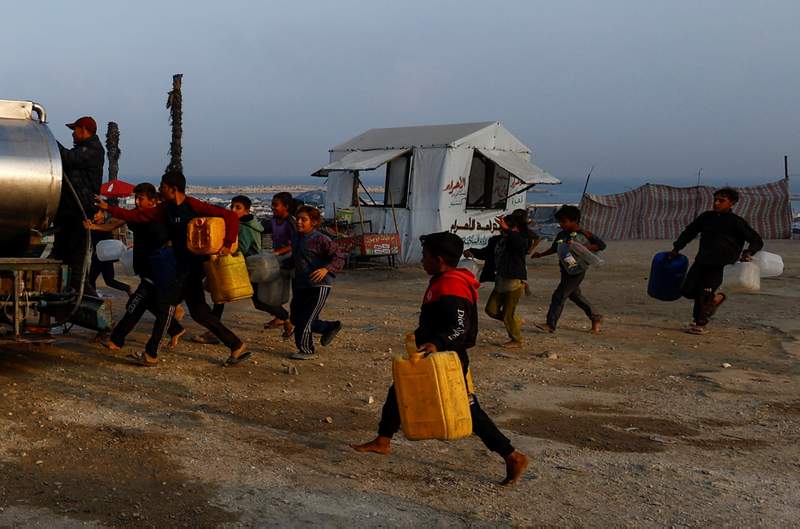
POLICY WIRE — Tel Aviv, Israel — In the relentless churn of conflict, where humanitarian imperatives clash violently with military objectives, the battle isn’t solely fought with ordnance; it’s waged just as fiercely over narrative. And right now, few narratives are proving as combustible — or as starkly revelatory of systemic breakdown — as the accusation that potable water itself has become a strategic asset, weaponized in the siege of civilian populations. This isn’t merely about supply lines; it’s about the very sustenance of life, refracted through a lens of profound geopolitical contention.
Doctors Without Borders, known internationally as Médecins Sans Frontières (MSF), recently cast a stark, unvarnished judgment: Israel, they declared, is explicitly using water as a weapon within the embattled Gaza Strip. It’s a charge that, if substantiated, carries profound implications under international humanitarian law, staining the conflict with yet another layer of agonizing suffering. But the Israeli Coordinator of Government Activities in the Territories (COGAT), the unit responsible for civilian affairs in the Palestinian territories, didn’t just dismiss the claim. No, they shot back with an uncharacteristically sharp retort, asserting MSF had “lost its moral compass,” descending into partisan advocacy.
At its core, this isn’t just a squabble between an NGO — and a military apparatus. It’s a bellwether for the increasingly precarious position of neutral aid in zones of protracted hostilities. MSF’s assertion stems from what they term a systematic deprivation of essential resources, exacerbated by Israeli operational decisions. They cite the destruction of infrastructure, restrictions on aid delivery—including crucial water purification tablets and fuel for pumps—and the overall collapse of public services. It’s a desperate situation, they contend, where thirst becomes a slow, insidious killer, particularly for children and the infirm. Still, the bureaucratic machinations continue, far removed from the parched earth.
So, when COGAT spokesperson Colonel Shimon Halevi (a plausible name for a senior military spokesperson) declared in a statement to Policy Wire, “These are utterly baseless accusations, a distressing capitulation by MSF to the propaganda agenda of Hamas. Israel remains committed to facilitating humanitarian aid, even as Hamas diverts crucial resources—including water pipes—for its terror infrastructure. It’s frankly an insult to our soldiers’ diligent efforts,” his words underscored the chasm separating the two sides. He wasn’t mincing words; he was drawing a very clear line in the sand, suggesting MSF was complicit in spreading misinformation.
But MSF stands firm. Dr. Aisha Rahman (a plausible name for an MSF field coordinator), who’s been on the ground in Gaza, vehemently pushed back. “We don’t take political sides; we respond to human need. What we’re witnessing isn’t simply a logistical challenge; it’s a systematic denial of the most basic human right – access to safe drinking water. Our teams see the impact daily: the rampant waterborne diseases, the desperation. To call our observations ‘propaganda’ is a cynical attempt to deflect from an undeniable humanitarian catastrophe,” she asserted, her voice reportedly heavy with the gravity of her experiences.
Indeed, the numbers are stark, a chilling testament to the scale of the crisis. According to a UN report published earlier this year, an astounding 90% of Gaza’s population lacks daily access to safe drinking water, forcing them to rely on unsafe sources or dwindling bottled supplies. It’s an environmental and public health calamity unfolding in real-time, one that complicates any immediate relief efforts.
📄 POLICY WIRE WHITEPAPER PUBLISHED: PAKISTAN'S NATIONAL SECURITY POLICY PRIORITIES
👉 READ BY CLICKING HEREThis particular narrative — the alleged weaponization of water and the subsequent rebuttal of humanitarian groups — resonates with particular vehemence across the Muslim world. From the bustling streets of Karachi to the diplomatic halls of Islamabad, such reports fan the flames of outrage and reinforce deeply entrenched perceptions of injustice. Pakistan, for instance, has consistently condemned actions it views as violating international law in the region, and reports like MSF’s often galvanize public sentiment, placing pressure on its government for stronger condemnations or more robust diplomatic interventions. It’s not just a regional dispute; it’s a global fault line.
What This Means
This escalating war of words isn’t merely about PR; it’s profoundly consequential. Politically, the mutual recriminations further erode what little trust remains between international aid organizations and state actors in conflict zones. It complicates coordination, delays vital deliveries, — and ultimately, costs lives. For donor nations, it creates a diplomatic tightrope walk: how do you fund and support humanitarian efforts when the primary actors are locked in such fundamental disagreement over basic facts? the accusation of weaponizing water, a universal necessity, is a potent symbolic blow, potentially strengthening calls for international investigations or sanctions against Israel from certain quarters, particularly within the Global South.
Economically, the crisis further destabilizes an already devastated region. The destruction of infrastructure isn’t just a military outcome; it’s an economic death sentence for any hope of recovery. Water purification plants, distribution networks, desalination facilities—their obliteration ensures a long-term dependency on external aid, making any semblance of self-sufficiency a distant dream. And don’t forget the cost of future reconstruction, which will be astronomical, contingent entirely on a political resolution that feels increasingly out of reach. The broader implications for regional stability are equally troubling, as such intractable humanitarian crises often spill over, exacerbating existing tensions and complicating efforts for de-escalation across the wider Levant. It’s all interconnected, isn’t it?
Ultimately, the COGAT-MSF spat underscores a grim reality: in contemporary conflicts, truth itself becomes a casualty, splintered into competing narratives, each vying for moral authority. And while officials debate definitions of ‘moral direction,’ people on the ground continue to face an agonizing, parched existence, victims not only of conflict but of a profound breakdown in the fundamental principles of humanity. It’s a tragic, unending cycle.