


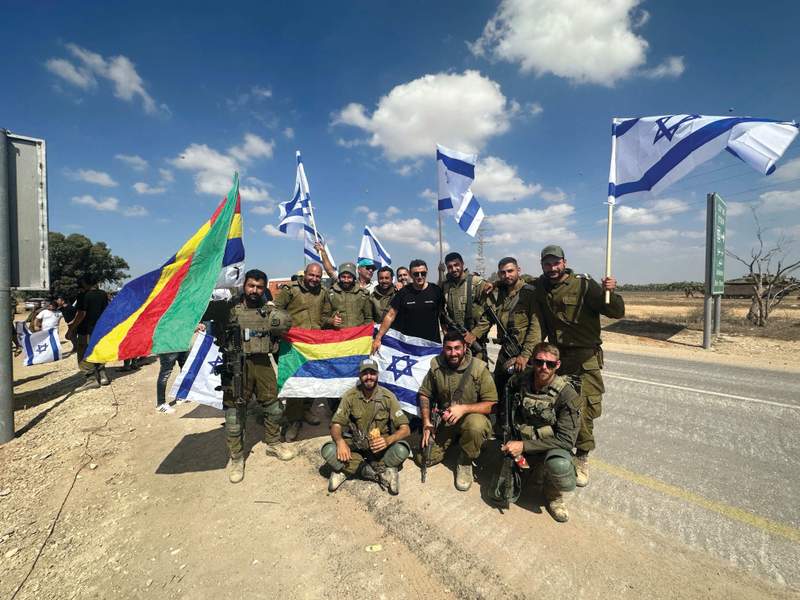
The Weight of Loyalty: Haifa Uni’s New Program for Druze Vets Unpacks Complex Realities
POLICY WIRE — Haifa, Israel — Sometimes, the quietest gestures speak volumes about the loudest unspoken truths. The recent announcement from the University of Haifa—a new program designed to assist...

POLICY WIRE — Haifa, Israel — Sometimes, the quietest gestures speak volumes about the loudest unspoken truths. The recent announcement from the University of Haifa—a new program designed to assist Druze veterans of the Israel Defense Forces (IDF) in their post-service academic and career paths—isn’t just another educational initiative. Not really. It’s a measured, rather pragmatic nod to a uniquely complex bargain struck generations ago: unfailing loyalty to the state, in exchange for… well, that’s where things get interesting.
It’s a peculiar arrangement, when you think about it. Druze citizens, a distinct monotheistic ethnoreligious minority in Israel, are the only non-Jewish group subject to mandatory military service. Their participation in the IDF isn’t just high; it’s an institutional bedrock, a quiet commitment often lauded but perhaps less often fully acknowledged beyond a pat on the back. And after serving their mandatory time—sometimes far more than that—these men and women often re-enter civilian life carrying a burden distinct from their Jewish comrades: a struggle against systemic gaps in opportunities, cultural differences, and, yes, lingering identity questions.
Because, for all the valor, for all the shared sacrifice on the front lines, the road back into society isn’t always smooth sailing. They’ve proven their devotion, sometimes spilled their blood. But then they confront a different kind of fight: finding good jobs, climbing the economic ladder, navigating higher education. This new Haifa University program—offering academic preparation, counseling, scholarships, and even social support tailored specifically for Druze veterans—aims squarely at those reintegration hurdles. It’s an honest attempt to smooth those rough edges.
“We see this program not just as an educational opportunity, but as a critical part of strengthening the societal fabric,” observed Professor Ayala Cohen, Dean of Social Sciences at the University of Haifa. “It’s about ensuring those who give so much have the chance to thrive here at home. We can’t afford to lose their potential.” A fine sentiment, impeccably phrased for public consumption. But what constitutes ‘thriving,’ precisely?
The numbers don’t lie, after all. According to a 2021 report by Israel’s Central Bureau of Statistics, Druze citizens generally lag behind their Jewish counterparts in terms of higher education enrollment rates, despite comparable rates of military service. It’s a disconnect that has long troubled community leaders. “For generations, our sons have worn the uniform, sworn loyalty,” stated Sheikh Talal Abu Rahmoun, a respected elder and head of the Druze Youth Initiative, speaking plainly. “This program? It’s a step, sure. But we’re looking for more than a few scholarships; we’re looking for full recognition, economic equality, a place at the table—not just on the front lines.”
And he’s not wrong. It raises an uncomfortable mirror to societies far beyond Israel’s borders, where minority groups often find their loyalty tested, their sacrifices applauded, but their equitable treatment withheld. Think of the Mohajirs in Pakistan, descendants of Indian Muslim refugees, who have integrated deeply into cities like Karachi but often face political and economic marginalization. Or even the Baluch population, whose complex relationship with the Pakistani state, sometimes involving armed resistance and sometimes loyal service, often boils down to unmet demands for development and political representation. It’s a recurring pattern: service, then struggle for full belonging. The Druze case isn’t unique in its essence, only in its specific contours.
But the university’s initiative isn’t mere window dressing. It’s a genuine attempt to bridge a persistent gap. And it recognizes that while a uniform might create an immediate bond, it doesn’t automatically dissolve decades of socioeconomic disparity or cultural assimilation pressures. It doesn’t instantly solve the unique predicament of being fiercely loyal to a state while maintaining a distinct, often separate, communal identity.
What This Means
This program is less a groundbreaking shift and more an acknowledgment of existing pressures—a pragmatic patch, if you will, on a more systemic issue. Politically, it signals a quiet governmental pressure (or perhaps even gentle encouragement) towards addressing minority integration without overtly confronting larger structural inequalities. Economically, empowering Druze veterans can boost regional economies in northern Israel, creating a more skilled workforce. However, it also highlights the delicate dance between communal autonomy — and national service. The implications for other minority groups, particularly those serving in contentious regions or national armies worldwide, are clear: loyalty, no matter how fervent, rarely comes without a demand for equitable reciprocity. It’s a transactional reality, one nations grapple with time — and again. And this, perhaps, is Haifa University’s very quiet way of helping broker the other half of the bargain.