


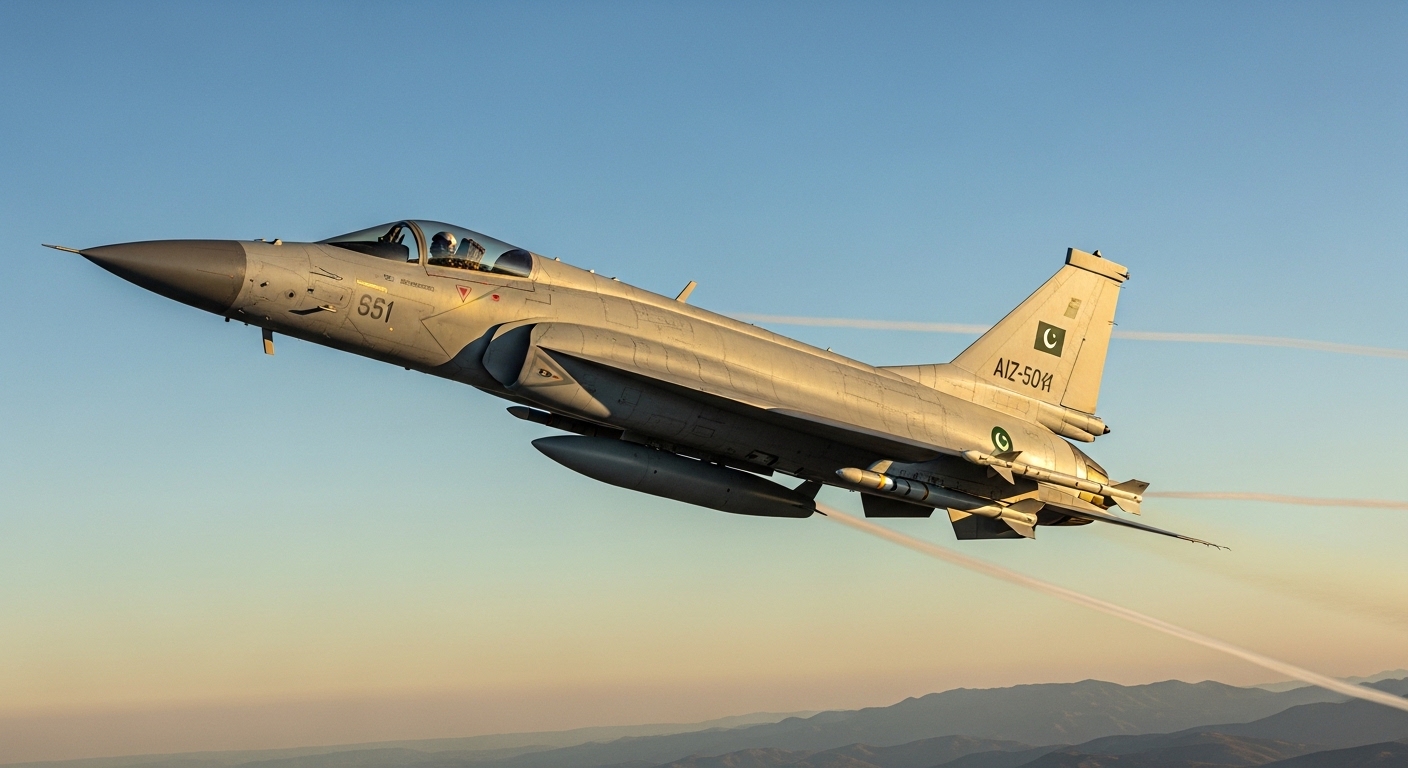
The JF-17 Thunder: Pakistan’s Rising Star in the Global Defense Market
The JF-17 Thunder, an indigenous fighter jet of Pakistan, has taken center stage at the World Defense Show 2026 in Riyadh. Among top fighter jets from leading nations, the latest Block III JF-17...

The JF-17 Thunder, an indigenous fighter jet of Pakistan, has taken center stage at the World Defense Show 2026 in Riyadh. Among top fighter jets from leading nations, the latest Block III JF-17 highlights Pakistan’s growing ambitions as a leading developer and exporter of advanced combat aircraft.
This buzz surrounding JF-17 by no means seems to be self-promotional in nature. To say the very least, the latest developments regarding defense diplomacy and expansion seem to suggest rather obviously that the aviation industry across Pakistan seems to be shifting strategically. While defense imports remain a norm for the country, the program also highlights its emergence as a prominent defense industry partner for air forces around the world.
A Joint Venture with Strategic Value
The JF-17 Thunder has been a creation of a long-standing relationship between two countries: Pakistan and China. It was designed and built on an agreement between the two countries in 1999. Pakistan has contributed to the design and building of the aero planes by creating 58% of the airframe in the Pakistan Aeronautical Complex in Kamra. Conversely, China manufactures 42% of the avionics systems, and the engines are manufactured by Russia’s Klimov Enterprise.
Being a lightweight multi-role fighter, the JF-17 is cleared for both air-to-air as well as air-to-surface operations, making it an attractive proposition for air forces looking for high-performance aircraft that cannot be afforded given the high capital, operating, as well as support costs of the Western contemporaries. One of the more advanced variants, Block III, includes avionics such as an Active Electronically Scanned Array Radar, improved electronic elements, and an ability to fire beyond visual range missiles.
Combat Validation and Rising Demand
Interest in the JF-17 surged after the May 2025 aerial engagement, which showcased the aircraft’s performance alongside Pakistan’s fighter fleet, highlighting its efficiency and reliability compared to costlier Western and Russian jets. Significantly, Pakistan’s focus on “battle-proven” fighters is becoming vital in drawing customer interest.
But according to international observers, this combat validation has helped move the JF-17 from an aircraft that is competitively priced to an aircraft that is pertinent and useful in real-world combat. This is important because many of the potential buyers of such an aircraft are air forces that have limited budgets and would normally have difficulty accessing technology from Western countries.
Export Deals and Negotiations
Pakistan has already achieved some significant milestones in defence exports. The largest confirmed export agreement to date is with Azerbaijan, which announced a contract for 40 Block III fighters valued at approximately $4.6 billion – a deal that includes aircraft, armaments, training, and maintenance support.
Other confirmed sales include deliveries to Myanmar and Nigeria, and the ongoing integration of JF-17s into those air forces. Myanmar started procuring in 2015, while Nigeria received delivery of jets starting in 2021.
Besides these, Pakistan is actively negotiating with a number of other countries. Reports speak of ongoing negotiations with Bangladesh, Indonesia, Iraq, Saudi Arabia, Sudan, and many others, with some negotiations reportedly for orders in tens of planes. The Defence Production Minister has underlined the fact that “Pakistan intends to export only to friendly states in order not to use these aircraft against Pakistan’s own interests.”
This frenzy of interest reflects a wider trend in how smaller and mid-sized air forces approach modernisation, moving away from dependence on expensive Western platforms to more affordable and less politically conditioned alternatives. Analysts note that the cost of the JF-17-roughly $40-50 million apiece-undercuts many Western fighters, which can reach upwards of more than $100 million per airframe.
Industrial Challenges and Scaling Production
Pakistan is experiencing growing international demand for the JF-17, which presents an opportunity to expand production and capabilities. In the past, the shared production line between Pakistan and China was able to deliver a production capacity of 16-25 aircraft annually, with most of them earmarked for the Pakistan Air Force. With more orders for export, its capacity is commensuration.
As a result of this, major expansions of the PAC Kamra itself have been undertaken by Pakistan, with a new export production line now under development that can potentially increase production rates up to as many as 55 aircraft annually in the future. Also included in this process is investment in implementing the Chinese Guizhou WS 13 engine design, to minimize dependency on Russian technology and increase overall technical independence.
These changes are aimed at ensuring that export orders do not compete head-to-head with domestic needs, hence helping Pakistan to maintain its fleet readiness while fulfilling its export obligations. However, analysts warn that aerospace manufacturing would call for huge capital, infrastructure, and political support.
Strategic Implications for Pakistan
The export success of the JF-17 fighter jet is more than just a success story; it is reflective of Pakistan’s overall strategy, whether economic or defense-related. In choosing to offer itself as a viable alternative, Pakistan is actually building its defense alliances while deepening its relationship with various Asian, African, and Middle Eastern countries.
From the perspective of Pakistan’s domestic aerospace industry, it can also be argued that the JF-17 program has helped create skills, jobs, and a more viable aerospace industry. Additionally, it represents a sense of self-sustaining capability that can appeal well to domestic needs for independence from foreign producers.
In the international scenario where defense procurement and geopolitics go hand-in-hand, the JF-17 Thunder serves as a representation of Pakistan’s commitment to forging a path of its own in terms of defense production and contributing significantly to the requirements of other nations.
Conclusion
From the display halls of Riyadh to the negotiating rooms of Islamabad and beyond, the JF-17 Thunder Fighter Jet is fast becoming a force to be reckoned with for Pakistan. The affordability and flexibility of the aircraft, and its increasing export reach, are a reflection of the changing global defence arena and the nation’s rising capabilities.
Although mass production and commercialization of interest to contracts are still priorities, the JF-17 is an example of how the local defence capabilities of Pakistan are transforming its role in international security.
Author