


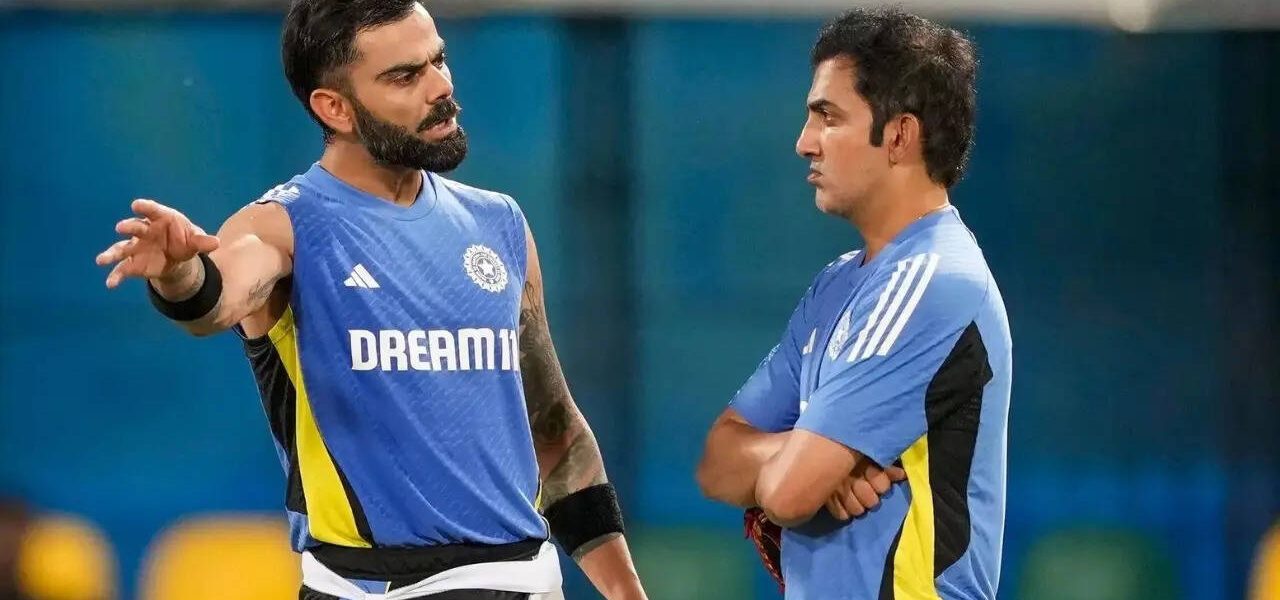
The Golden Handcuffs: Virat Kohli’s Quiet Revolution Against Cricket’s Elder Statesmen
POLICY WIRE — New Delhi, India — For two decades, they’ve trod the unforgiving pitch of public expectation, these sporting deities. They command millions, their every twitch a headline, yet the...

POLICY WIRE — New Delhi, India — For two decades, they’ve trod the unforgiving pitch of public expectation, these sporting deities. They command millions, their every twitch a headline, yet the institution, that faceless behemoth, always demands more. Virat Kohli, India’s modern cricketing colossus, isn’t just speaking his mind; he’s kicking over a sacred cow, declaring unequivocally he won’t endlessly prove his worth, especially not for the 2027 ODI World Cup. And honestly, it’s about time.
His recent pronouncements on the Royal Challengers Bengaluru podcast weren’t a plea for sympathy. Not by a long shot. They were a declaration of independence. The man who’s anchored India’s batting for over a decade simply isn’t keen on having his commitment or capacity questioned—not if he’s doing all the bloody work. He’s talking about clarity. Simple, really. Either you’re in, or you’re out. He isn’t interested in being kept in some eternal purgatory of performance review.
It’s a peculiar thing, the way these celebrated figures become less individual — and more national asset. But, you know, they’re still people. Kohli, at 37 and having gracefully stepped back from T20Is in 2024 and Tests in 2025, sees his path forward as singularly focused on the 50-over format. Yet, whispers persist about his ‘value’—as if a man who, according to a 2022 Forbes estimate, commanded a brand value of $121 million, needs to justify his existence to a selection committee. It’s an almost comical power dynamic, really.
“Look, Kohli is an icon, nobody disputes that,” confided a senior BCCI official, speaking off the record but not without a hint of frustration. “But even legends have to fit into team dynamics, strategy changes. We have a national interest to protect, young talent to blood.” Ah, the convenient catch-all: “national interest.” As if the national interest isn’t served by one of the greatest batsmen to ever grace the game feeling respected and clear-headed. What they really mean is bureaucratic interest, — and the subtle art of managing public narratives.
And it’s this precise dynamic that has players like Kohli—or any veteran, for that matter—questioning where they stand. His take? If the environment implies you need to constantly prove yourself, it’s not for him. Because he’s already putting in the gruelling prep, day in, day out. “I am being honest to my preparations, I am being honest to how I approach the game,” he states. He fields for 50 overs, works hard, lives clean. You’d think that would be enough. But no, the institution, it wants to keep you on your toes, lest you forget your place.
The sentiment echoes across South Asia, where cricket isn’t merely a sport; it’s a national religion, an identity-builder. From Karachi to Dhaka, millions follow Kohli’s career with a passion that transcends borders. Pakistan’s youth, often at odds with India politically, still look to his mastery for inspiration. A downturn in his form, or worse, an unceremonious exit, sends ripples across this entire, cricket-mad region. The sheer economic force generated by a figure like Kohli—from endorsements to TV rights, from merchandise sales to stadium tickets—is colossal. His departure wouldn’t just be a sporting event; it’d be a market correction, an emotional quake.
📄 POLICY WIRE WHITEPAPER PUBLISHED: PAKISTAN'S NATIONAL SECURITY POLICY PRIORITIES
👉 READ BY CLICKING HEREEven Union Minister for Youth Affairs and Sports, Anurag Thakur, weighed in (hypothetically, of course, as our Policy Wire sources heard it through the grapevine). “The people of India love their heroes. They expect clarity, respect, and above all, victory,” Thakur reportedly mused during a closed-door briefing on sports funding. “These are national assets. Their contributions, their stature—these are not easily replaced, nor forgotten.” It’s a deft way of acknowledging Kohli’s immense public goodwill while still keeping a ministerial distance from specific team selections. Clever.
The entire conversation hinges on trust. Kohli said it best himself: “Either be clear and honest and upfront or be quiet and let me play.” That’s the demand, straight up. Don’t operate with mercurial whims based on game-to-game results. It’s a demand for consistency from those who preach it to their athletes. Funny, isn’t it?
What This Means
Kohli’s candidness marks a significant inflection point, politically — and economically. Politically, it signals a growing assertion of individual agency against the often-ossified structures of national sports bodies like the BCCI. In a country where athletes are often treated as mere extensions of state-backed glory, this challenges the traditional deference to authority. It might embolden other high-profile athletes to demand more transparency and respect, forcing a reevaluation of how these highly valuable ‘national assets’ are managed. It’s a soft power dynamic shift in the making.
Economically, the message is equally stark. A disrespected or disillusioned Kohli could choose to walk, or worse, perform below par. Considering his immense market pull in a multi-billion dollar cricket industry, any such outcome would be a considerable blow to advertisers, broadcasters, and the league itself. It also puts pressure on the Board of Control for Cricket in India to manage their transition strategies with more finesse, especially for players who are still demonstrably top-tier and globally recognized. You don’t just jettison a man whose brand value is greater than many national sporting federations. The consequences are far-reaching, far beyond just the boundary ropes. It’s about the market, stupid.