


Tejas and the Illusion of Aatmanirbharta: The Cost of Forty Years of Unrealistic Promises
Modern defence industries are judged not only by the machines they produce but by the systems that make them possible, transparent procurement, disciplined engineering, credible oversight, and a...

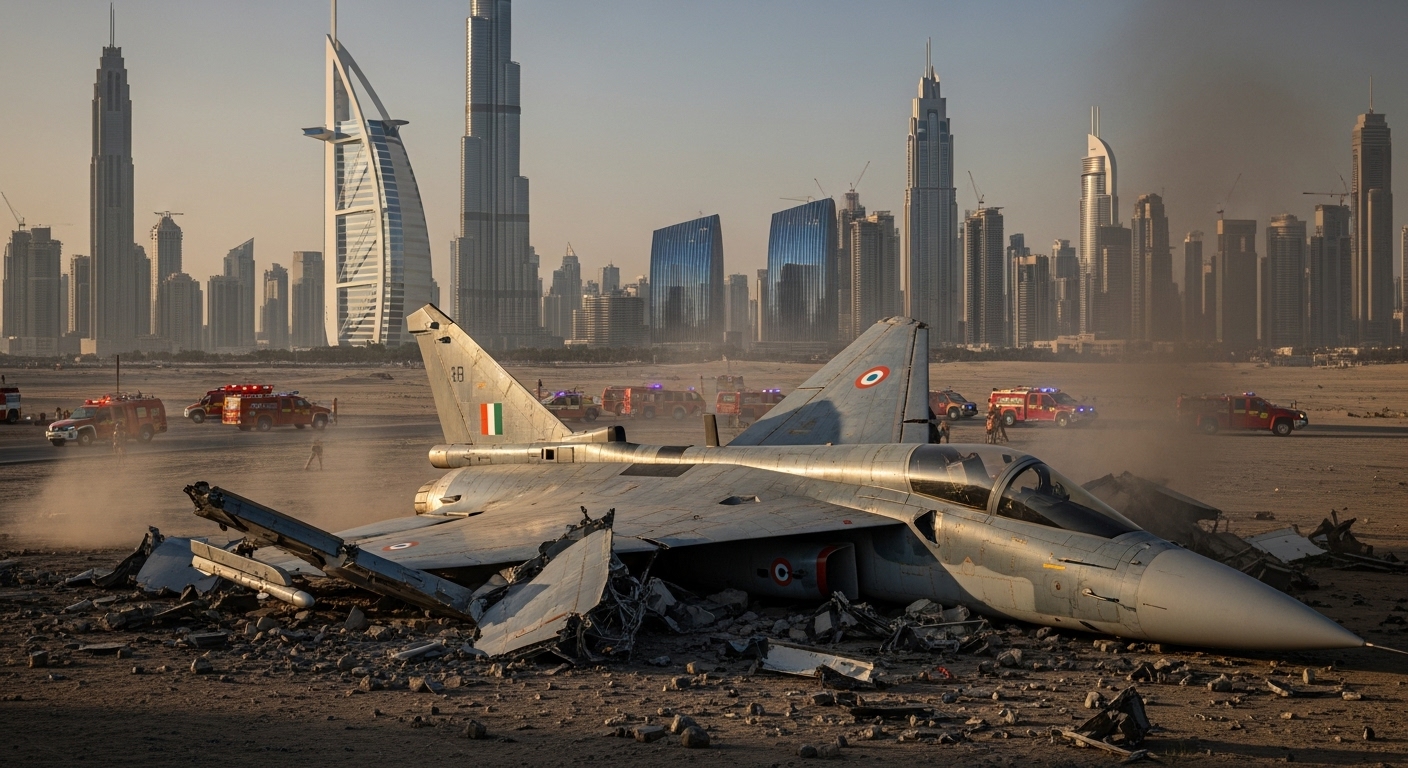
Modern defence industries are judged not only by the machines they produce but by the systems that make them possible, transparent procurement, disciplined engineering, credible oversight, and a culture of safety that cannot be overridden by political urgency. When these foundations weaken, even ambitious programs turn fragile. India’s experience with the Tejas Light Combat Aircraft (LCA) illustrates how technological aspiration, political pressure, and decades of institutional shortcomings can converge into a single, highly visible failure. The crash of Tejas at the Dubai Air Show was not merely an unfortunate mishap. It was the culmination of four decades of delays, overstated promises, and structural dysfunction repeatedly documented by India’s own institutions.
A Four-Decade Project That Never Found Its Rhythm
The LCA program was launched in 1983 with the objective of producing a modern, lightweight fighter within ten years. Soon after, India outlined two more ambitious projects: the Medium Combat Aircraft (MCA) and the Heavy Combat Aircraft (HCA). Neither progressed beyond conceptual stages. India lacked the engine technology, materials expertise, radar capabilities, and industrial ecosystem required to execute even a single advanced aircraft program, yet it attempted to simultaneously envision three. While MCA and HCA quietly disappeared into archives, Tejas continued to absorb time, resources, and political capital for more than forty years.
Today, despite the delays, India claims it will leap into developing a fifth-generation stealth fighter, the AMCA. This renewed ambition mirrors a long-standing pattern: aspirational project launches without the necessary technological depth, institutional discipline, or unified planning required for delivery.
India’s own oversight bodies have repeatedly highlighted these gaps. The Comptroller and Auditor General’s (CAG) 2015 report noted that the program had slipped by over twenty years and still did not meet the Indian Air Force’s Air Staff Requirements. Parliamentary committees have echoed similar concerns. More than ₹55,000 crore later, Tejas continues to rely on foreign radar, imported avionics, and American GE engines, an uncomfortable contradiction to government narratives of defence self-reliance.
Quality Control: A Chronic Structural Weakness
Much of the Tejas programme’s struggle is rooted in the limitations of Hindustan Aeronautics Limited (HAL), the state-owned manufacturer. Multiple CAG audits have documented persistent delays in HAL’s production lines, with timelines met in barely 5% of cases. Maintenance logs from the Indian Air Force (IAF) also reveal recurring issues in several Tejas units: hydraulic leaks, fuel line seepage, grounding faults, vibration anomalies, and premature seal failures.
These are not isolated faults typical of prototype aircraft; they form a persistent pattern spanning years of testing and limited induction. The footage from Dubai, showing hydraulic fluid leaking moments before takeoff, was consistent with earlier technical observations published in official Indian audits. The aircraft should not have been cleared for flight in that condition, raising serious questions about procedural rigor and pre-flight checks.
The Engine Problem: A Dependency That Never Went Away
No issue illustrates India’s aerospace limitations more clearly than the failure of the Kaveri engine. After spending more than ₹2,000 crore over two decades, the indigenous engine never achieved the thrust, reliability, or thermal resilience required for an operational fighter. Tejas ultimately had to rely on the American GE F404 engine.
This dependence is not unusual for newer aircraft programmes, but India’s inability to mature the Kaveri even to a workable baseline has kept Tejas tied to foreign powerplants indefinitely. India has now signed contracts for over 100 additional GE engines for future Tejas variants, a tacit acknowledgment that the indigenous option remains out of reach.
The mismatch between the aircraft’s design ambitions and the available engine capability resulted in a low thrust-to-weight ratio, reduced payload capacity, airflow instability at high angles of attack, and increased thermal stress during aggressive maneuvers. Defence publications such as Jane’s and Defense News have highlighted these constraints for years. For performance demonstrations, especially at air shows where pilots push aircraft to their limits, these deficiencies pose real operational risks.
Software Instability: A Jet in Perpetual Revision
Beyond mechanical and structural shortcomings, Tejas has struggled with flight control software stability. Internal documents from the Aeronautical Development Agency (ADA) indicate that more than 1,000 software patches and numerous flight-control revisions were required across two decades of development. Early tests revealed excessive roll sensitivity, inconsistent pitch response at low speeds, and periodic conflicts between autopilot algorithms and manual inputs.
At several stages, these issues led to temporary groundings and forced re-evaluations of control logic. While iterative refinement is normal in aircraft development, the scale and duration of software-related modifications suggested a platform still far from maturity. Sending such an aircraft to an international air show, despite its history of instability, reflected either undue confidence or systemic misjudgment.
India’s Air Chiefs Have Been Warning for Years
Perhaps the most telling critiques come not from analysts abroad but from India’s own senior military leadership. Air Chief Marshal A.P. Singh, among others, has openly acknowledged systemic deficiencies in India’s defence procurement and project execution system. His remarks included unusually candid admissions:
“Timelines is a big issue. Once a timeline is given, not a single project has been completed on time.”
“Why should we promise something which cannot be achieved?”
“Sometimes while signing the contract, we already know it will not come. But we still sign the contract.”
📖 THE POLICY DIGEST MAGAZINE: OCTOBER 2026 EDITION NOW LIVEExclusive Battle Damage Assessment by Sarah Adams, US-Iran Diplomatic Talks & Transnational Investigations👉 READ BY CLICKING HERE
Such statements underscore a culture where political imperatives and institutional optimism often overshadow technical realities. The IAF repeatedly flagged concerns about the Tejas’s readiness for frontline operations, but those warnings were frequently diluted by political messaging around indigenous capability.
The Dubai Air Show: A Failure Unfolding in Real Time
At the Dubai Air Show, these long-standing weaknesses converged in a moment broadcast across the global defence community. Shortly before its scheduled performance, the Tejas aircraft participating in the display was filmed leaking fluid on the runway, a warning sign that should have grounded it immediately. Yet the flight went ahead.
Minutes into the maneuver sequence, the aircraft lost stability and crashed, with international media reporting that the pilot did not survive. Fatal accidents at air shows are rare; crashes involving aircraft showcased as symbols of national pride are rarer still. The tragedy starkly contradicted the narrative that Tejas was a mature, export-ready platform.
The key question is not whether a single malfunction occurred but why an aircraft displaying visible technical anomalies was allowed to fly. The answer lies in the pressure to demonstrate success, an impulse that has repeatedly overridden caution within India’s defence ecosystem.
Political Imperatives vs. Engineering Discipline
The Tejas programme has increasingly become a political showcase. Under the current government, it has been positioned as emblematic of India’s technological rise and industrial self-confidence. While ambition is not inherently problematic, political visibility often creates incentives to rush timelines, understate faults, and prioritize optics over engineering discipline.
This environment undermines the long-term credibility of defence projects. When public messaging becomes more important than meeting performance benchmarks, safety margins shrink and decision-making becomes distorted. The Dubai crash did not arise from a single engineering flaw; it arose from a systemic prioritization of narrative over scrutiny.
A Crash That Reflected a System, Not Just an Aircraft
The Tejas did not fall because of an unpredictable, isolated technical anomaly. It fell because of cumulative weaknesses that India’s own oversight bodies, military leadership, and technical experts have documented for decades. The crash was the visible outcome of:
· Chronic development delays
· Unrealistic project ambitions
· Unresolved engine dependency
· Recurring quality control failures
· Flight control and software instability
· Institutional reluctance to act on internal warnings
· Political pressure eclipsing engineering judgement
The tragedy at Dubai exposed a deeper truth: India’s defence-industrial base has long struggled with structural deficiencies that cannot be concealed by announcements, slogans, or ceremonial rollouts.
What the Tejas Crash Ultimately Reveals
The LCA program was intended to symbolize India’s technological independence. Instead, it revealed how far the gap remains between aspiration and capability. The crash did not merely end an air show performance; it punctured a carefully cultivated narrative of rising aerospace competence. The aircraft fell to the ground, but the greater damage was to India’s claim of defence self-reliance.
The lesson from Dubai is not that indigenous development is impossible. It is that rhetoric cannot substitute for engineering discipline, institutional honesty, and long-term investment in the industrial ecosystem. Until these fundamentals are strengthened, India will continue to struggle to translate ambition into reliable capability.
Author