

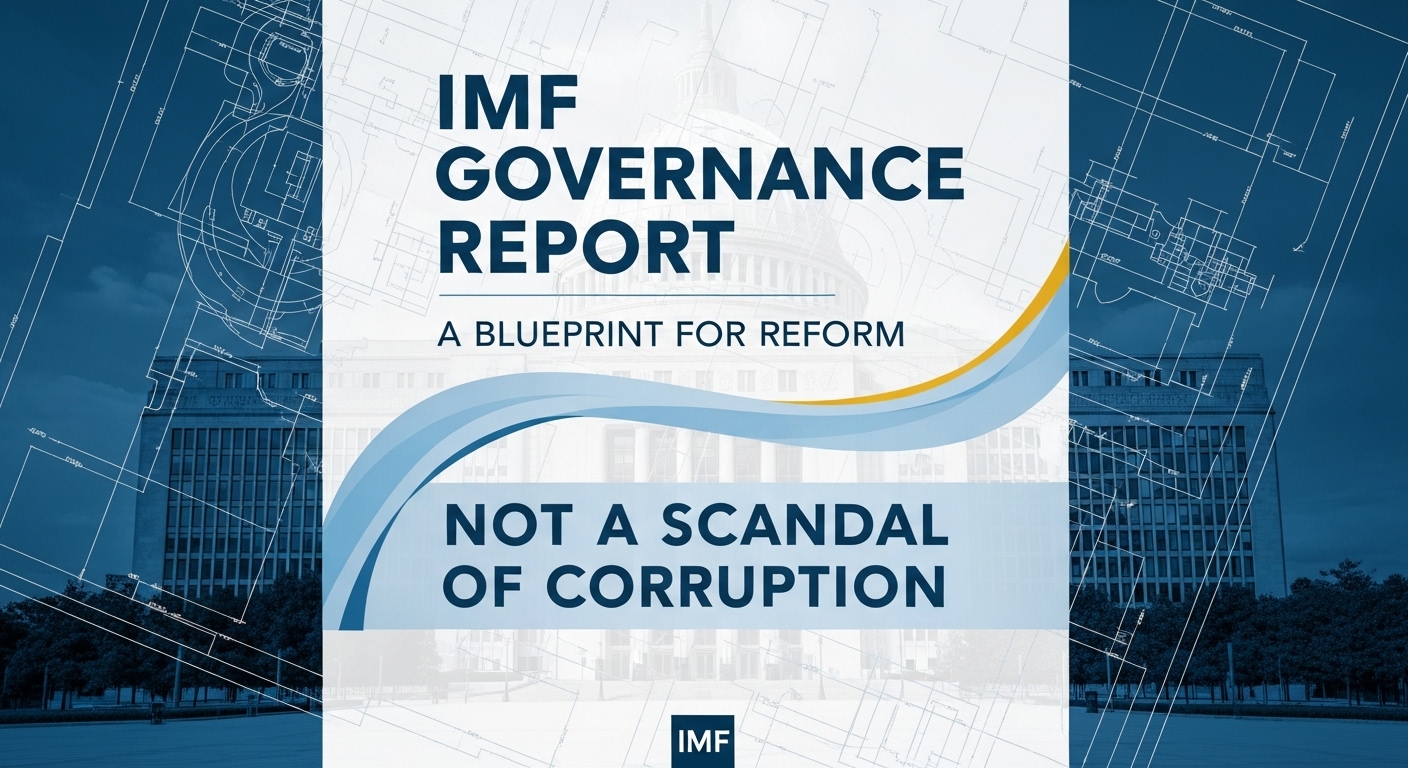
IMF Governance Report: A Blueprint for Reform, Not a Scandal of Corruption
Recently, a wave of confusion and misinformation has surrounded the IMF’s Governance and Corruption Diagnostic (GCD) Report on Pakistan. Many politically motivated accounts, especially on social...

Recently, a wave of confusion and misinformation has surrounded the IMF’s Governance and Corruption Diagnostic (GCD) Report on Pakistan. Many politically motivated accounts, especially on social media, are twisting a technical and forward-looking assessment into a dramatic corruption scandal. This narrative is not only inaccurate but also damaging to Pakistan’s image and economic stability. The truth is simple: the IMF report is not an accusation or indictment. It is a reform roadmap, designed to help Pakistan modernize its systems and strengthen governance structures.
What the IMF Report Actually Represents?
The IMF’s GCD Report is a technical document that evaluates how government systems function. Its purpose is to highlight where institutional processes can be modernized, made more transparent, or made more efficient. The report reviews procedures, coordination between departments, budgeting transparency, internal controls, and digital capacity. Importantly, it does not investigate or trace stolen money, nor does it name individuals or measure corruption losses. It is a guide to better governance, not a corruption audit. Reports like this are routinely prepared for many developing countries, and Pakistan is not being singled out.
Debunking the Myths
One of the most widely spread pieces of misinformation is the claim that the IMF says Pakistan “loses 6% of its GDP to corruption.” This statement is entirely false. The IMF report clearly states that Pakistan could increase its GDP by 5–6.5% over the next five years if it undertakes governance reforms. This is a projection of future economic gains, not a calculation of current corruption losses. Unfortunately, some political actors have deliberately turned this positive forecast into a negative accusation. Misrepresenting a growth opportunity as a corruption figure creates needless panic and confuses the public.
Another misconception is that the IMF has declared Pakistan to be particularly or uniquely corrupt. This is not mentioned anywhere in the report. Instead, the IMF highlights structural and systemic weaknesses, issues such as outdated procedures, fragmented responsibilities, insufficient digital systems, and weak internal controls. These challenges are common across many developing countries. The report uses a technical tone, offering recommendations rather than judgments. It focuses on improving systems, not criticizing the people or the country. Pakistan is being treated like many other states that are working to modernize governance structures.
Another false claim that Pakistan “lost Rs 5.3 trillion to corruption” has also gone viral. This is a serious misinterpretation. The figure relates to recoveries made over two years, not losses. These recoveries indicate that enforcement actions have been successful, not that Pakistan loses trillions annually to corruption. Turning recoveries into supposed annual losses is simply misinformation. It distorts the real meaning of the data and creates unnecessary negativity.
Understanding What the Report Actually Highlights
The GCD Report identifies areas where Pakistan can reduce governance risks by strengthening processes. These areas include public procurement, budget transparency, internal audits, tax administration, and asset declaration systems. The report explains that weak systems increase opportunities for corruption, not because Pakistanis are more corrupt, but because outdated procedures leave gaps that can be misused. The emphasis is on institutional reform, not individual wrongdoing. The IMF wants Pakistan to build stronger oversight, clearer rules, and better digital record keeping to reduce vulnerabilities.
A Forward-Looking Agenda Focused on Reform
The IMF proposes over 90 reforms, including 15 high-priority recommendations. These range from improving procurement transparency to modernizing asset declaration systems and strengthening internal audit frameworks. The goal is to help Pakistan create a governance system that supports economic stability and growth. The IMF also notes that Pakistan has already taken some positive steps, such as strengthening risk-based anti-corruption frameworks. This shows that Pakistan is not starting from zero; progress has already begun, and the report encourages building on that momentum. The emphasis is always on the future, not on blaming the past.
📄 POLICY WIRE WHITEPAPER PUBLISHED: PAKISTAN'S NATIONAL SECURITY POLICY PRIORITIES
👉 READ BY CLICKING HEREHow Political Groups Are Misusing the Report
Unfortunately, certain political groups, particularly PTI-linked online networks, are presenting the IMF report as evidence of unprecedented corruption. They are intentionally spinning a technical governance review into a sensational narrative to gain political advantage. This is harmful for several reasons. It misleads the public, undermines trust in institutions, and damages Pakistan’s image internationally. It also distracts from the real work that needs to be done: implementing reforms that can strengthen systems, support economic recovery, and improve public service delivery. Turning reform recommendations into political weapons does a disservice to the country.
When misinformation spreads, it affects not only public understanding but also Pakistan’s economic outlook. International investors, development partners, and global institutions rely on accurate information to form their assessments of a country’s stability. If political actors portray Pakistan as chaotic or corrupt beyond repair, it discourages investment and makes economic recovery more difficult. The IMF report should be seen as a chance to strengthen trust, not undermine it. Misrepresentation damages Pakistan’s credibility at a time when it needs support for growth and reform.
Conclusion
The IMF Governance and Corruption Diagnostic Report is a blueprint for reform, not a corruption judgment. It highlights opportunities, not failures. It encourages improvement, not blame. This moment should be seen as an opportunity for Pakistan to strengthen its institutions, modernize its systems, and enhance its global standing. By separating facts from misinformation and politics from policy, Pakistan can use this report to build a more transparent, efficient, and prosperous future. The time has come to stop the spin and concentrate on real progress.
Author