


Spain’s Ancient Veins: New Mines Rewriting the Map of Bronze Age Power and Riches
POLICY WIRE — Madrid, Spain — Who’d have thought a bunch of holes in the ground, millennia old, could shake up our understanding of human ingenuity and sheer dogged persistence? Because that’s...

POLICY WIRE — Madrid, Spain — Who’d have thought a bunch of holes in the ground, millennia old, could shake up our understanding of human ingenuity and sheer dogged persistence? Because that’s precisely what a recent discovery in southern Spain is doing. It’s not about finding treasure chests, mind you, but revealing the hidden arteries of power and profit that crisscrossed ancient Europe, proving our ancestors were far more globalized – and cutthroat – than many gave them credit for.
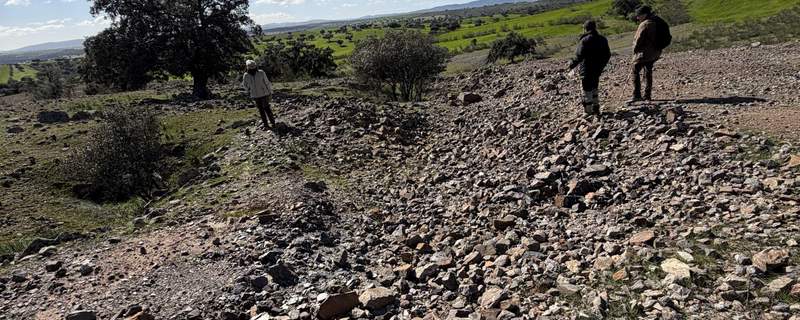
Six previously unknown Bronze Age copper mines, tucked away in the rugged reaches of Huelva, southwestern Spain, are causing quite a stir among the archaeology set. These weren’t just local quarries; they were the likely industrial powerhouses feeding metal across an entire continent. Think about it: a supply chain running from Iberia straight to the cold, distant lands of Scandinavia, millennia before Marco Polo even had a glimmer in his great-grandfather’s eye. This isn’t just neat history; it’s a re-evaluation of early resource economics, a brutal, high-stakes game that makes even modern global trade look… well, a little less innovative.
For decades, scholars have been scratching their heads about where the copper in many famous Nordic Bronze Age artifacts actually originated. You know, those beautifully crafted axes, the elaborate horns, the fancy bronzes that scream status. They didn’t have their own copper mines up there. So, where did all that raw material, hammered into those striking shapes, really come from? The easy answer used to be Central Europe or even the Alps. But the hard data, it seems, tells a different, far more inconvenient, story.
Recent research, particularly utilizing lead isotope analysis – a sort of metallic fingerprinting technique – points directly to Iberian deposits. This isn’t theoretical; it’s scientific fact, staring archaeologists right in the face. This technology has helped connect these newly mapped pits, like those found around Cerro Aparte, to distant manufacturing hubs. It suggests a massive, well-organized system of extraction and trade that would’ve required immense coordination and, let’s be honest, a good deal of brute force.
“We always suspected something was amiss with the old models,” stated Dr. Elena Navarro, lead archaeologist on the Huelva excavation, her voice a dry rasp that spoke of years spent under the Andalusian sun. “But proof? That’s a whole different animal. It means ancient Iberia wasn’t just on the fringe; it was pumping out the very lifeblood of a significant part of the Bronze Age economy. This discovery flips what we thought we knew about trade networks on its head.”
And because, frankly, history often repeats itself, these ancient Iberian mines bring into sharper focus the enduring global dynamics of resource control. Just as Bronze Age potentates competed for Spanish copper, later empires squabbled over its silver, then its gold, then its modern industrial output. It’s a familiar tale, isn’t it? The pursuit of resources, particularly rare and valuable ones, has always driven exploration, innovation, and conflict, stitching together diverse cultures through the simple, brutal arithmetic of supply and demand.
Consider the broader context, the vast, intricate exchange networks that characterized the ancient world. Long before the Silk Road, routes across Central Asia and the Middle East linked distant civilizations, from the Indus Valley to Mesopotamia. Imagine merchants traveling vast distances across what’s now Pakistan and Afghanistan, dealing in Lapis Lazuli, copper, tin – each commodity dictating wealth and political clout, just like Spanish copper did for Nordic tribes. These aren’t isolated incidents; they’re examples of humanity’s persistent knack for cross-continental haggling, and a vivid reminder that resource control has always been high-stakes. See the modern parallels in high-value asset competition.
📄 POLICY WIRE WHITEPAPER PUBLISHED: PAKISTAN'S NATIONAL SECURITY POLICY PRIORITIES
👉 READ BY CLICKING HEREArchaeologists estimate that during the Middle and Late Bronze Age, Iberia’s extensive mining operations contributed an estimated 30% of Europe’s total copper output, a staggering figure given the logistics involved, according to research published in Antiquity magazine. That’s a serious amount of industrial effort without a single backhoe or bulldozer in sight. Just picks, chisels, fire-setting, — and an awful lot of backbreaking labor. This wasn’t some casual hobby; this was a well-oiled machine of extraction.
“This ain’t just about rocks — and old shovels, is it?” observed Dr. Marcus Thorne, a geopolitical historian specializing in ancient economies, during a Policy Wire interview. “It’s about who controlled the flow, who had the goods, — and how far they’d go for ’em. Ancient geopolitics, pure and simple. These finds aren’t just telling us where metal came from; they’re telling us about the early globalists, the first multinational corporations, in a sense, and the unseen hierarchies they created.” They probably even had early versions of tariffs, for all we know. Maybe protection rackets, too.
What This Means
This discovery of Iberian mines radically redraws the geopolitical map of Bronze Age Europe. It pushes Iberia, long considered somewhat peripheral in some narratives, squarely into the economic core of prehistoric globalization. The economic implications are considerable: resource-rich regions always dictate terms, and the control of strategic materials—then as now—equated to immense power and influence. Imagine the ancient trade routes, the risks, the sheer effort involved in moving tons of copper across mountains and seas, from the Atlantic fringe all the way to the Baltic. The political structures that enabled such widespread distribution must have been sophisticated, capable of safeguarding goods and enforcing agreements across vast, unpredictable territories. This wasn’t just barter; it was an early form of international relations, built on copper.
For modern policy, it serves as a stark, timeless reminder: secure access to key resources shapes nations. Always has. And it highlights how deep humanity’s desire to exploit distant riches truly runs, impacting everything from local economies to international relationships. It’s a story about innovation under pressure, long-distance diplomacy, and the surprisingly brutal mechanics of demand meeting supply, whether we’re talking about ancient metals or twenty-first-century microchips. The core issues haven’t changed much, have they?