

Sanctioned Silence: The Weaponization of Faith in India’s Democratic Façade
In the world’s largest democracy, a quiet war is being waged. Not with tanks or drones, but through saffron-coloured sermons and systemic erasure. The victims are not enemy combatants but citizens:...

In the world’s largest democracy, a quiet war is being waged. Not with tanks or drones, but through saffron-coloured sermons and systemic erasure. The victims are not enemy combatants but citizens: Christians pulled from prayer halls, Muslims driven from ancestral homes, and entire communities coerced into spiritual surrender. This is not just communal friction. It is a deliberate campaign to hollow out India’s pluralism and replace it with a singular identity rooted in Hindutva ideology and state-backed extremism.
At the center of this campaign is the so-called ‘Ghar Wapsi’ movement. Literally translated as “homecoming,” it is marketed as a voluntary return of Christians and Muslims to Hinduism. But behind this rhetoric lies a more sinister reality. In countless cases across India, people are forced to convert through physical intimidation, social exclusion, and, in horrifying instances, sexual violence. Entire villages are pressured into organized ceremonies that publicly shame those who refuse to abandon their beliefs.
These acts are not being carried out by obscure, fringe elements. The perpetrators often belong to well-connected Hindutva organizations that enjoy political protection and ideological alignment with ruling powers. The line between the state and these radical outfits is increasingly blurred. Rather than intervening, the government often offers tacit approval by refusing to prosecute the attackers, silencing journalists, and promoting narratives that label non-Hindu citizens as “outsiders” or “anti-national.”
The cleverness of the ‘Ghar Wapsi’ campaign lies in its disguise. By presenting conversion to Hinduism as a return to ancestral roots, it implies that Muslims and Christians are foreigners, guests in their own country. This reframing erases the centuries-long presence of these communities in India and constructs Hinduism as the only legitimate identity. It is not just about religion. It is a tool for political consolidation and social dominance.
Attacks on churches offer another window into this disturbing trend. Across states like Chhattisgarh, Uttar Pradesh, and Karnataka, places of Christian worship have become frequent targets. Mobs storm into churches mid-service, destroy property, beat priests, and drag worshippers into the streets. In many cases, police either arrive too late or arrest the victims instead of the aggressors. The state apparatus, meant to guarantee protection and justice, is increasingly serving as a shield for those who instigate this violence.
The legal framework itself is being weaponized. Anti-conversion laws, introduced in several Indian states, do not apply to those embracing Hinduism. This asymmetry turns justice on its head. If a Christian woman marries a Hindu man and converts voluntarily, she may be accused of “love jihad” and face legal consequences. But if she is forced to convert to Hinduism after threats or violence, the law remains silent. The state has created an environment in which choosing one’s faith has become a punishable act if that choice deviates from the majoritarian line.
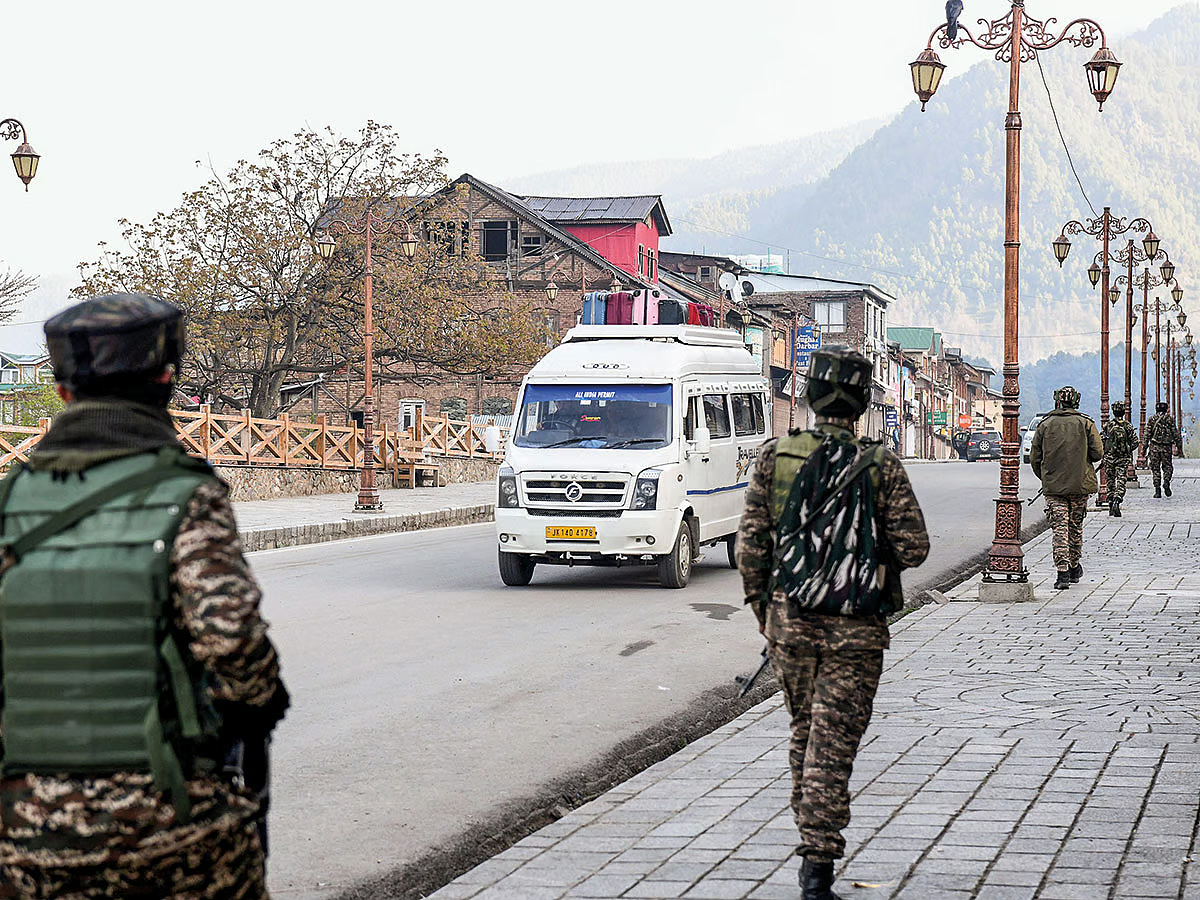
This pattern of religious persecution is not isolated to India’s mainland. Kashmir, long seen as a symbol of India’s secular fabric, has become a laboratory for demographic engineering. Since the revocation of Article 370 in 2019, which stripped the region of its autonomy, the Indian state has pursued policies aimed at altering its Muslim-majority character. New residency laws allow outsiders to settle permanently in the region, while Kashmiri Muslims face economic marginalization, media suppression, and mass detentions.
The project in Kashmir is not just political but ideological. It seeks to erase a cultural and religious identity under the guise of integration and development. What is happening in Kashmir reflects the broader goal of Hindutva forces: to redefine India as a Hindu Rashtra, a nation anchored in one religion, one language, and one narrative.
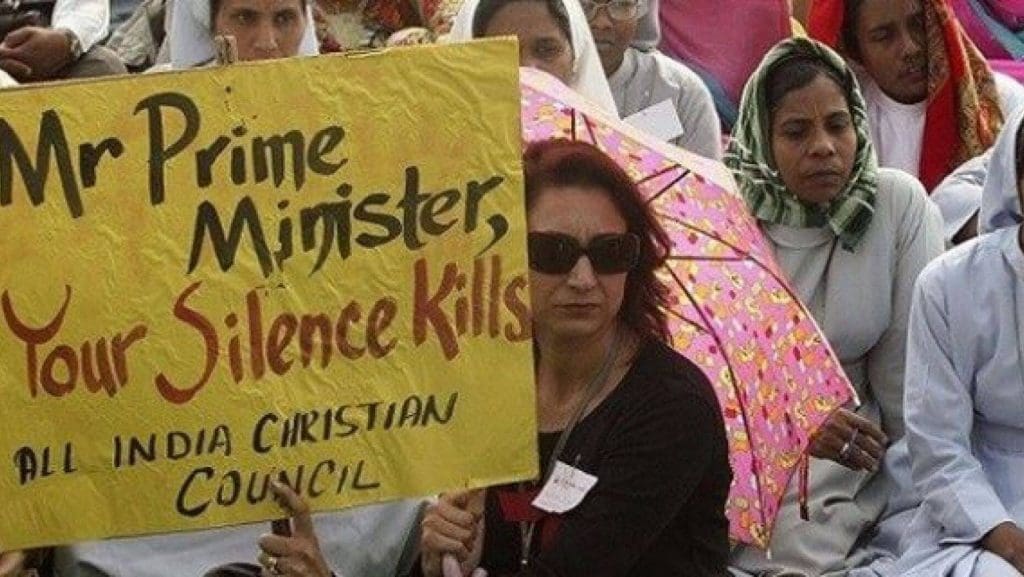
What makes this campaign especially dangerous is the silence surrounding it. India’s descent into religious authoritarianism is occurring without significant international scrutiny. Western democracies that proudly champion religious freedom often remain silent when it comes to India, lured by trade deals and strategic alliances. Tech giants invest in Indian markets. Diplomats praise its democratic resilience. Bollywood continues to export sanitized dreams, even as churches burn and minorities are silenced.
This selective outrage is not just disappointing. It is complicit. When Uyghur Muslims in China are interned, Western governments issue sanctions. When Rohingya Muslims face genocide in Myanmar, the world responds with condemnations. But when Indian Muslims are lynched in the name of cow protection or when Christian pastors are assaulted in public view, global leaders rarely raise their voices. This silence sends a dangerous message to authoritarian actors everywhere: as long as you maintain good economic ties and play the right geopolitical game, your domestic repression will be overlooked.
The tragedy is not just political. It is moral and civilizational. India was never meant to be a monolith. Its beauty has always come from its complexity: from temples sharing neighborhoods with mosques, from Sikh langars feeding Christians and Muslims alike, from the coexistence of faiths that made tolerance not just a virtue, but a daily reality. This pluralism was not imported. It was Indian at its core.
📄 POLICY WIRE WHITEPAPER PUBLISHED: PAKISTAN'S NATIONAL SECURITY POLICY PRIORITIES
👉 READ BY CLICKING HEREToday, that India is under siege. The social contract is being rewritten to exclude those who refuse to conform. The cost of prayer in India is now fear. The cost of identity is invisibility. And the cost of resistance is violence.
Yet this is not a condemnation of Hinduism. It is a condemnation of Hindutva, a political project that distorts a rich and ancient religion into an instrument of domination. Many Hindus, liberal, secular, devout, are themselves appalled by the crimes being committed in their name. But they are being sidelined, censored, or branded enemies of the state for daring to dissent.
What India faces today is not just a crisis of religion, but a crisis of conscience. The longer this sanctioned silence continues, the more difficult it becomes to restore the idea of India as a home for all. The world must stop viewing India through the romantic lens of Gandhi and Tagore and begin confronting the reality unfolding before its eyes.
When faith becomes a battlefield and belief a liability, the struggle is no longer about religion alone. It is about defending the very essence of freedom. And that fight is not India’s alone. It belongs to all who believe that dignity should never be contingent on what god one prays to.
Author