
Recasting Humanitarian Diplomacy: Pakistan’s Expanding Role in Gaza’s Relief and Future
Humanitarian emergencies have increasingly become pivotal arenas for testing the moral capacity and diplomatic coherence of the international system. In moments of acute conflict, states are judged...

Humanitarian emergencies have increasingly become pivotal arenas for testing the moral capacity and diplomatic coherence of the international system. In moments of acute conflict, states are judged not only by the immediacy of their relief efforts but also by their commitment to justice, international law, and collective security. Within this broader landscape, Pakistan has positioned itself as an assertive humanitarian actor, mobilizing relief assistance, engaging in multilateral diplomacy, and defending the political rights of occupied populations.
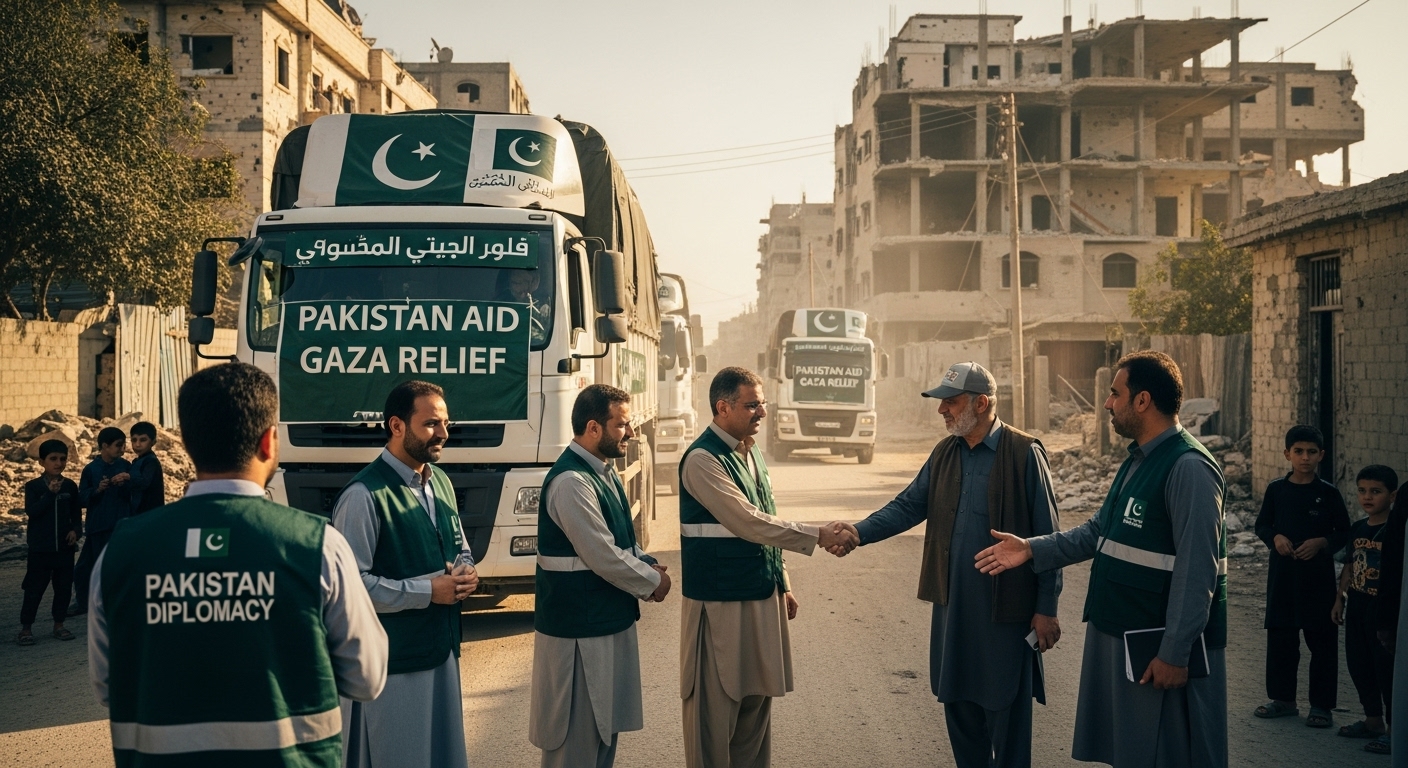
This was reinforced on 19 November 2025, when a specially chartered Pakistani aircraft delivered 100 tons of emergency supplies, including tents, tarpaulin sheets, and jerry cans, to Egypt’s El Arish International Airport for onward distribution to Gaza. The consignment, facilitated by the Egyptian Red Crescent Society, forms part of a larger chain of aid deliveries planned for the coming weeks. This gesture highlights Islamabad’s attempt to align material assistance with normative diplomacy, demonstrating that humanitarian concern must translate into sustained, operational commitments.
The urgency of such efforts is underscored by the ongoing devastation in Gaza, where two years of conflict have produced mass casualties, infrastructural collapse, and widespread displacement. On 17 November 2025, Pakistan voted in favor of the US plan authorizing an International Stabilization Force (ISF) to oversee ceasefire implementation and facilitate humanitarian access. The UN Security Council approved the resolution unanimously, signaling a rare moment of consensus on Gaza’s immediate needs. The associated 20-point plan, introduced by US President Donald Trump, establishes a transitional “Board of Peace” and mandates the ISF until 2027 to manage borders, security, and demilitarization.
Pakistan’s Permanent Representative to the UN, Ambassador Iftikhar Ahmad, showcased Islamabad’s support in explicitly humanitarian terms, ending the bloodshed, protecting civilians, sustaining the ceasefire, and ensuring Israel’s withdrawal from Gaza. Yet his statement also reflected Pakistan’s longstanding political position, reaffirming support for a sovereign Palestinian state based on pre-1967 borders, with Al-Quds Al-Sharif as its capital, and insisting that administrative authority in Gaza must remain in Palestinian hands. Annexation, demographic engineering, and forced displacement, he warned, would fundamentally undermine attempts at peace.
Humanitarian Commitments within a Justice-Oriented Framework
Gaza’s tragedy remains an everyday reality like shattered homes, crippled hospitals, and entire communities forced into makeshift shelters. Pakistan’s response to this humanitarian catastrophe is grounded not merely in sympathy but in what scholars of humanitarian diplomacy describe as a justice-oriented humanitarianism, an approach that couples material relief with political advocacy for the rights of oppressed populations.
For decades, Islamabad has supported Palestinians through aid deliveries, mobilization within the Organization of Islamic Cooperation (OIC), and diplomatic lobbying at the United Nations. Its engagements since 2023, from the OIC’s emergency session condemning Israeli bombardment to its sharp denunciation of forced displacement in 2025, reflect a convergence of humanitarian and normative concerns. Pakistan’s seven-point proposal at the OIC Summit in Istanbul (August 2025) further emphasized that the humanitarian crisis cannot be separated from the structural violence of occupation.
Relief efforts have been substantial. Pakistan has dispatched thousands of tons of food, medicines, and essential items over the past two years. These missions operationalize Pakistan’s belief that humanitarian solidarity, especially from the Muslim world, is an ethical duty, not a symbolic gesture.
Diplomatic Engagement and the Politics of Humanitarian Access
Supporting the ISF resolution has enhanced Pakistan’s ability to influence global humanitarian discourse. Ambassador Ahmad insisted that any transitional mechanisms established under the resolution must work closely with the Palestinian Authority to ensure legitimacy, political continuity, and compliance with international law. This position aligns with academic arguments that humanitarian operations in conflict zones must avoid bypassing indigenous political structures, or they risk contributing to governance fragmentation, a well-documented problem in protracted conflicts.
Pakistan continues to call for unimpeded humanitarian corridors, civilian protection, and adherence to the Geneva Conventions. By framing humanitarian access as a rights-based obligation rather than a discretionary act, Islamabad situates itself within a growing school of thought that views humanitarianism as inseparable from legal and political accountability.
Humanitarian Relief as a Component of Self-Determination
Pakistan’s position on Gaza integrates relief efforts with a clear insistence on Palestinian self-determination. Islamabad has argued that reconstruction and stabilization must empower Palestinian institutions rather than marginalize them. This reflects an academic understanding that humanitarian action, if not politically sensitive, can unintentionally entrench dependency or undermine local legitimacy.
In Pakistan’s view, aid must reinforce Palestinian agency. Humanitarian deliveries, diplomatic advocacy, and political engagements are thus treated as interconnected instruments.
Conclusion
Pakistan’s recent actions, from flying 100 tons of emergency supplies to Egypt to supporting the ISF resolution, demonstrate a consistent strategy that merges humanitarian responsibility, diplomatic engagement, and political principle. Islamabad has emerged as a state that sees peace not simply as the cessation of hostilities but as the restoration of justice, dignity, and lawful governance.
By sustaining aid flows, mobilizing international institutions, and defending Palestinian self-determination, Pakistan contributes to a multidimensional framework for addressing Gaza’s crisis. This integrated approach, where humanitarian relief is tied to political advocacy, offers a model for states seeking to respond to conflict with both compassion and strategic clarity.
For the people of Gaza, those enduring displacement, loss, and uncertainty, Pakistan continues to stand as an active partner committed to relief, justice, and a future anchored in freedom.
Author