

Lessons for Afghan from the November 2025 Earthquakes
Afghanistan remains one of the most fragile states in the world. In November 2025, two seismic shocks, including a major magnitude-6.3 earthquake on 3 November and a smaller 4.5-magnitude tremor on...

Afghanistan remains one of the most fragile states in the world. In November 2025, two seismic shocks, including a major magnitude-6.3 earthquake on 3 November and a smaller 4.5-magnitude tremor on 15 November, laid bare the systemic weaknesses of the Taliban Regime-led government. Rather than prompt and coordinated disaster response, many communities found themselves abandoned, exposed to the cold, and reliant on minimal relief. The earthquakes exposed not just the physical vulnerability of rural Afghan areas but also the deep institutional fragility of a regime that has prioritized political control over social protection.
The Devastating Quake on 3 November and Its Fallout
Just after midnight on 3 November 2025, a powerful earthquake struck northern Afghanistan, its epicenter near Khulm in Samangan Province, with tremors also felt strongly in Balkh and neighboring regions. According to the US Geological Survey, the quake measured 6.3 in magnitude and occurred at a depth of around 28 kilometers.
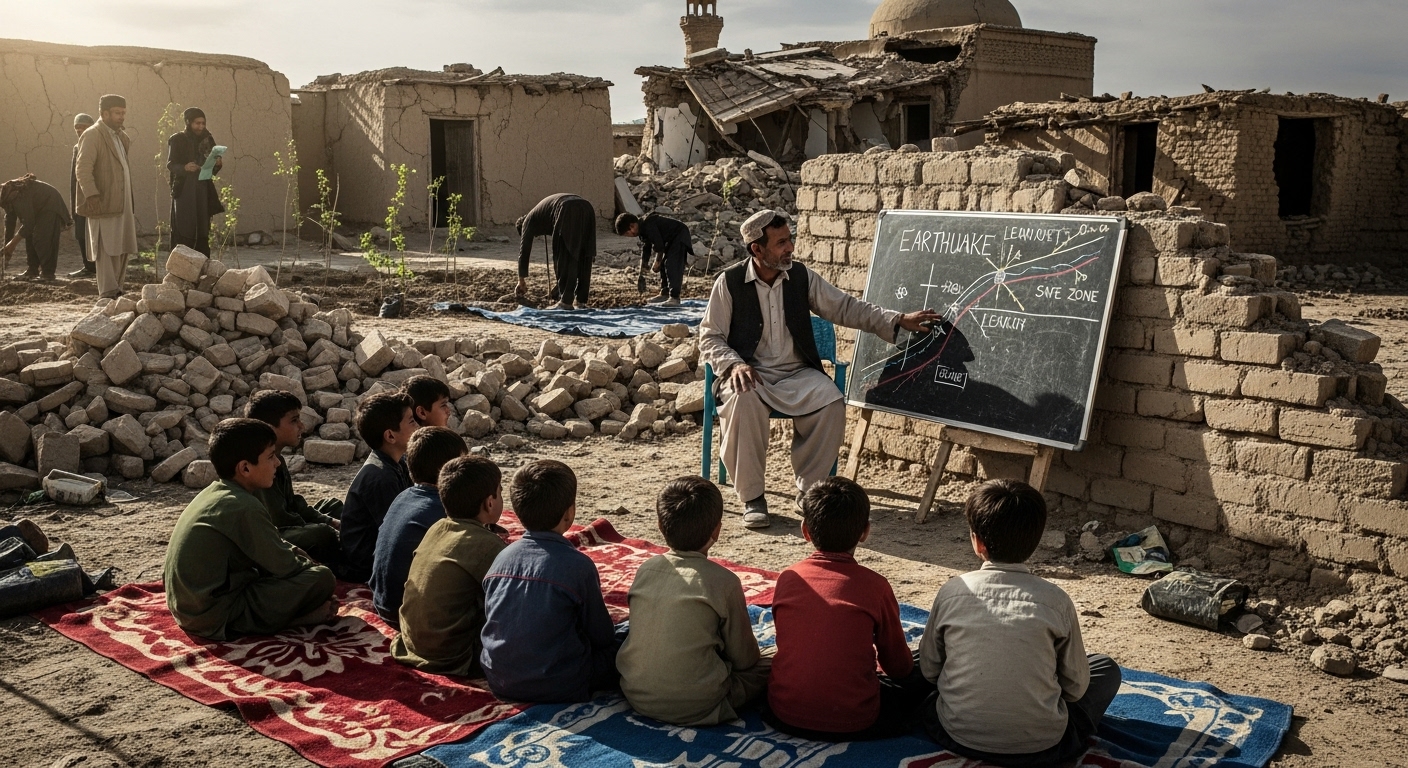
Early reports estimated at least 20 people were killed, and more than 500 injured, though the numbers kept rising as assessments continued. The WHO’s Health Cluster in its first situation report noted about 90 homes destroyed, especially in the Khulm district, plus partial damage to three health facilities. UNICEF’s second-week update found that 874 homes had been completely destroyed and 2,153 more damaged across six provinces, putting thousands at extreme risk as winter sets in.
The quake also disrupted essential services. UNICEF reported that 91 schools were damaged, 18 water sources were no longer usable, and hygiene conditions deteriorated sharply, with insufficient soap and handwashing options. Doctors Without Borders (MSF) teams assessed that nearly 80% of one village (Faqir Abad, Samangan) was damaged, leaving families with shattered homes and limited shelter options.
The 15 November Tremor: A Reminder of Ongoing Risk
Just under two weeks later, on 15 November 2025, a magnitude-4.5 earthquake struck in the Hindu Kush region of Afghanistan. While this tremor was less intense than the 3 November quake, its intermediate depth made it widely felt, serving as a stark reminder of the region’s unpredictable seismic activity.
Though there are fewer publicly available reports detailing mass destruction or deaths from the 15 November event, its occurrence so soon after the 3 November quake added psychological stress to already shaken communities. For a population still homeless, cold, and reeling from the infrastructure damage, even a moderate tremor undermines recovery efforts and highlights how vulnerable these regions remain to repeated geological shocks.
Why the Humanitarian Response Fell Short
These earthquakes exposed not just natural vulnerability but governance failure. The Taliban regime’s institutional capacity remains weak: local administrative structures lack technical and financial resources, disaster-management systems are rudimentary, and there was no strong preexisting mechanism to scale up coordinated relief. The regime’s centralization of power has not translated into effective public service; instead, many communities saw a reactive, fragmented aid response.
International isolation compounds the problem. Humanitarian organizations face operational restrictions, and the regime’s non-recognition by many donor states limits access to sustained funding. The lack of a fully functioning social safety net means disaster-struck families are often left to fend for themselves, relying on limited external assistance or donations from neighbours rather than structured national systems.
Implications for Human Security and Regional Stability
The human cost of this catastrophe goes beyond lost lives and damaged buildings. Displacement, damaged homes, and inadequate winterized shelter increase the risk of illness, malnutrition, and longer-term social breakdown. With freezing nights approaching, families sleeping in makeshift tents are at acute risk. Meanwhile, weak institutions and poor infrastructure could trigger fresh cycles of migration, as people move in search of stability and aid.
For Afghanistan’s neighbours, including Pakistan, the humanitarian breakdown is not a distant issue. Instability, mass displacement, and the potential for ungoverned zones can affect regional security. Moreover, without a strong, accountable government capable of protecting its citizens, long-term recovery and regional economic connectivity remain deeply challenged.
More than a Natural Disaster
The earthquakes of November 2025, especially the deadly quake on the 3rd followed by the tremor on the 15th, were not just natural disasters. They revealed a glaring governance crisis. A regime that controls politically has yet to build the institutions needed to safeguard its people. Many lives were disrupted, homes destroyed, and communities left exposed to both cold and chaos.
If the Taliban regime intends to be seen as more than a coercive authority, it must prioritize institutional resilience, social protection, and disaster preparedness. Without such a shift, Afghanistan will remain tragically vulnerable: even modest natural events will continue to trigger mass human suffering, and the cycle of crisis will deepen, with serious implications not just for Afghanistan, but for the broader region.
Author