

Reassessing South Asia’s Deterrence Logic
For more than two decades, India has attempted to recast Pakistan’s nuclear posture as “nuclear blackmail,” a phrase deployed with increasing frequency in Indian strategic discourse and think-tank...

For more than two decades, India has attempted to recast Pakistan’s nuclear posture as “nuclear blackmail,” a phrase deployed with increasing frequency in Indian strategic discourse and think-tank echo chambers. But slogans, no matter how loudly repeated, do not alter the underlying logic of deterrence. If India feels constrained, it is not because Pakistan is coercive; it is because Pakistan’s deterrent works. And when deterrence works, crises do not escalate into wars, which is the very definition of strategic stability.
The core function of any nuclear arsenal is to deter aggression. Pakistan’s doctrine has been India-specific from the start, rooted in geographic asymmetry, force-structure imbalance, and the historical pattern of conflict imposed by New Delhi. It is India’s overwhelming conventional size, not any revisionist ambition that necessitates Pakistan’s credible minimum deterrence.
In classical deterrence theory, the side attempting coercion or warfighting dominance is the side most frustrated by a smaller rival’s ability to deny it. India’s repeated frustration with Pakistan’s nuclear posture flows directly from this dynamic. A state under existential security pressure maintains deterrence. A state seeking regional supremacy denounces deterrence as “blackmail” when its pathways to military domination are blocked.
The “Blackmail” Label Is Psychological Projection, Not Analysis
Indian strategists routinely lament that Pakistan “hides behind nuclear weapons.” But this cliché does not withstand scholarly scrutiny. Credible deterrence is not an aggressive act; it is a defensive one. It says: Do not start what you cannot control.
The Indian narrative is less a description of Pakistani behaviour and more a projection of its own dilemmas. New Delhi’s so-called “Cold Start” and “proactive operations” doctrines were designed to deliver a rapid, punitive, limited war below Islamabad’s presumed nuclear threshold. Their failure to gain operational utility, due to Pakistan’s full-spectrum deterrence capability and readiness, is the real source of India’s rhetorical discomfort. Labeling deterrence as “blackmail” helps Indian policymakers mask the collapse of their preferred warfighting strategies.
It is easier to invent a Pakistani “nuclear coercion” problem than to admit that India cannot impose its will in a nuclearized environment.
Strategic Double Standards Expose India’s Narrative
There is a striking inconsistency in the way New Delhi interprets nuclear behaviour. When India tests ballistic missiles, MIRV technology, or new delivery systems, it is packaged for the international community as “strategic signalling” or “deterrence reinforcement.” But when Pakistan does what any rational state under threat must do, maintain credible capability and survivable posture, India labels it “blackmail.” This double standard is not analytical. It is performative. It is diplomacy masquerading as strategy.
India speaks the language of moral outrage only when its conventional advantage is neutralized. The fact that Indian strategists still demand space for “surgical strikes,” “limited war options,” and “punitive retaliation,” while simultaneously lamenting Pakistani deterrence, reveals the contradiction at the heart of their argument. They want a nuclear South Asia where only India’s force is unconstrained.
Deterrence Works When It Constrains. That Is the Point
The purpose of Pakistan’s full-spectrum deterrence is to impose uncertainty on Indian war planners at every rung of the escalation ladder. If Indian leadership feels pressure or caution during crises, that is not nuclear coercion. That is the textbook definition of a functioning deterrent posture.
Critics often claim that Pakistan’s posture is “too flexible.” Yet flexibility is precisely what ensures stability in an environment where India seeks escalation dominance. A rigid doctrine in an asymmetric landscape invites miscalculation. A tailored response posture, encompassing strategic, operational, and battlefield options, is what prevents misinterpretation, prevents adventurism, and prevents war. War prevention is not blackmail. It is stability.
The Real Contest Is Narrative Control, Not Escalation Dynamics
India’s complaint is fundamentally political, not strategic. Knowing it cannot neutralize Pakistan’s deterrent or achieve escalation dominance, India tries to delegitimize the very concept of credible deterrence. The “nuclear blackmail” label is part of a broader narrative campaign aimed at portraying Pakistan as irresponsible while portraying itself as the “natural” hegemon entitled to shape South Asia’s security architecture.
But international security does not operate on entitlement. It operates on capability and resolve. Pakistan’s deterrent neutralizes the threat posed by India’s massive conventional forces and its increasingly aggressive political rhetoric. That balance, uncomfortable for India but essential for South Asia, is why full-scale war has not returned since 1999.
If India Wants Less Deterrence, It Must Create Less Threat
Nuclear doctrines do not exist in a vacuum. They respond to threat perception. Pakistan does not flaunt its nuclear capability. It stabilizes its region with it. Islamabad’s arsenal is not a tool of compellence but a shield against compellence. If India seeks a world in which Pakistan “does not rely” on deterrence, the solution is not to alter the narrative, but to alter the threat environment. End coercive doctrines, abandon fantasies of punitive war, and reduce the military asymmetry that drives Pakistan’s security calculus.
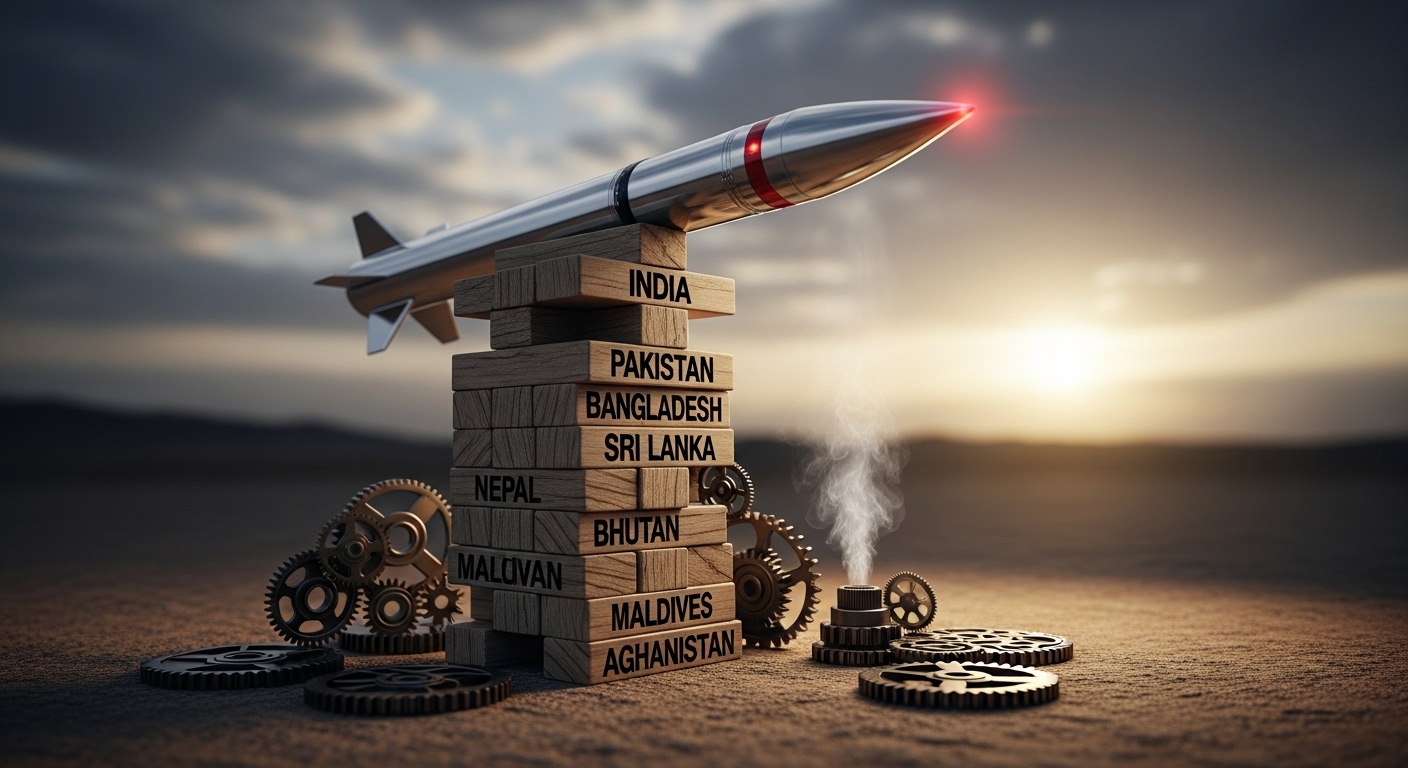
The balance of terror is not ideal. No nuclear environment is. But it is infinitely preferable to the imbalance of power that would exist without Pakistan’s credible deterrent. India’s attempt to reframe deterrence as “blackmail” is political theatre, not strategic insight. The fact remains: South Asia’s stability rests on nuclear parity, not Indian dominance. Pakistan does not seek nuclear advantage; it seeks nuclear balance. And balance is what prevents catastrophe. If India feels deterred, then Pakistan’s doctrine is doing exactly what every responsible nuclear doctrine is designed to do, keeping the peace.
Author