

Monaco’s Mean Streets Get Meaner: FIA Chops 2026 F1 Power to Curb High-Speed Mayhem
POLICY WIRE — MONTE CARLO, MONACO — Motorsport’s cutting edge, it turns out, sometimes needs a good old-fashioned blunting. While engineers worldwide hustle to squeeze every last electron of...

POLICY WIRE — MONTE CARLO, MONACO — Motorsport’s cutting edge, it turns out, sometimes needs a good old-fashioned blunting. While engineers worldwide hustle to squeeze every last electron of performance from future machines, the guardians of speed have declared ‘enough’—at least for one particularly infamous stretch of asphalt. We’re talking about the 2026 Formula 1 cars, whose advanced hybrid power units are so brutally effective, even the regulatory body governing them feels compelled to chop their legs out from under them. A blunt intervention, sure, but then again, that’s just how it’s done.
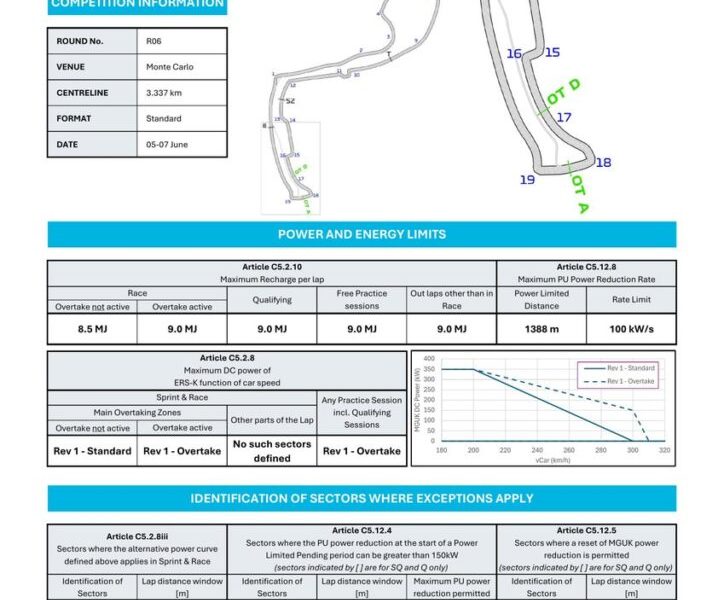
It’s not just about a few extra horses; it’s a full-on electric tidal wave. The cars slated for the 2026 season pack a serious wallop, specifically designed for regenerating energy. On most sprawling, modern circuits, teams grapple with battery drain, trying to conserve every kilowatt. But Monaco? It’s a different beast entirely. Its tight, winding 3.337-kilometre layout forces drivers to hit the brakes—hard, often—about 15 times every single lap. And that means roughly 19 seconds of heavy deceleration, an absolute buffet for kinetic energy recovery systems (KERS). The problem, as laid out in no uncertain terms by an official FIA document recently seen by Spanish outlet SoyMotor, is simple: these futuristic chariots recharge faster than they can spend, building up an absurd surplus of raw, unadulterated electric muscle.
To combat what essentially amounts to an energy weapon on wheels, the FIA is pulling the trigger on an extreme, circuit-specific nerf. Forget the notion of unrestricted innovation for a moment; safety, apparently, has its limits. The new rules cap the maximum battery recharge limit per lap at a startling nine megajoules for qualifying. If unleashed, that endless supply of electricity would hurl these cars down Monte Carlo’s cramped corridors at speeds that, frankly, give anyone pause—drivers, engineers, and yes, even insurance adjusters. They’d accelerate with a violence that’d make slamming into those notorious barriers less a risk and more a grim certainty.
And so, the hammer drops. To neutralise this potent threat, the FIA is mandating a bespoke ‘Rev 1’ engine map for Monaco. Under typical 2026 operating protocols, the electric motor’s full 350 kW output would power the car up to a blistering 290 km/h. But for Monaco? That electrical advantage gets aggressively kneecapped, tapering off drastically starting at a mere 200 km/h. By the time a car even sniffs 300 km/h, the battery assistance hits absolute zero. Just gone. But wait, there’s more. Coupled with a total ban on active aerodynamics for the race weekend, this regulatory crackdown utterly obliterates any straight-line engine supremacy.
“We’re talking about ensuring human lives aren’t collateral damage for technological bravado,” stated FIA President Mohammed Ben Sulayem, a keen observer of motorsport’s global footprint, from the high-tech tracks of Europe to the budding interest in his native Middle East and broader South Asia. “It’s our responsibility to keep these phenomenal machines within parameters that, while challenging, remain safe. This isn’t a ban on speed; it’s an assertion of control.” His comments resonate with the body’s increasing global governance role, setting precedents that ripple even into the policy discussions of emerging motorsport hubs like Pakistan. One can just imagine the headaches this kind of back-and-forth gives design teams, too. “It’s like spending a fortune designing a fighter jet, then being told you can only use half the engine thrust when flying through certain valleys,” quipped Beatrice Dubois, technical director for a prominent privateer team, speaking under condition of anonymity to avoid pre-season political entanglements. “But that’s racing, isn’t it? Another challenge to engineer around. We’ll still deliver a spectacle—just perhaps a slower one through certain bits.”
📄 POLICY WIRE WHITEPAPER PUBLISHED: PAKISTAN'S NATIONAL SECURITY POLICY PRIORITIES
👉 READ BY CLICKING HEREThis whole thing shifts the dynamic dramatically. Overtaking will now rely purely on raw mechanical grip — and chassis compliance. It won’t be about who can brute-force their way past on sheer electric surge. And that guarantees an all-out survival test, one where Saturday’s qualifying session might just dictate the entirety of Sunday’s results. Good luck, drivers. You’re going to need it.
What This Means
This aggressive FIA intervention, led by an administration keenly aware of global safety standards, carries far more weight than a simple speed limit for a single race. Politically, it reasserts the FIA’s absolute authority over technological creep, signalling to manufacturers that innovation will always be tempered by governance. It’s a delicate, ongoing negotiation, you see, between unbridled engineering ambition and the practical—and potentially tragic—realities of what happens when those ambitions hit concrete. Economically, such bespoke regulations add layers of complexity and cost for teams already managing multi-million-dollar budgets. Designing circuit-specific engine maps and hardware tweaks isn’t cheap; it diverts resources that could be used for broader performance gains, illustrating the hidden expenditures in top-tier motorsport. it subtly underlines the ongoing debate in many industries—from advanced aviation to AI development—about how much regulatory oversight is truly necessary to safeguard lives versus hindering progress. Even in high-octane racing, the balance between freedom — and control is, frankly, everything.