

Forging Stability: The Evolving Pakistan–Saudi Defence Partnership
Defence cooperation among states is shaped by converging security concerns, aligned strategic objectives, and long-standing institutional linkages. In regions where transnational militancy,...

Defence cooperation among states is shaped by converging security concerns, aligned strategic objectives, and long-standing institutional linkages. In regions where transnational militancy, geopolitical rivalry, and hybrid warfare intersect, robust military partnerships serve as essential tools for sustaining stability. The relationship between Pakistan and Saudi Arabia is a notable example of such cooperation. It is one of the most enduring security partnerships in the Muslim world and continues to evolve in response to shifting regional circumstances. Understanding this relationship requires situating recent developments within its broader historical foundations.
A New Phase: The Riyadh Meetings and the SMDA Framework
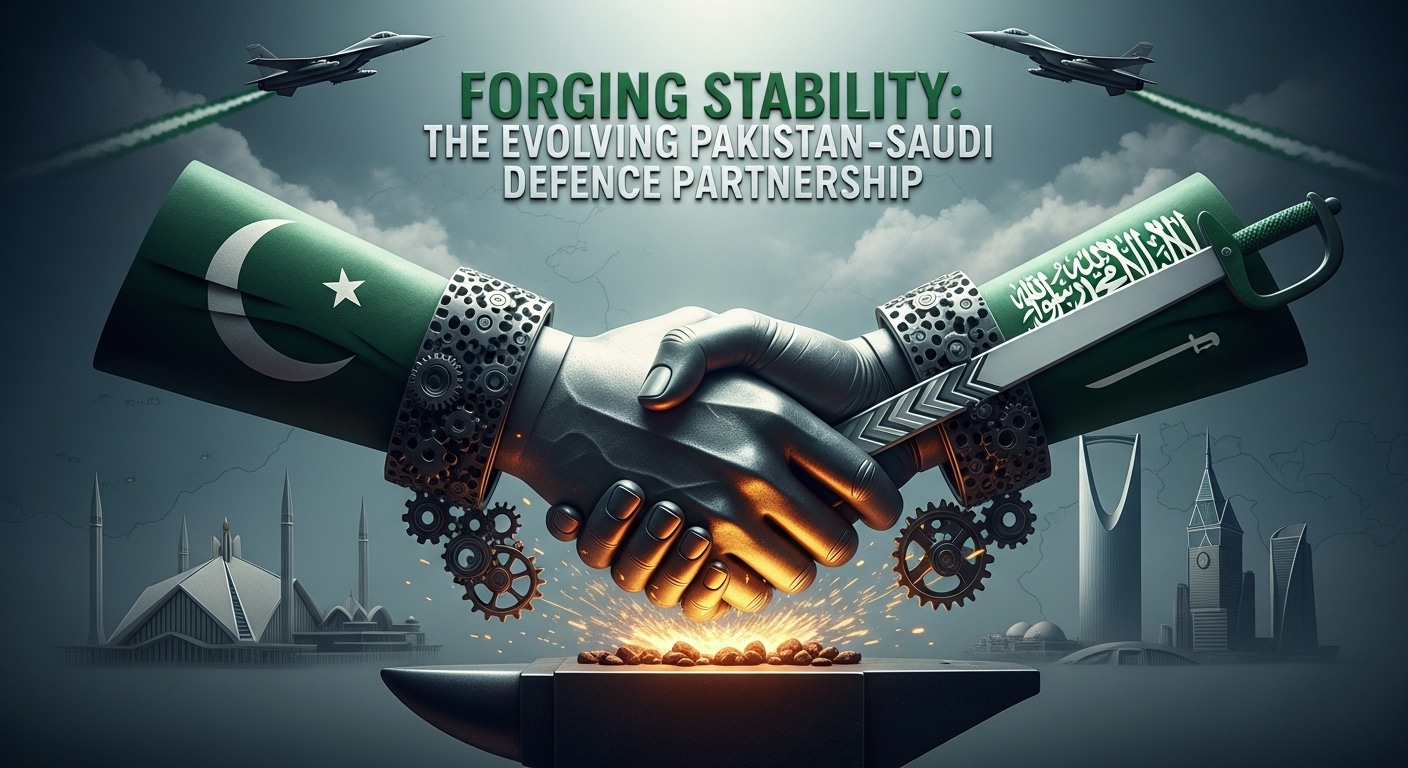
Within this wider analytical context, the recent high-level defence engagement in Riyadh holds particular significance. A Pakistani military delegation led by General Syed Amer Raza, Chief of the General Staff, met with General Fayyaz bin Hamid Al Ruwaili and Khalid Al Biyari, Assistant to the Saudi Minister of Defense for Executive Affairs. According to Pakistan, the discussions assessed progress under the Strategic Mutual Defence Agreement (SMDA) between Pakistan and Saudi Arabia. The meetings focused on expanding interoperability, deepening joint training programs, and enhancing coordinated defence planning through mechanisms established by the SMDA.
The SMDA has rapidly become the central framework for structuring the bilateral defence relationship. It formalizes consultations, joint assessments, and long-term planning, enabling both states to harmonize their security strategies.
Historical Foundations of a Trusted Partnership
The Pakistan–Saudi defence partnership is rooted in nearly six decades of cooperation. In the 1960s, Pakistan played a formative role in assisting Saudi Arabia as it built modern military institutions. Pakistani military officers trained Saudi soldiers and air personnel, and Saudi officers frequently attended Pakistani military academies such as the Pakistan Military Academy and the National Defence University.
During the 1970s and 1980s, Pakistan deployed several thousand troops to Saudi Arabia at Riyadh’s request, contributing to internal security and strengthening defence structures during a period marked by regional instability. After the Grand Mosque incident of 1979, Pakistan’s support aided Saudi Arabia in modernizing its counterterror and rapid-response capabilities. Over time, these contributions established deep institutional trust and a pattern of cooperation that continues to guide contemporary defence engagements.
Counterterrorism as a Core Pillar of Cooperation
Counterterrorism collaboration represents one of the most significant dimensions of Pakistan–Saudi defence engagement. Pakistan’s extensive experience in conducting counterinsurgency and counterterrorism operations has resulted in tested doctrines, integrated intelligence frameworks, and specialized training models. These provide valuable lessons for Saudi Arabia as it continues to refine its security apparatus.
Joint training programs, intelligence exchanges, and coordinated exercises allow Saudi forces to benefit from Pakistan’s operational experience. For Saudi Arabia, which is implementing ambitious reforms under Vision 2030, Pakistan’s counterterrorism expertise contributes to both immediate security needs and long-term institutional development. The SMDA helps align these efforts within a shared strategic framework.
Military Diplomacy and Institutionalized Strategic Cooperation
The Strategic Mutual Defence Agreement represents a shift from traditional advisory cooperation to a more structured and institutionalized partnership. Through the SMDA, both countries have established mechanisms for regular strategic dialogue, coordinated capability development, and joint operational planning.
For Pakistan, this evolution strengthens its profile as a capable and credible military diplomatic actor. It leverages Pakistan’s extensive training infrastructure, operational experience, and professional military culture. For Saudi Arabia, the SMDA ensures consistent access to Pakistan’s expertise, enhancing its defence preparedness across multiple domains including counterterrorism, rapid response, and integrated force development.
Pakistan as a Stabilizing Force in the Muslim World
Pakistan’s engagement in Saudi defence capacity building extends beyond bilateral considerations and contributes to broader regional stability. As one of the world’s largest and most professional standing armies, Pakistan plays an active role in peacekeeping missions, crisis response, and multilateral security cooperation. Its partnership with Saudi Arabia strengthens regional security frameworks across the Gulf and contributes to a more coherent defence posture across the Muslim world.
Both states share an interest in countering militancy and maintaining a stable regional order. The expansion of the SMDA supports this shared vision by aligning strategic priorities and fostering closer coordination in addressing emerging security threats.
Conclusion
Pakistan’s renewed emphasis on supporting Saudi defence capacity building reflects the continued evolution of a partnership anchored in historical experience and aligned with contemporary strategic imperatives. The recent meetings in Riyadh demonstrate the commitment of both states to strengthening a defence relationship that combines military diplomacy, counterterrorism cooperation, and a shared desire for regional stability. As the Strategic Mutual Defence Agreement continues to mature, Pakistan–Saudi defence collaboration is poised to reach new levels of institutional depth and strategic relevance, reinforcing one of the most important security partnerships in the Muslim world.
Author