


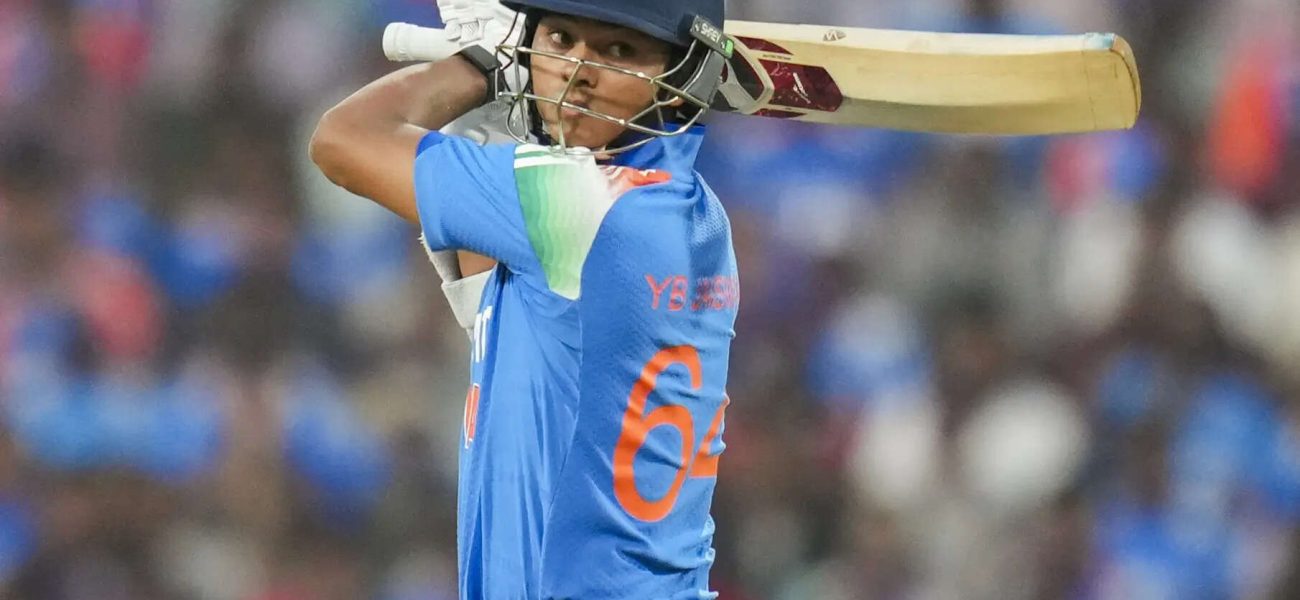
Prodigy in Limbo: Indian Cricket’s Selective Blindness to a Game-Changer
POLICY WIRE — Mumbai, India — In the cutthroat realm of international cricket, a single, match-winning century rarely guarantees a lasting berth. But for Yashasvi Jaiswal, India’s flamboyant young...

POLICY WIRE — Mumbai, India — In the cutthroat realm of international cricket, a single, match-winning century rarely guarantees a lasting berth. But for Yashasvi Jaiswal, India’s flamboyant young opener, even an undisputed impact knock—116 not out against South Africa in just his fourth One-Day International—has proven insufficient. What gives? We’re talking about a prodigious talent who, barely five months removed from that heroics, can’t even get a look-in for a routine series against Afghanistan or a preparatory stint with the ‘A’ squad in Sri Lanka. It’s a baffling disappearance from the white-ball radar that suggests less a strategic long-game, and more a systemic glitch in the selection matrix.
It’s not as if his form’s evaporated. Far from it. Jaiswal’s recent T20 International performances, before his inexplicable benching, redefined India’s aggressive opening ethos. Remember the days India would poke — and prod in the powerplay, waiting for the death overs to explode? Jaiswal flipped that script, hammering runs from ball one. His T20I strike rate of 164.31 isn’t just a number; it’s a statement of intent, a paradigm shift that put opponents on the back foot immediately. Yet, he hasn’t featured in a T20I for nearly two years. The guy transforms the team’s approach, then he’s banished. Makes you scratch your head, doesn’t it?
Chief selector Ajit Agarkar, when pressed on the conspicuous absence, offered a classic non-answer, a masterclass in obfuscation. “Look, Vaibhav has certainly put in the work, — and we appreciate that. But let’s not pretend Yashasvi hasn’t made his mark either. We’re very aware of his capabilities,” Agarkar reportedly mumbled to journalists, deflecting neatly to another promising young batsman. Such corporate speak doesn’t quell the growing unease. And it definitely doesn’t explain why a player lauded by experts, whose stock has only risen in Test cricket—racking up runs across diverse conditions, mind you—is treated like an afterthought in limited-overs formats.
Because, honestly, being overlooked for the senior team is one thing when you have established giants like Rohit Sharma and Shubman Gill at the top. Most players would get that. But then to be excluded from the India A squad heading to Sri Lanka under Tilak Varma’s captaincy? That’s where the narrative fractures. It feels less like player management, more like deliberate marginalization. You don’t get better by sitting at home. That’s a truism, not just for sport, but for any craft.
Former India chief selector MSK Prasad minced no words when reflecting on the decision. “This young man, Jaiswal, he’s a rare bird, an all-format talent who should be groomed meticulously. To leave him out of even the A squad is an oversight, perhaps even an unfortunate missed opportunity for him to stay sharp,” Prasad told Policy Wire in an exclusive chat, his voice laced with discernible frustration. “He’s a fighter, and these things happen, but we can’t afford to waste such a player simply because we have a surfeit of options at present. We need to be nurturing these kinds of prospects systematically, not letting them fade.”
And Prasad’s point isn’t isolated. It harks back to previous selections—or non-selections—where seemingly obvious talents languished on the sidelines, waiting for an inscrutable committee to open the door. Consider Shreyas Iyer, for example. There have been whispers within the Board of Control for Cricket in India (BCCI) of a push for more left-handers in the line-up, which on its face seems to benefit Jaiswal. But then Abhishek Sharma and Sanju Samson suddenly jump ahead in the queue, begging the question: is it genuine strategy or just another layer of selection politics?
📄 POLICY WIRE WHITEPAPER PUBLISHED: PAKISTAN'S NATIONAL SECURITY POLICY PRIORITIES
👉 READ BY CLICKING HEREIt’s not just India struggling with this kind of dynamic. Across the cricketing nations of the Subcontinent, from Pakistan to Bangladesh, the battle between individual brilliance and team hierarchy—or the often-opaque selection politics—is a recurring drama. For aspiring youngsters in Karachi or Dhaka, just like those in Mumbai, a player’s perceived ‘X-factor’ often gets buried under layers of seniority, past reputations, or inexplicable administrative decisions. It creates a deep cynicism, a sense that even pure talent might not be enough. The talent is there, raw — and undeniable, but the system doesn’t always reward it logically. It’s the twilight of old orders, often with fresh faces waiting impatiently.
What This Means
The curious case of Yashasvi Jaiswal isn’t just about one player; it’s a symptom of a larger, potentially damaging trend within Indian cricket. When a player who has proven his mettle—scoring consistently at Test level and transforming T20I dynamics—can be shunted aside with such apparent nonchalance, it sends a dangerous message. First, it tells emerging talent that exceptional performance isn’t necessarily the golden ticket; unseen factors, perhaps management whims or tactical fads, hold more sway. Second, it jeopardizes team depth. Indian cricket’s strength often lies in its abundant talent pool. But that pool needs careful stewardship, a clear pathway, not arbitrary road bumps. Neglecting a player like Jaiswal, especially when he’s just 24 and already an established Test opener, risks creating disillusionment and wasting a truly generational talent needed for the 2027 World Cup cycle. It suggests a focus on the immediate, not on building a cohesive, future-ready unit. Long term, such short-sightedness can hobble a national team’s adaptability and stifle the very innovation players like Jaiswal bring to the game. It isn’t good for player morale or competitive stability, not by a long shot.
The board’s insistence on left-handers is a decent rationale, yes, but when it becomes a rigid, exclusive mandate that overlooks explosive form, it’s just poor selection. You’ve got to wonder if it’s the right choice, or just the comfortable one.