
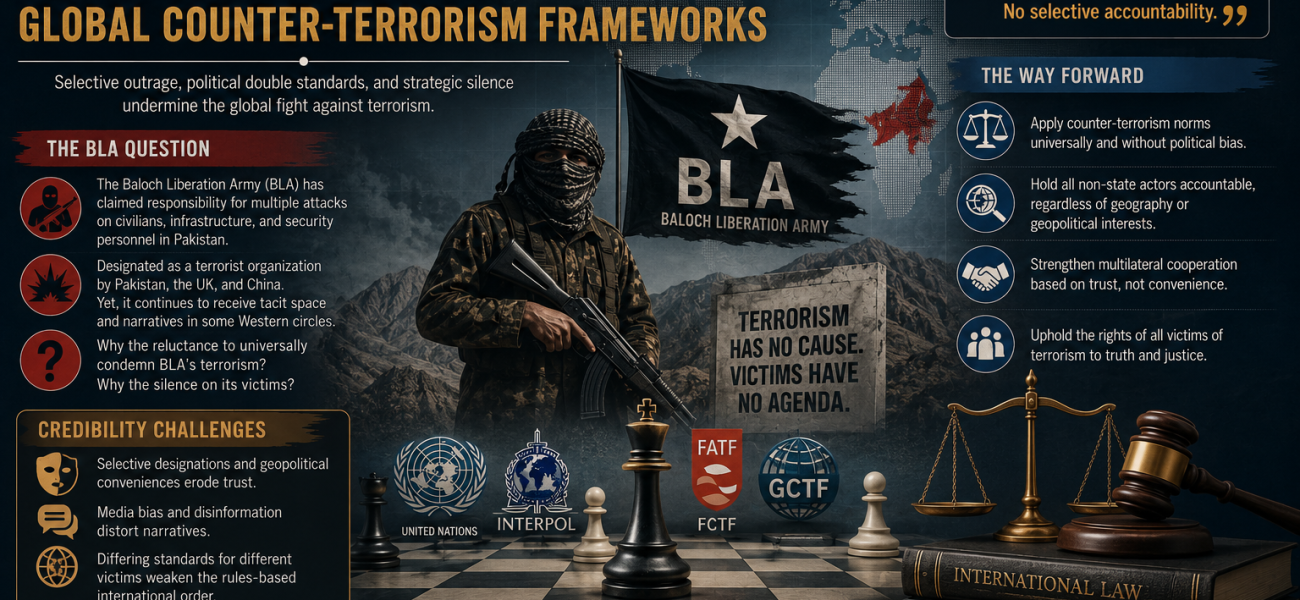
The recent move made by Pakistan-China to tag the Baloch Liberation Army (BLA) and, its Majeed Brigade, in the United Nations Security Council’s 1267 sanction list has sparked a lot of discussion. It was reported that the United States, the United Kingdom and France opposed the plan, leading some observers to suggest that it would be a diplomatic failure for Pakistan. However, this type of reading is a one-way street, as it is blind to the bigger question- why do violent groups, with a history of such killings continue to be treated unevenly by the international community.
In the broader context of international counter-terrorism, the question is even more pertinent. The new Global Terrorism Index reports that terrorism continues to be a consistent threat on the international security scene, with thousands of acts of terrorism taking place every year in dozens of countries. In 2024 alone, violent non-State actors killed over 7,500 people around the world, highlighting their ongoing threat to peace and security. Consistency is vital to effective counter-terrorism arrangements. If comparable strategies are interpreted differently across geographic areas, or depending on political, regional or national agendas – then the validity of such concepts is put to question.
Not only political agenda but also Pakistan’s apprehensions about Baloch militant activities hinge on hard facts of security. During the last 20 years, there have been multiple attacks on civilians, security forces, infrastructure, transport systems and foreign nationals by the insurgent groups of the Baloch people. Especially the BLA’s Majeed brigade has come to be linked with high profile actions involving suicide bombers. The group has also taken credit for the attack in 2018 at the Chinese Consulate in Karachi, the 2022 suicide bomb attack on Chinese teachers at the Confucius Institute of the University of Karachi and several attacks on projects connected to the China Pakistan Economic Corridor (CPEC).
Being a victim of such attacks is more than just having lost someone they loved. The estimated cost of China’s investments in CPEC projects is around USD 65 billion, which is one of the largest infrastructure development projects in developing countries. They include energy projects, port infrastructure, connecting the country with the job market and industrial development. Hackers targeting foreign engineers, workers and strategic infrastructure not only pose a threat to human life, but also have the ability to harm economic development, investor trust, and regional connectivity. It is not just a question of human casualties that has an economic impact, but also of projects postponed, security costs being raised, trade routes being disrupted and putting off foreign investment.
Human costs are the most important aspect of the discussions yet to come. There often can be a lot of rhetoric around sanctions and diplomatic means that can hide the realities of victims’ experiences. The fact that members of families are impacted by a suicide bombing, targeted killing and incidents on public infrastructure put them in a different mindset than just wanting to resolve procedural challenges in international bodies, they would more prioritize prevention. Ultimately, counter-terrorism policy is only legitimate if it does support civilians. Designation mechanisms debates, therefore, should be based not only on the political preferences of the key players, but also grounded in the nature of violent actions and the effects of such actions on human security.
This poses a more general question for the international system. Definitions, if left to destiny, will be prey to geopolitical interests when dealing with counter-terrorism. In general the emphasis of international law, UN resolutions and accepted counter-terrorism conventions is on conduct, rather than political intent. The will to make deliberate attacks on civilians, along with suicide bombings, hostage-taking and attacks against non-combatant targets, have historically been considered convenience signs of terrorism, irrespective of the excuse given for their use by perpetrators. Comparable tactics generate different international reactions, which brings accusations of double standards to the fore.
Historical incidents have also shown that the threat of crisis that is emerging internationally often comes long after it has been perceived on the ground. Many are today known as terrorist organizations that operated for many years before a general consensus was reached internationally to label them as terrorist. Collective action has been frequently postponed due to political disputes, conflicting strategic interests and regional calculations. All the hallmarks of violence are still the same. Instead, they are examples of the challenges in the need to reach consensus in a more polarized global reality.
📄 POLICY WIRE WHITEPAPER PUBLISHED: PAKISTAN'S NATIONAL SECURITY POLICY PRIORITIES
👉 READ BY CLICKING HEREThe current conflict should thus be seen in the broader framework of geopolitical divisions. The major powers of today often disagree on conflicts, Sanctions, regional alliances and their priorities when it comes to security. International decision-making is growing more strategic and is being impacted from Eastern Europe to the Middle East through the Indo-Pacific. Difficulty in agreeing on specific violent non-state actors may help spill the light on the current geopolitical division more than on the relevance of a specific security issue for an affected state.
A state does not therefore have to be judged by the votes of external forces with respect to its action against terrorism. Over the last two decades, Pakistan has put in huge effort in the presence of militant groups by using high level of military, intelligence and law enforcement resources in the fight against their activities. Official figures and independent analysis indicate that due to terrorist activities and counter-terrorism operations Pakistan has sustained tens of thousands of human casualties, and has seen an economic loss of well over $150 billion. These are key statistics reflecting a nation’s interest in combating violent extremism.
The BLA designation debate doesn’t only apply to one sanctions proposal. It points to a wider ominous problem the world faces today: can the international community hold together on a strategy to counter and deny transnational terrorism in a rapidly shifting geopolitical landscape of heightened rivalry? Without addressing this, there will be doubts about double standards and selective scrutiny – the trustworthiness of international counter-terrorism measures, when they are most needed, will be compromised.
Author