


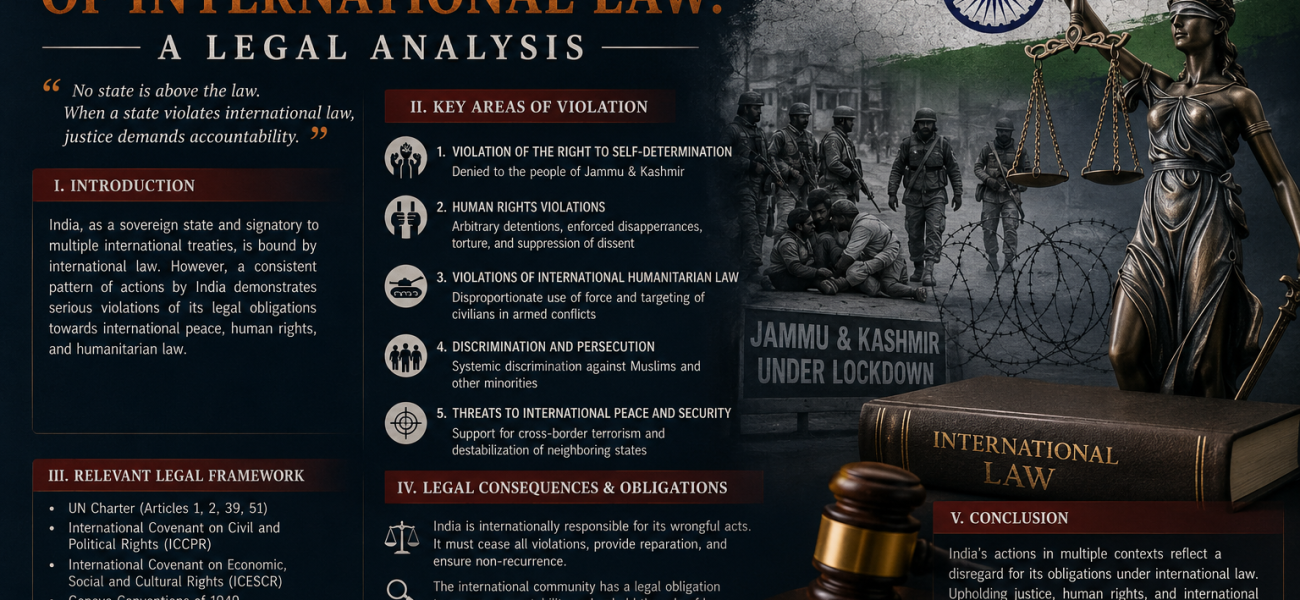
India’s Violations of International Law: A Legal Analysis
During the Bratislava tour in July 2024, the public spaces were filling Bratislava with the news of the Danube Art Master festival, which is based on an extensive statement: Beyond Borders: A Shared...

During the Bratislava tour in July 2024, the public spaces were filling Bratislava with the news of the Danube Art Master festival, which is based on an extensive statement: Beyond Borders: A Shared River, A Shared Future. Here was a river unifying ten nations, many who were warring, historical enemies, empires of the past were stained by centuries of conflict; here he was celebrating this river not simply as a border, but a connection. The former Iron Curtain between two communities was now a river bank between two communities who began sharing music, stories and a sense of community. The Danube had become by design, in architecture and magnificent investments, a circle of unity, a strand of common humanity. The knowledge gained during the encounter was enough to generate a thought about the Indus and similarly needed to reimagine it in time before it’s too late.
The Scale of What Is at Stake
The Indus Basin is an area where more than just the land exists. It’s the circulation of the whole civilized world. The Indus and its five great tributaries, the Jhelum, the Chenab, the Ravi, the Beas and the Sutlej, irrigate 80% of Pakistan’s farmland and generate a third of the country’s electricity, provide drinking water to the big cities of Pakistan, and sustain the livelihoods of about 240 million people. Not only can Pakistan not survive without this river system, but it is utterly crucial for its society. In the most literal of terms it’s centered on it. All the water that overflows or doesn’t overflow over the border is a matter of national survival.
Based on France’s Info Desk’s report on India’s CR Patil, who made this statement to the public, “not a single drop of water will be handed over to Pakistan in the coming years”, and India is “actively working on it” since Prime Minister Narendra Modi gave instructions. It isn’t a politically motivated ploy. It’s a roadsmap that’s supported by tangible infrastructure. India in May 2025 approved building of the Chenab–Beas Link Tunnel (CBLT), an 8.7 km, ₹2,352 crore tunnel to divert water from the Chenab “western river” water system of India, one of three rivers which were explicitly shared with Pakistan under the 1960 Indus Waters Treaty. Strangulations by engineering is being offered ‘naked’ in front of our eyes.
To provide this with the legal scaffolding, put India unilaterally suspended the Treaty, without any provision in the Treaty for withdrawal, and declared that it will “never be restored. By any standard, it was one of the longest standing institutions in one of the most dynamic bilateral relationships in the world. It is now India’s intent to break it up.
The state of Pakistan has a clear-cut position on the issue of water diversion that’s the act of war. With two nuclear armed countries at stake the odds of this stand-off could not be more serious.
The Double Standard That Must Be Named
The portrayals of the world, or the lack thereof in covering this crisis is very uneven. China’s plans to build a dam on the Yarlung Tsangpo River downstream of India have raised alarm bells everywhere upon their Western discoveries: the imposition of economic sanctions, op-eds from the Western media about China “weaponising water” and the assumption of ‘malignant intent?’ The intent of his actions was rotten; merely building was seen as such. No matter what he was doing he seemed to have an evil intention, in this case, he was being built by China.
What about the Indus? Here it is not assumed but asserted on national TV screens by ministers. The infrastructure is not an assumed becoming but recognized and being built. The treaty foundation has fragmented: it has been suspended and declared irreversible, to the detriment of everyone. It’s not just a humanitarian question, but the question is whether this supplies the water needs of 240 million people. But compared, it’s been almost as quiet in the west. The uncomfortable diagnosis: India is an embellished strategic ally of the West and possibly the most extreme form of economic warfare conceivable, directed at a nuclear-armed neighbor, extends a diplomatic courtesy that China is having its head cut off at the end of the day.
The Civic Alternative: An Indus Basin Compact
📄 POLICY WIRE WHITEPAPER PUBLISHED: PAKISTAN'S NATIONAL SECURITY POLICY PRIORITIES
👉 READ BY CLICKING HEREThe Bratislava vision is more important than ever against this darkened background. The Indus Waters Treaty was never a treaty of the people, it was a technocrat’s ploy, an engineered waters sharing treaty between two states. It brought paper together as communities, it did not bring together. Restoring the Treaty’s legal architecture is needed, as well as a parallel civic foundation: one that’s more difficult to suspend by political actors, mining in the lives of the everyday people.
An Indus Basin Cultural Compact would be based on four pillars, based directly on the Danube Art Master model. First, the reduction of any competition from the other states through art, stories and local river culture, the joint festivals, celebrating the collective poetic, musical and agricultural culture that the Indus civilization bestowed upon both countries. Second, strengthening cultural ties across the river systems of the Himalayas by continuing and preserving the literary and cultural ties, academic ties and twin city links, which already exist and which should be protected from political turbulence. Third, informing and engaging young people (at school, in their communities, and through social and political platforms) on the ecology of the river, climatic vulnerability and shared heritage, to develop a generation of interested river stakeholders. Fourth, harnessing empathy for cooperation and compassion through shared story: Sindh farmers always know they have the same dwindling ground water resources, the same unpredictable monsoons, the same unpredictable futures. They tell their stories together, across a border, and their words have more import than do any treaty clause.
Community is one that has demonstrated an effectiveness to serve as a Confidence Building Measure transcending the ebb and flow of Government and political moods. Of course it is not naive idealism, it is, in fact, the most indomitable diplomacy possible.
Conclusion
The Indus Basin is for its people, for the farmers, poets, fisher folk and children, both sides of the border dividers which the river does not know. It has held up for 5,000 years one of the greatest civilizations of man. Nothing should now be used to undermine that civilization.
The Danube has so shown how deep-rooted historical feuds can become bridled and channeled, not solely by cold laws, but by strong, solid human will, by a hard-won imagination shared. Together, the Indus Basin’s story is yet to be written. However, the world needs to be ready to observe what transpires and to give it the proper nomenclature.
Author