


New York’s Diamond Scrutiny: Beneath the Headlines, A Season’s Unwritten Script
POLICY WIRE — New York, United States — It’s a familiar drama, this incessant churn of expectation, performance, and ruthless pragmatism. The spotlight never dims on the game in New York, that...

POLICY WIRE — New York, United States — It’s a familiar drama, this incessant churn of expectation, performance, and ruthless pragmatism. The spotlight never dims on the game in New York, that crucible where heroes are forged one day and quietly sidelined the next. Beyond the roaring crowds — and the statistical marvels, a less glamorous, more existential contest unfolds. It’s a silent, daily reckoning over who gets to stay on the stage, who’s deemed valuable enough to earn another at-bat, and whose narrative is deemed compelling enough to warrant prime attention.
Take Aaron Judge. He’s marching, it seems, to another appointment with history. The grandest slugger of his generation, perhaps. In 2026, he’s reportedly on pace for 54 home runs, a statistic MLB.com’s Mike Petriello meticulously tracks. If he pulls it off, that’ll be his fifth 50-homer season, unprecedented. But even such a monumental, individual feat — a seemingly immutable force against the shifting sands — can’t insulate the wider team from its own intricate power dynamics, its managerial headaches, and its moments of profound uncertainty.
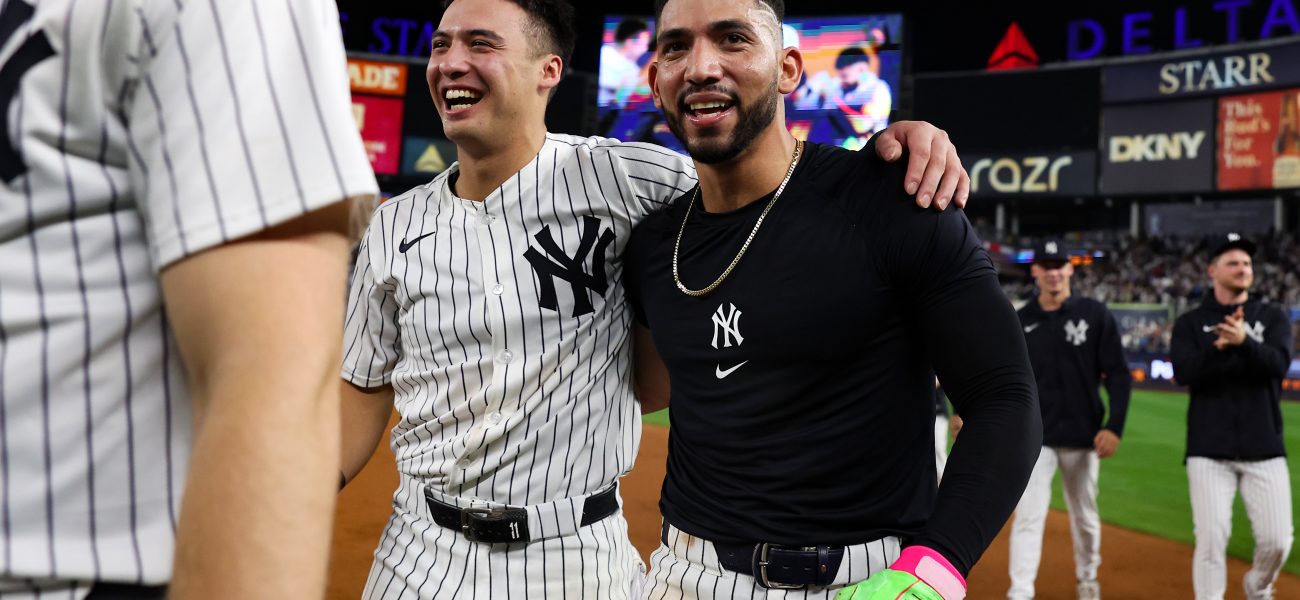
Consider José Caballero — and Anthony Volpe, two young infielders whose fates now hang in delicate, agonizing balance. Caballero, aiming for a Friday return from a finger injury, finds himself stepping back into a labyrinthine role. He played well while Volpe rehabilitated; now Volpe’s back, playing well in his stead. It’s a classic organizational squeeze, a testament to the brutal, zero-sum game of professional sports rosters. Because there aren’t enough seats on the bus. Yankee manager Aaron Boone, perpetually measured, offered only the faintest glimpse into his calculus. “He’ll be in there,” Boone conceded. “Look, we still got a couple days to go between that even being an option, so we’ll see.” The subtext? Everything’s fluid, every position an audition, every contribution weighed against an increasingly narrow margin.
It isn’t always about tactical genius, mind you. Sometimes, it’s about superstition, psychology, or just plain weirdness. And New York, like any global metropolis from London to Karachi, adores a compelling sidebar. That’s why we get the odd tale of Miami infielder Jazz Chisholm Jr. borrowing teammate Giancarlo Stanton’s pants to break out of a season-long slump. He had a 1.302 OPS in his first five games in the “roomy trousers,” as MLB.com’s Max Ralph noted. “I think it’s great,” Stanton quipped, “they’ve got homers in them.” It’s theater, plain and simple, a manufactured narrative to inject belief when the numbers don’t add up. Just like how public figures across the Muslim world often craft carefully managed images to inspire confidence, sometimes performance is everything.
The Yankees, of course, arrived to face the Blue Jays recently with their own carefully cultivated narrative: revenge. Toronto had, apparently, ‘had their number’ all last season. Yet, while the Yankees managed to grab the first two games in dramatic fashion, they weren’t exactly dominant. It was enough, however, for a media cycle obsessed with vindication. Simultaneously, outfielder Jasson Domínguez continues a slow, agonizing recovery from injury, another variable in the complex equation of roster management, another young man on the clock.
What This Means
This daily drama, playing out on baseball’s grandest stage, offers more than mere sporting distraction. It reflects the inherent volatility of any high-stakes ecosystem, be it a Fortune 500 company or a national government. The constant recalibration of value – who’s playing well enough today, who’s worth the investment tomorrow – parallels economic markets grappling with shifting data points. Player contracts become not just salaries but capital investments, evaluated for their return on expectation. For every promising rookie like Volpe, a seasoned pro like Caballero faces the harsh truth that past performance is no guarantee of future inclusion.
Managers like Boone become proxies for policymakers, balancing short-term gains against long-term strategic goals, often with imperfect information and under immense public scrutiny. The constant search for the edge – whether it’s a veteran returning from injury, a minor leaguer proving his worth, or even an infielder’s sartorial superstition – speaks to the relentless pressure for optimization. It’s a microcosm of global competition, where marginal advantages can dictate success or failure, and where narrative control (or pant-wearing antics) often sways perception as much as hard data. Ultimately, what transpires on the diamond, under the harsh New York glare, isn’t just a game. It’s a blunt lesson in managing resources, expectations, — and very public, very human ambitions in an unforgiving world.