


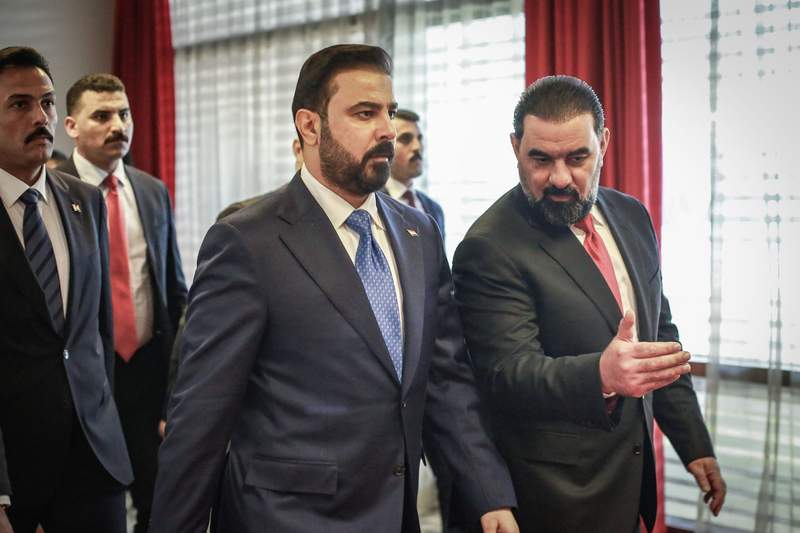
Baghdad’s Risky Play: A ‘Handover’ or Just Reshuffling the Deck?
POLICY WIRE — Baghdad, Iraq — In Iraq, the lines between government and armed factions ain’t just blurry, they’re often imaginary. So when word drops that an [QUOTE_PLACEHOLDER] has...

POLICY WIRE — Baghdad, Iraq — In Iraq, the lines between government and armed factions ain’t just blurry, they’re often imaginary. So when word drops that an [QUOTE_PLACEHOLDER] has supposedly handed over its arms to the national army, some folks celebrate. Others? They just check their watches.
It’s an old dance, this performance of state control. Militias, some of them born from the crucible of war, others simply thriving in chaos, routinely announce gestures of cooperation, sometimes even integration. But what’s actually being relinquished? And what leverage does the central authority truly gain? Don’t confuse ceremony for substance, not here, not ever.
This particular outfit, an [QUOTE_PLACEHOLDER], has certainly left its mark on Iraq’s fractured landscape. Its fighters, like so many others, grew powerful in the shadow of external threats — and internal weakness. For years, they operated with a degree of autonomy that made a mockery of official decrees. They built their own parallel structures, commanded loyalty, and, let’s be frank, held the keys to certain neighborhoods and strategic patches of desert.
The act of ‘handing over’ arms, then, becomes less about disarming a threat — and more about a strategic recalibration. Because it’s rarely all the weapons, is it? It’s the old stuff, maybe some less-than-effective hardware, the kind that makes for good photo opportunities. The real arsenals? The stuff that matters? It often just gets squirrelled away. Or maybe it shifts hands, changing allegiance without truly changing its fundamental purpose: asserting power beyond the official uniform.
You gotta wonder who’s really pulling the strings here. Baghdad has, for decades, walked a tightrope. One side, the demand for absolute state sovereignty; the other, the gritty reality of entrenched, well-armed, and often politically connected non-state actors. This isn’t just about men with guns. It’s about a complex web of loyalties, tribal connections, religious affiliations, and, naturally, some serious external influences. Many of these groups owe as much — if not more — to regional patrons than to the Iraqi prime minister’s office. Think Tehran, for instance. Iran’s long arm in Iraqi politics and security is no secret, providing logistical, financial, and ideological support to groups that align with its regional objectives.
And because, frankly, power is rarely surrendered willingly, this move feels less like genuine disarmament and more like a tactical repositioning. A nod to officialdom, perhaps, a momentary lowering of the public profile, or a calculated maneuver to access state resources while retaining de facto control. We’ve seen it play out time and again. It’s like asking a mob boss to turn in his baseball bat collection; he’ll probably keep the custom-made one under the bed.
But there’s a flicker of hope, even in this cynical observer’s eye. Any step, however small or symbolic, towards consolidating state authority is, on paper, a good thing. The challenge, — and it’s a hell of a challenge, lies in ensuring these steps are irreversible. Making sure they aren’t just cosmetic bandages over deeper, festering wounds of institutional weakness — and mistrust. An influential Iraqi militia handing over weapons is news. The sustained, undisputed authority of the national army over *all* territory? That would be a miracle.
For nations across the broader Muslim world, particularly in South Asia like Pakistan, the struggles of a central government grappling with non-state armed groups resonate deeply. Pakistan has its own long, painful history of wrestling with militant organizations and tribal forces operating beyond explicit state control. The very concept of sovereign authority is perpetually tested, sometimes frayed, often reforged. It’s a shared regional trauma, the lingering question of who truly wields power.
The numbers speak volumes about the scale of the challenge. Independent observers, like the Center for Strategic and International Studies (CSIS), estimated in a 2022 report that irregular armed groups still possess over 70% of the light and medium weaponry in circulation across various conflict zones in Iraq, despite numerous disarmament initiatives.
So, an [QUOTE_PLACEHOLDER] supposedly integrated, their arsenal now supposedly managed. The street cleaner’s broom sometimes just pushes the dirt into another corner, doesn’t it? And sometimes, for a moment, the floor looks tidy. But what really counts is whether that dirt stays put or comes sweeping back out again. That’s the messy part of governance no headline quite captures.
What This Means
This latest purported disarmament, even if partial, holds several critical implications, all dancing on the head of a pin. Politically, Prime Minister Sudani’s government gets a minor propaganda win. It lets him signal, domestically and internationally, that his administration is making progress on its mandate to assert state control. It’s an affirmation of his legitimacy, however fleeting. But, let’s be real, it doesn’t change the underlying power calculus overnight. The militia, likely a Shia-aligned force, probably isn’t genuinely folding up shop; it’s entering a new phase of operation. They might now secure state salaries for their fighters, giving them a formal role, yet they’ll retain their independent command structure and ideological leanings. This subtle institutional capture can be more insidious, harder to dislodge, than overt rebellion.
Economically, less visible friction from armed groups *could*—operative word: *could*—theoretically make certain areas more amenable to reconstruction or investment. But widespread economic stability demands consistent, unchallenged state authority, something Iraq is nowhere near achieving. Until security becomes predictable, beyond the ebb — and flow of militia politics, investors won’t exactly be lining up. The broader implication touches upon regional stability. Iran, a key supporter of many Iraqi militias, might be subtly orchestrating such ‘hand-overs’ as a way to maintain influence through semi-official channels, rather than overt proxy actions. It allows Tehran to claim compliance with international calls for stability, while retaining its grip through local allies who now operate with a veneer of state legitimacy. For an observer, it feels a lot like Moscow’s dismissals — a show of power masking a deeper game. It isn’t peace; it’s just a different kind of war, fought with memos — and handshake deals rather than mortar shells. For now.