


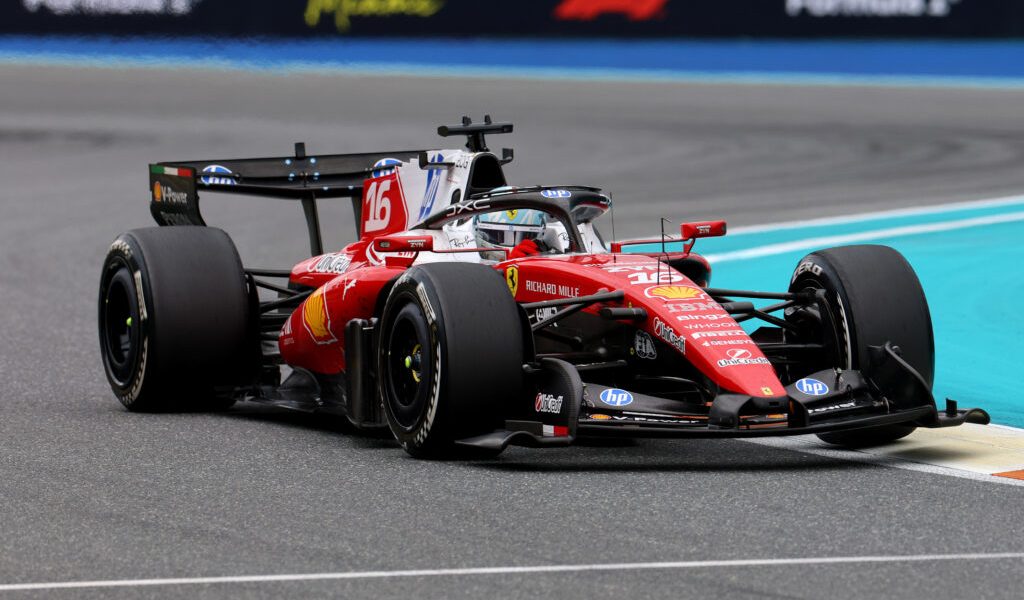
Formula Friction: Regulatory Tinkering Stalls Ferrari’s Grand Plans
POLICY WIRE — Geneva, Switzerland — Another season, another skirmish in Formula One’s endless battle of wills. This isn’t about blistering lap times or daring overtakes—not directly, anyway....

POLICY WIRE — Geneva, Switzerland — Another season, another skirmish in Formula One’s endless battle of wills. This isn’t about blistering lap times or daring overtakes—not directly, anyway. It’s about bureaucracy, the art of the perceived neutral intervention, and how a governing body’s slight nudge can send a multi-million-dollar racing strategy straight into the gravel trap. For Scuderia Ferrari, that nudge feels less like a course correction and more like a tactical blockade, courtesy of the FIA.
Because let’s face it, nothing ever stays truly static in F1. Not the technology, certainly not the rivalries, — and especially not the rulebook. The big shift for 2026 brought with it a whole new power unit philosophy, an almost Zen-like balance of electric and conventional energy. This transition — designed, we were told, for a brighter, greener future — has led to some truly peculiar machinery. And here’s where Ferrari made its bet: a compact turbo. Its genius? Lightning-fast starts, turning those precious first few seconds of a race into a red blur for rivals. It’s a risk-reward gamble they’ve always relished.
But then, the inevitable: the rest of the grid started making noise. Lots of noise. They found their initial energy deployment — the grunt getting off the line — was more of a wheeze than a roar. And just like that, the FIA stepped in. Cue the ‘blue light,’ a new pre-start ritual giving teams extra seconds to spool up their turbos. A boon for many, perhaps, but a body blow for the Maranello outfit.
“Imagine, without the blue light,” Ferrari Team Principal Fred Vasseur recounted, his voice laced with a weary incredulity, “some cars would still be on the grid in China.” He was speaking, of course, metaphorically — though one sometimes wonders, watching the current grid. Vasseur’s team, you see, engineered their 2026 car around that small turbo, effectively sacrificing some high-end race pace for that explosive start. But the rule change? It’s yanked the rug out from under them. “You can put on the table the safety grounds, and it’s the right of the FIA, and I have just to accept,” Vasseur acknowledged, pragmatically. “But at the end, I think it’s also a bit unfair to us.”
Unfair? Perhaps. But definitely politically astute, from the FIA’s perspective. “I went to the FIA one year ago, — and we spoke about this,” Vasseur reiterated, highlighting the foresight his team had. “And I really appreciated the answer from the FIA [that] you have to design the car for the regulations, not the regulations for your car. I think this is a very good approach.” He then cut to the chase: “So then to have half of the grid, 40% of the grid complaining, that it’s mega dangerous and so on. Politically [it] was well played but not very fair.” It seems the safety argument gained traction quickly when a significant chunk of the paddock started feeling disadvantaged.
Of course, this isn’t just about Ferrari. It’s about the very nature of competition, where a clever interpretation of the rules, or a strategic technical choice, can be legislated into irrelevance. “Honestly, it was getting a bit much,” muttered Andrea Stella, McLaren’s Team Principal, only half-joking after a recent sprint race. “They had a real jump on us, didn’t they? Now, everyone’s got a fighting chance. That’s what F1’s supposed to be about—a proper scrap.” That ‘scrap,’ naturally, looks different depending on which side of the regulation you’re standing. McLaren, by the way, has since closed the gap considerably, putting more pressure on Ferrari’s second-place standings.
Meanwhile, the FIA maintains its line. “Look, the paddock wasn’t a library, was it?” offered an FIA technical delegate, speaking on background, referencing the pre-existing grid chaos. “We’re not just moving goalposts for the sake of it; we’re ensuring every driver can safely, effectively get off the line without half the field staring at a blank wall.” They paint a picture of order restored, a field leveled, a safer starting procedure. Who are we to argue with safety? Even when the timing feels a tad coincidental. The politics of regulation, after all, are rarely as clear-cut as a black and white flag.
What This Means
This isn’t just a squabble over a turbocharger; it’s a window into the perpetual tension between innovation and governance that characterizes modern global sports and, frankly, most international industries. For Ferrari, the immediate impact is plain to see. Their unique advantage is gone, necessitating costly mid-season adaptations or, worse, a slide down the constructors’ standings. Financially, fewer points mean less prize money, less brand prestige, and potentially a knock to their sponsorship deals, which are already astronomically high.
Politically, the FIA asserts its authority, reminding teams who really calls the shots. This particular ruling illustrates a crucial aspect of regulatory bodies: their capacity to reshape competitive landscapes at will, often in response to lobbying (or ‘complaining’) from a critical mass of stakeholders. It also highlights the intricate, sometimes almost opaque, processes within F1’s Sporting Advisory Committee (SAC) and Power Unit Advisory Committee (PUAC)—arenas where decisions that impact billions in revenue are hammered out behind closed doors. Just as OPEC+ makes moves that ripple through global economies, so too do F1’s committees determine the competitive viability of iconic brands.
And yes, even from a perch here in Policy Wire, we notice how these decisions, ostensibly about fair play, resonate. Think about countries like Pakistan, where global sports like F1, despite not having local representation, command significant viewership. Perceived unfairness, or heavy-handed governance against a popular team, doesn’t just annoy enthusiasts; it can impact fan loyalty, drive away nascent interest, and even feed into broader narratives about whether powerful entities truly champion universal fairness, or simply serve their loudest constituents. A global sport, after all, requires global trust. Right now, Ferrari’s trust is clearly wavering.