

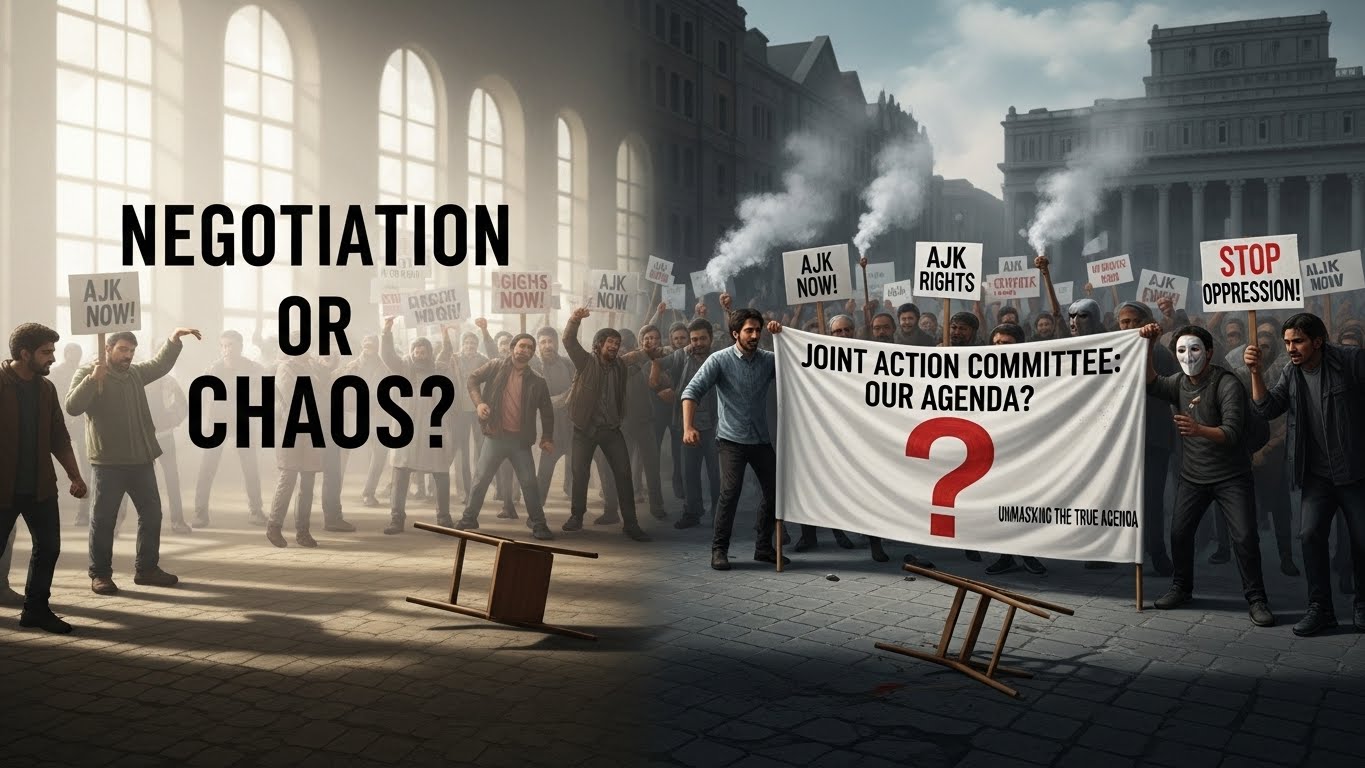
Negotiation or Chaos? Unmasking the True Agenda of the Joint Action Committee in Azad Jammu & Kashmir
In conflict resolution and governance matters, negotiation for peaceful dialogue has been at the forefront in dealing with social or political unrest. In these movements, if there is a transition...

In conflict resolution and governance matters, negotiation for peaceful dialogue has been at the forefront in dealing with social or political unrest. In these movements, if there is a transition from constructive engagement to disruptive activities, the efficiency of dialogue as a mechanism will be considerably affected. One can see that the operations of Joint Action Committee (JAC) otherwise known as the Jammu and Kashmir Joint Awami Action Committee (JAAC) have not been more dialogue-oriented, but rather aimed at creating turmoil and mayhem, as it is evident in the recent happenings in Azad Jammu and Kashmir (AJK). It is clear that though Government of Pakistan has tried to respond to the demands made by the Joint Action Committee, the strategy taken by the committee was still harmful to the dialogue process. A critical evaluation of the circumstances reveals that the operations that have been pursued by the Joint Action Committee have continued to be counterproductive towards the stability in the region.
Government Action and Negotiations
In most cases, Initially, both the federal government and the AJK government interacted with the JAAC in good faith. But after the protests broke out in late September 2025, paralysing the normal course of everyday living in AJK’s major cities, including Muzaffarabad, Mirpur, and the Neelum Valley, Islamabad’s efforts were extensive in attempting a peaceful resolution instead of using force. A high-level government delegation, encompassed in the direct supervision of Prime Minister Shehbaz Sharif, was dispatched to Muzaffarabad in an attempt to find a long-term solution.
Government representatives, including Federal Ministers Amir Muqam and Tariq Fazal Chaudhry, also reiterated that “most demands made by the committee have already been accepted or measures have been taken, and that it’s a responsibility to resolve it peacefully.”
The official stats from the press briefings indicate:
Over 172 FIRs lodged against protest cases have been withdrawn, except for a few serious cases involving deaths. All persons detained regarding peaceful protest activities were released, Radio Pakistan reported. Besides, all employees who had been suspended during the protests were reinstated to their jobs so that their livelihoods were not permanently affected due to unrest. This shows that despite the Pathankot-like situation, the government tried to manage the crisis, keeping its focus on justice and fairness. These steps just show the functioning towards addressing the valid concerns of the protesters amid maintaining public order. There were agreements on several issues of governance and development that had previously been raised by the committee, including policies in the education sector.
That the government was open to dialogue was obvious, with Prime Minister Shehbaz Sharif himself ordering an expansion of the negotiation committee and going ahead with the dialogue process right away, while also appealing for peacefulness and cooperation.
The Boycott of the Meeting on January 5
In spite of these concerted efforts and considerable strides made on most fronts, the JAAC decided to boycott the scheduled meeting for compliance on January 5, without any warning or explanation, despite the establishment of an implementation committee by the governments of Pakistan and AJK to oversee the agreement.
Boycotting a meeting in which both parties were supposed to make an evaluation of progress, especially after the scale of compliance, is not representative of a partner who is serious about reaching an end of differences. Rather, it is more of a tactic of one who thrives in making disruptions.
Beyond Negotiation: The Committee’s Shifting Agenda
In fact, initially, many of the requirements laid down by the JAC were related to socioeconomic factors such as subsidies, electricity charges, and the provision of public services, which were true given the region’s developmental concerns.
However, the tone of the committee escalated further. Certain leaders have started demanding that the 12 slots reserved in the AJK assembly that represent the refugees be abolished, because it’s a matter of the constitution. This shows that once the demands turned towards these areas, there was no longer any concern for administrative matters.
This was worsened by the comments from the members perceived to be divisive and not in line with the concept of national unity. These comments have since been toned down by the government representatives who reiterated the position of the refugees and migrants in the national constitution. This was evident during the media interactions.
The Cost of Escalation: Public Order and Regional Influence
The impasse caused by the committee not cooperating actively has had serious repercussions. The call for protests and interruptions made by the JAAC has resulted in paralysis everywhere in AJK, with markets being closed and the roads blocked.
Further, the fact, as reported in independent media, that there had been instances where there had been violence leading to deaths and injuries on all sides of the conflict, as a result of a failure to dialogue, and thereby entering into unmanaged confrontation, does not bear mentioning.
A Government Dedicated to Dialogue, a Committee Split on Negotiation
When considered in aggregate, a clear pattern emerges from all of this evidence: that is, the Government of Pakistan and the Government of Azad Jammu & Kashmir have demonstrated a clear willingness to negotiate and comply with requests. They have negotiated for a long time and accepted all requests except a few.
Quite to the contrary, the abrupt boycotting of compliance meetings, increases in demands to constitutional and politically sensitive spheres, and rallies by the Joint Action Committee have served to indicate a shift in the direction of a negotiation process to a political confrontation. It is not advocacy or protest, it is a bid to make things volatile and upset processes which were already well into the swing.
To restore peace and development in the region, stakeholders should be taken back to the negotiation and peaceful solutions rather than being agitated. The government has already set the clear route on how this interaction is going to be made, now it is high time when the civil society players have to prefer cooperation to anarchy.
Author