


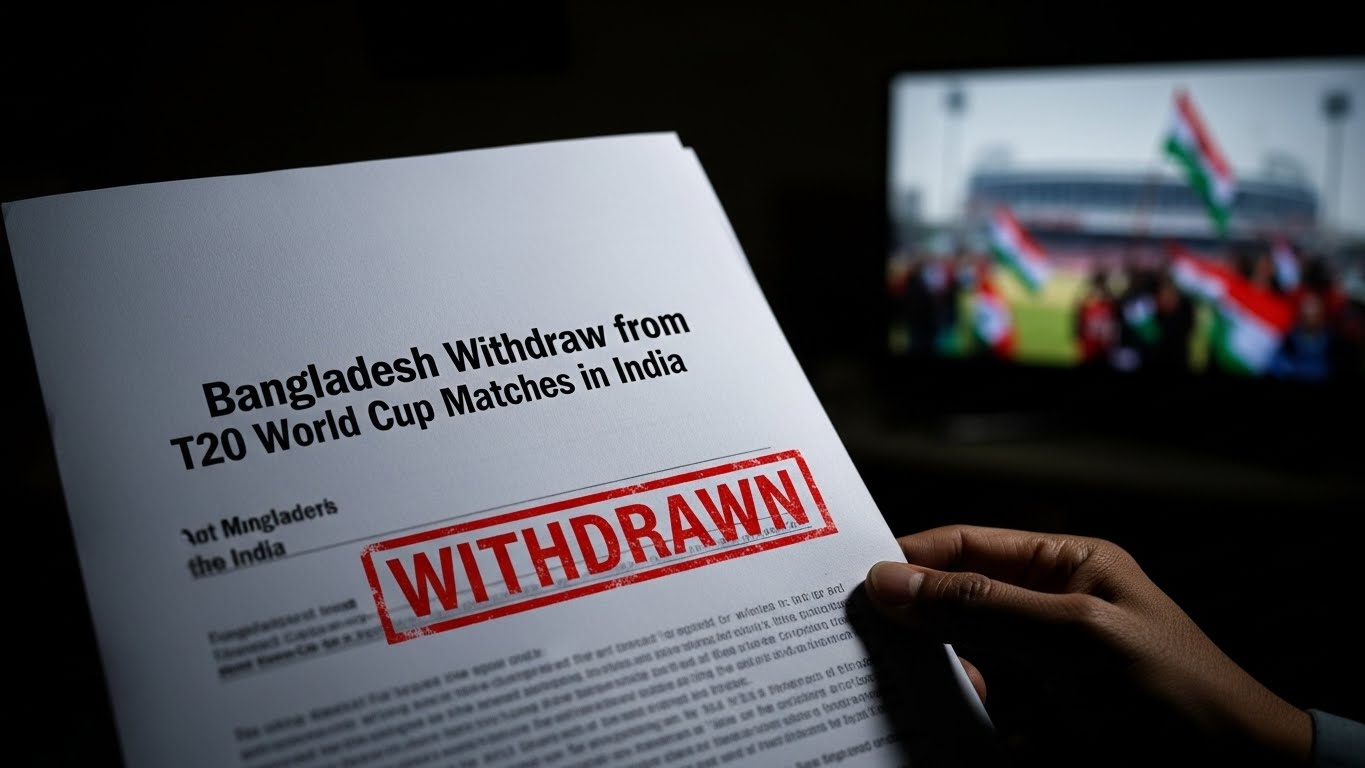
Bangladesh Withdraws from T20 World Cup Matches in India Amid Rising Political Tensions
Sport is often celebrated as a space where politics recede and competition unites. In South Asia, cricket has long carried that ideal more than any other game, bridging borders, languages, and...

Sport is often celebrated as a space where politics recede and competition unites. In South Asia, cricket has long carried that ideal more than any other game, bridging borders, languages, and histories shaped by conflict. Yet in recent years, the promise of cricket as a neutral and unifying force has steadily eroded. Stadiums have begun to echo the same ideological battles found in parliaments and streets, and cricketing institutions increasingly reflect regional power politics rather than sporting impartiality.
This growing politicization of sport has now manifested in a stark decision by Bangladesh, the withdrawal from playing its Twenty20 World Cup matches in India. The Bangladesh Cricket Board (BCB) announced that it has formally requested the International Cricket Council (ICC) to relocate all of Bangladesh’s matches to venues outside India, citing serious concerns over the safety of its players amid escalating political tensions between the two neighboring countries.
Bangladesh was scheduled to play three matches in Kolkata during the T20 World Cup, which runs from 7 February to 8 March and is being co-hosted by India and Sri Lanka. According to the BCB, the decision was taken after a careful assessment of the prevailing environment and the increasingly hostile political climate surrounding Indo-Bangladesh relations.
These concerns are rooted in recent developments that have strained bilateral ties. Last month, violent unrest in Bangladesh’s Mymensingh district resulted in the killing of Hindu factory worker Dipu Chandra Das, who was beaten and set on fire by a mob accusing him of making derogatory remarks about the Prophet Muhammad. The incident triggered outrage in India, with hundreds protesting outside Bangladesh’s high commission in New Delhi. Diplomatic tensions were further aggravated after Bangladesh’s former prime minister Sheikh Hasina fled to India following mass protests at home.
Within this charged atmosphere, the presence of Bangladeshi cricketers in India, particularly in politically sensitive venues such as Kolkata, has become fraught with risk. Cricket matches, far from being isolated sporting events, are now embedded in a broader landscape of nationalist mobilization, religious polarization, and media sensationalism. The BCB’s move, therefore, reflects not merely a logistical concern but a sober recognition of how quickly sporting spaces can become politicized flashpoints.
The decision also follows the recent expulsion of Bangladeshi fast bowler Mustafizur Rahman from the IPL 2026, an episode that further inflamed tensions. While Indian cricket authorities have framed the matter in contractual or regulatory terms, the incident has been widely perceived in Bangladesh as politically motivated. For many in Dhaka, Mustafizur’s treatment symbolised a broader pattern of exclusion and pressure within Indian-dominated cricket structures. Bangladesh’s firm reaction, culminating in its request to relocate World Cup matches, signals a refusal to separate sporting decisions from their political consequences.
This controversy has reignited longstanding criticism of the Board of Control for Cricket in India (BCCI), which many observers argue has increasingly allowed nationalism and state politics to seep into sports administration. In the past, similar incidents have been seen regarding India’s treatment of Pakistan, including pressure over venues, visa regimes, scheduling decisions, and the informal sidelining of Pakistani players and teams. Other cricketing nations, particularly smaller boards, have also complained, albeit more quietly, about coercive practices enabled by India’s overwhelming commercial influence in global cricket.
At the core of this imbalance is the BCCI’s outsized power within the ICC, coupled with the governing body’s consistent failure to act as a neutral regulator. India’s dominance of broadcasting revenues and sponsorship markets has translated into institutional leverage, allowing the BCCI to shape tournament logistics and policy outcomes with minimal resistance. The ICC, dependent on Indian revenue streams, has appeared either unwilling or unable to enforce meaningful checks on this power.
Concerns about politicization have intensified due to the overlapping roles held by key individuals within cricket governance. Jay Shah, who served as BCCI secretary from 2019 to 2024 and continues as chairman of the ICC, has become a focal point of criticism. Shah is also the son of India’s home minister Amit Shah, a senior leader of the ruling Bharatiya Janata Party (BJP) and a prominent figure closely associated with the Hindu nationalist ideology of the Rashtriya Swayamsevak Sangh (RSS).
While familial ties do not inherently imply misconduct, critics argue that this convergence of political authority and sports administration has entrenched ideological bias within cricketing institutions. During Jay Shah’s tenure, the Asian Cricket Council (ACC), over which he also presided, faced repeated accusations of partisanship, particularly in matters involving Pakistan and other politically sensitive member states. Decisions that should have been governed by sporting neutrality increasingly appeared aligned with India’s broader domestic and regional political narratives.
For Bangladesh, the implications are both immediate and profound. Cricket is the country’s most powerful tool of international visibility and national pride, and its players are among its most recognizable global ambassadors. Ensuring their safety is not only a sporting responsibility but a national obligation. By seeking the relocation of its World Cup fixtures, Bangladesh is challenging the assumption that cricket can remain apolitical when the institutions governing it are visibly entangled in ideology and power politics.
The ICC now faces a defining test. Ignoring Bangladesh’s concerns would reinforce the perception that international cricket governance is beholden to the interests of its most powerful member. Addressing them seriously, however, would signal a commitment to player safety, institutional credibility, and the principle that no board, regardless of financial clout, stands above the game.
Bangladesh’s withdrawal is not an act of defiance against cricket itself. It is a warning. In South Asia, cricket has become a mirror of regional politics, reflecting rising intolerance, asymmetrical power, and the normalization of hate-driven narratives. Unless governing bodies confront this reality and reclaim the game’s neutrality, cricket risks losing its moral authority, transforming from a shared passion into yet another arena of division and distrust.
Author