


The Collapsed Lead: Cleveland’s Sports Meltdown Becomes a Leadership Parable
POLICY WIRE — Cleveland, USA — When a commanding 22-point lead vanishes faster than a promise from a rookie politician, the autopsy always starts at the top. For the Cleveland Cavaliers, and...

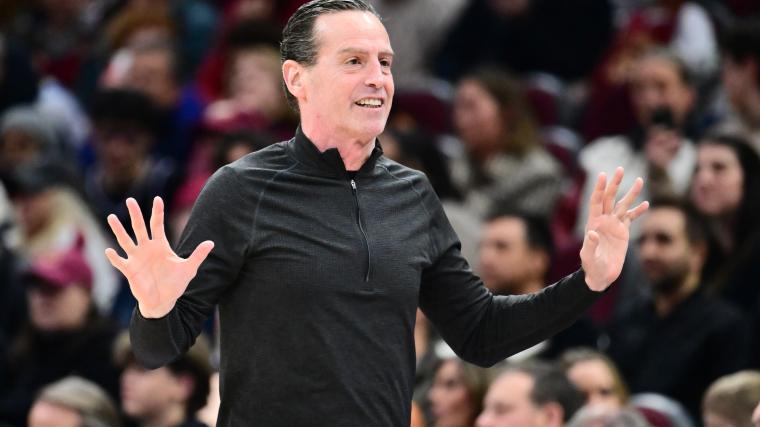
POLICY WIRE — Cleveland, USA — When a commanding 22-point lead vanishes faster than a promise from a rookie politician, the autopsy always starts at the top. For the Cleveland Cavaliers, and specifically head coach Kenny Atkinson, the sudden, shocking implosion during Game 1 of the Eastern Conference Finals wasn’t just a loss; it was a public unraveling, a masterclass in how to turn impending victory into an existential crisis. Fans aren’t just hurt; they’re feeling betrayed.
It was Tuesday night at Madison Square Garden. Cleveland had the Knicks exactly where they wanted them, cruising with a hefty lead and less than eight minutes left on the clock. But the script, apparently, wasn’t shared with New York. They uncorked a stunning 44-11 run, including overtime, pilfering a 115-104 victory. And guess what? Atkinson kept his timeouts tucked away, like prized collector’s items, even as the walls were literally crumbling around his squad. It’s almost perverse, isn’t it?
Enter Ken Carman of Cleveland’s 92.3 The Fan, who didn’t mince words. “How do you not call a timeout?” he bellowed into the airwaves, his voice a potent distillation of a city’s exasperation. “Any person who’s ever seen basketball — ever seen a basketball, I mean—knows you stop the bleed!” Carman’s ire echoed across local media, but his points about the inexplicable strategic inertia cut deepest. But Atkinson? He had his reasons, supposedly. “I prioritize saving timeouts for the game’s final, most critical possessions, those one- or two-point skirmishes where a clear strategy requires a reset,” Atkinson explained to reporters, maintaining a veneer of stoicism that, frankly, didn’t fool anyone.
This isn’t just about a basketball game; it’s about decision-making under duress. It’s about trust. The optics, let’s be honest, aren’t good. They signal a coach whose adherence to a theoretical future outmaneuvered the glaring present, and that sort of disconnect can ripple far beyond the court. A league veteran, speaking off the record, offered a nuanced view, stating, “In these moments, a coach’s job isn’t just X’s and O’s; it’s about managing momentum, managing player psychology. Sometimes you’ve gotta use that time to let them breathe, recalibrate.” Because sometimes, strategy needs an immediate injection of reality, not a long-term savings plan. And when your opponents sweep in — and deliver a psychological knockout like that, the blow reverberates.
Consider the broader context, particularly in regions where public faith in leadership, whether in sports or governance, is frequently tested. In countries like Pakistan, for instance, where passion for cricket rivals religion, an equivalent sporting collapse can provoke days of intense national debate, almost bordering on existential angst. When a favorite team squanders an unassailable position due to what’s perceived as poor leadership, it reflects broader anxieties about competence and accountability. Fans in Lahore or Karachi react with the same visceral outrage as those in Cleveland when leaders, be they on the pitch or in the parliament, fail to act decisively when circumstances demand it. It’s not just a game; it’s a proxy for collective hopes — and fears.
Statistically, the implosion was historic. The Knicks’ 44-11 run to close the game, after trailing by such a margin, is what ESPN Stats & Information confirms was one of the most statistically improbable comebacks in recent playoff history. Brunson’s personal 15-point explosion in those crucial minutes twisted the knife. Harden looked gassed; Carman rightly questioned why something wasn’t done. Atkinson’s adherence to his ‘savings plan’ left players, — and by extension the entire franchise, vulnerable. He simply didn’t intervene, even as disaster unfolded in plain sight. It was a failure of proactive leadership, pure — and simple.
What This Means
This seemingly localized sports drama in Cleveland offers a potent parable for political and economic leadership on a global stage. Atkinson’s reluctance to spend his strategic currency (timeouts) — despite clear and present danger — mirrors the fiscal conservatism or political inaction often criticized in governmental and corporate sectors. A leader, whether on the bench or in an executive suite, who clings to abstract principles over agile responsiveness in a crisis quickly loses legitimacy. The fan base’s outrage isn’t merely about basketball; it’s a demand for accountability, for proactive problem-solving when the stakes are highest.
Economically, such a public leadership failure can dent a franchise’s intangible value — fan engagement, team morale, and even future endorsements. Think about the market confidence that erodes when a financial institution’s leadership ignores warning signs, or a political party refuses to adjust course despite public outcry. The Cavaliers’ struggle to rebound from a deeply entrenched culture of questionable decisions highlights the long shadow cast by poor choices in high-pressure environments. The trust gap between leader — and follower, once opened, is extraordinarily difficult to bridge. And in a globalized sports market, where brand loyalty drives billions, this sort of spectacle makes an impact. Perhaps the Cavs need to take a page out of Nigeria’s ‘whiz kids’ playbook, where quick, decisive strategic pivots are embraced.