


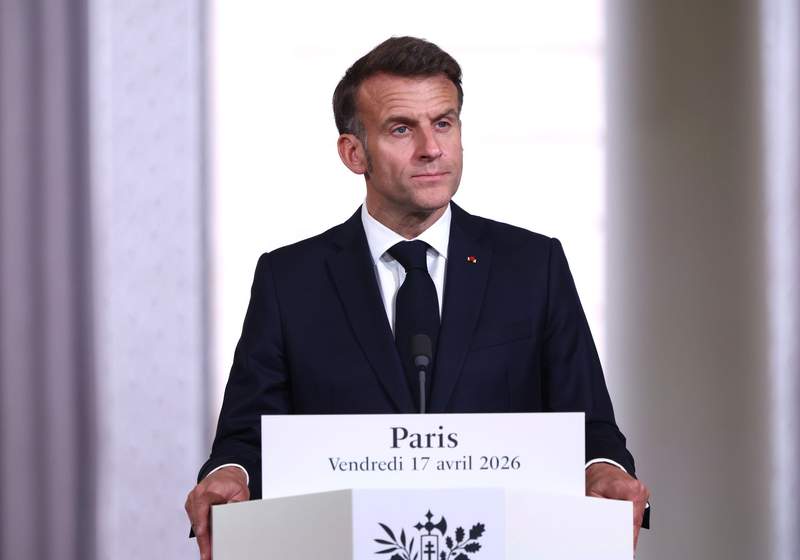
Macron Defies Doubts: European Future Fighter Project Remains Airborne
POLICY WIRE — Paris, France — Europe’s ardent ambition to forge its own formidable defense muscle has long been a rather protracted saga, riddled with more near misses than outright triumphs –...

POLICY WIRE — Paris, France — Europe’s ardent ambition to forge its own formidable defense muscle has long been a rather protracted saga, riddled with more near misses than outright triumphs – a kind of defense-industrial Groundhog Day, if you will. From the failed Eurofighter export deals to a patchwork of national procurement strategies, true continental autonomy in defense has often felt like a mirage. And yet, into this familiar narrative, French President Emmanuel Macron plunged this week, emphatically dismissing whispers that the continent’s most ambitious defense undertaking to date, the Future Combat Air System (FCAS), stands on the brink of collapse. Talk about a cliffhanger.
For weeks, industrial squabbles and technological disagreements between key partners France, Germany, and Spain have ignited a firestorm of conjecture. Some defense analysts, bless their pessimistic hearts, suggested the project was simply too unwieldy, too politically charged, to ever truly take flight. But will it actually fly? But Macron, ever the champion of European sovereignty (and, let’s be honest, French industrial clout), isn’t about to let this crucial endeavor falter on his watch.
He’s asserted unequivocally; the program – a multi-decade effort, let’s remember, envisioned to deliver a new generation of stealth fighters, drones, and networked combat systems by 2040 – remains a veritable bedrock of European strategic independence. “We absolutely need this project for our strategic autonomy, for our industry, and for our Europe,” Macron told reporters, a subtle but firm rebuke to those forecasting its demise. “It’s a huge industrial challenge, but it’s one we’re entirely capable of meeting if we maintain unity.”
Make no mistake, the stakes couldn’t be higher. Basically, this thing is a huge deal. Russia’s ongoing war in Ukraine has vividly laid bare the imperative for Europe to diminish its reliance on external defense providers, particularly from the United States. the global power shifts toward the Indo-Pacific mean Washington’s focus will unavoidably wander, leaving Europe to increasingly fend for itself. Doesn’t sound great, does it?
Behind the headlines, the real friction points often pivot squarely on workshare — and intellectual property. France’s Dassault Aviation and Germany’s Airbus Defence and Space are the primary industrial behemoths, each fiercely guarding its expertise and seeking a dominant role. Spain, though a junior partner (and quite understandably demanding its due), also demands a fair slice of the development pie. Not just jobs. It’s about cementing critical technological capabilities for future generations — a foundational necessity, truly, if Europe ever hopes to dictate its own destiny rather than merely react to global currents.
Slowly. But progress. “The conversations are complex, naturally, given the scale of innovation and investment involved,” stated Christine Lambrecht, Germany’s Minister of Defense, in a recent interview. “But our commitment to a shared European future, one where we can defend our values and interests with sovereign capabilities, hasn’t wavered. We owe it to our citizens to see this through.” And her words underscore a palpable consensus that, despite the political and industrial headwinds, the project’s strategic necessity arguably outweighs its immediate quagmire.
And that matters far beyond European borders. A potent, autonomous European defense industrial base could recalibrate global defense markets. Nations in the Middle East and South Asia, traditionally reliant on American, Russian, or Chinese military hardware, could well covet European alternatives with increased interest. Consider Pakistan, for instance, which consistently seeks to diversify its strategic partnerships and defense procurement, perpetually trying to balance on a razor’s edge in a volatile region. So, a truly advanced, non-aligned European fighter could offer an attractive proposition, lessening its reliance on traditional suppliers and potentially altering regional power dynamics. Quite the domino effect, eh?
Cost is another colossal hurdle. Initial estimates for the program’s development and procurement phase routinely exceed €100 billion, making it, frankly, one of the most eye-watering defense projects in European history — and finding consensus on funding, especially during these tight economic times, strains the very sinews of European solidarity, pushing it to its absolute breaking point. Delays have already pushed back key milestones, with the first flight of a demonstrator aircraft now not expected until the late 2020s. Don’t hold your breath.
What This Means
The continued endurance of FCAS isn’t merely an industrial question; it’s a profound political and diplomatic litmus test for Europe. Its success would herald a new epoch of genuine strategic autonomy, allowing Europe to flex its geopolitical muscles and protect its interests without constant reliance on allies. A new epoch. Conversely, its failure would be a devastating blow to the idea of a united, sovereign European defense. Economically, thousands of high-tech jobs across three nations hang in the balance, as do billions in potential export revenue. Diplomatically, a successful FCAS would bolster Europe’s standing on the world stage, enabling it to act as a more independent security actor, capable of contributing to global stability – or projecting force – on its own terms.
But a failed FCAS, however, would force European nations back to a fragmented procurement model, likely increasing their dependence on American F-35s or developing national solutions that lack the scale and interoperability a joint project promises. It would also send a disquieting omen to potential partners like India or the Gulf states, who observe Europe’s commitment to its own defense capabilities with keen interest.
“The survival of FCAS isn’t about the technical specifications of a jet; it’s about political will and Europe’s fundamental belief in its own future,” opined Dr. Aris Sarris, a Senior Fellow at the European Council on Foreign Relations. “Ultimately, the project’s trajectory will be a direct reflection of whether European leaders are prepared to overcome national interests for the sake of collective strategic imperative. Or, you know, just give up.”
Related: EU Seeks to Toughen Russia Sanctions After Hungarian Obstacle Fades