


Delhi’s Delicate Dance: Why a Coup Leader Gets the Red Carpet, Not the Cold Shoulder
POLICY WIRE — New Delhi, India — International relations, you know, aren’t exactly a kindergarten playdate. They’re a blood sport, often less about hand-holding — and more about hard-nosed...

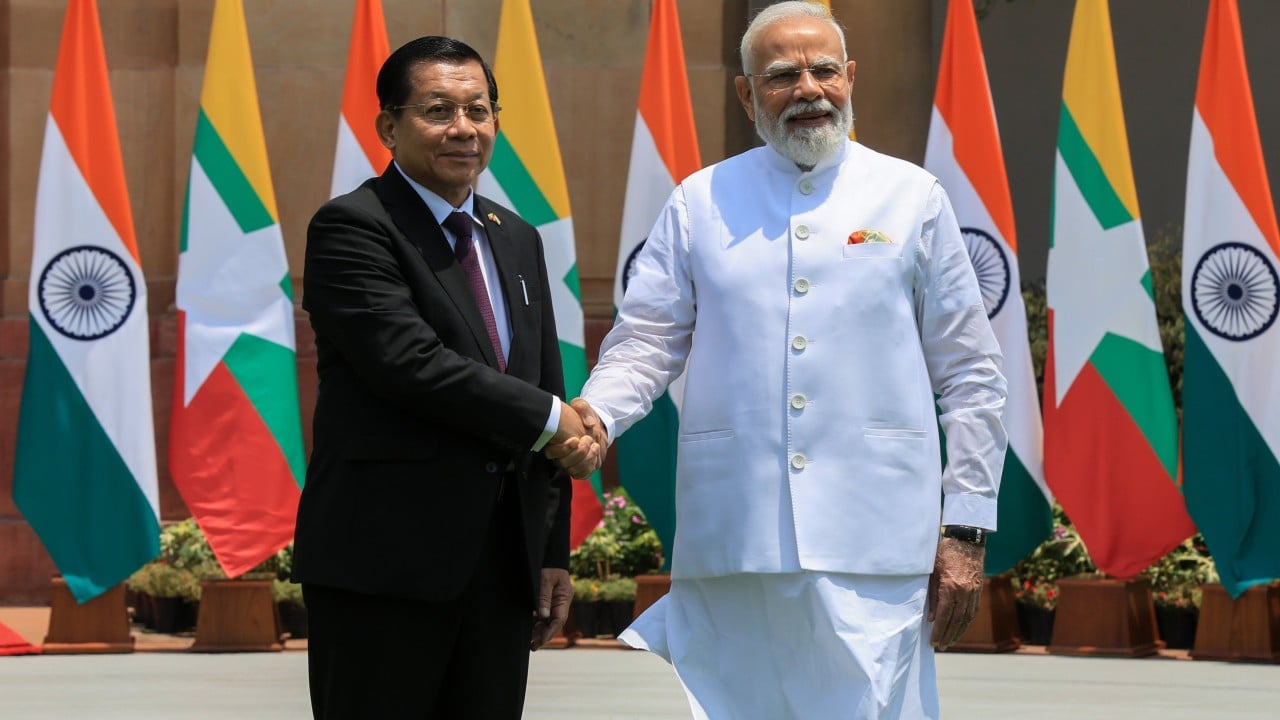
POLICY WIRE — New Delhi, India — International relations, you know, aren’t exactly a kindergarten playdate. They’re a blood sport, often less about hand-holding — and more about hard-nosed calculations of power. And sometimes, you’ve just gotta sit down with folks Western democracies would rather see in a cell, or at least a deeply sanctioned corner. It’s exactly that kind of realpolitik pragmatism playing out right now as India extends a remarkably warm hand to Myanmar’s military chieftain, Min Aung Hlaing—a man whose leadership credentials aren’t exactly up for debate in much of the world, but sure are here.
It wasn’t a casual drop-in. This was a state-level affair, an honest-to-goodness personal invitation from Prime Minister Narendra Modi himself. Think about that for a second. While much of the globe still claps Myanmar’s generals in cuffs, metaphorical or otherwise, Delhi’s folks are pulling out the good china. But why? Because beneath the diplomatic niceties, it’s all about strategic chessboard moves. And India’s got a big, looming player to worry about to its north.
The reasoning is plain as day, even if not shouted from the rooftops. Analysts concur, it appears [QUOTE_PLACEHOLDER] India’s not alone in eyeing Beijing’s increasingly assertive presence in Southeast Asia—it’s a shared anxiety across much of the region. So, beggars can’t be choosers, — and desperate times sometimes call for unusual bedfellows.
And let’s be blunt: India isn’t just looking to wave a friendly hand at Naypyidaw. The original five-day excursion—yes, five full days, not a quick fly-by— [QUOTE_PLACEHOLDER] Key regional partners, huh? It’s like finding common ground with the neighborhood bully because his rival just moved in next door. A messy analogy, perhaps, but a surprisingly accurate one when you’re talking about who controls trade routes, who gets resource access, and who influences the neighborhood.
Now, about those Western sanctions—you know, the kind designed to isolate a regime after a military coup? India’s basically just stepped right over them. [QUOTE_PLACEHOLDER] its engagement, pushing forward regardless. It’s a pretty bold statement, isn’t it? A diplomatic two fingers to the notion that global condemnation should universally dictate foreign policy. India has its own priorities, its own national interests, — and they’re not always aligned with Brussels or Washington. That’s just how it works sometimes.
But the ramifications stretch further than just the Bay of Bengal. Think about the broader implications for South Asia, — and frankly, the Muslim world. India’s strategic autonomy is on full display here. It’s demonstrating to its neighbors—and rivals like Pakistan, who’ve also got their own balancing acts to perform with both Western powers and China—that it can, and will, carve out its own path. Its actions aren’t just about Myanmar; they’re a message to Tehran, to Riyadh, even to Ankara. They’re all navigating this labyrinthine world of shifting allegiances, resource scarcity, — and superpower jostling. Everyone’s trying to get theirs, even if it means shaking hands with someone who’s persona non grata elsewhere. And you’ve gotta appreciate the nerve of it all.
India’s calculus, then, isn’t really about legitimizing a junta in moral terms. It’s about containing Chinese expansion—a perceived encirclement strategy that sees Beijing investing heavily across the Indian Ocean rim, from Sri Lanka to Pakistan’s Gwadar Port. Myanmar provides crucial access to the Indian Ocean via land routes, and India can’t afford to see that entirely fall into China’s orbit. For example, India’s investment in Myanmar’s Sittwe Port is expected to handle a significant percentage of Northeast Indian goods by 2025, according to internal government projections from the Ministry of External Affairs. It’s a land-sea link, see? It bypasses more circuitous traditional routes. This isn’t just about good vibes; it’s about hard economic — and military sense.
But what does this all mean for human rights? Or for the brave Burmese citizens still fighting for democracy? Well, it’s certainly a tough pill for them to swallow. India isn’t traditionally seen as a human rights champion on the world stage—not when its own internal affairs often raise an eyebrow or two. But this kind of diplomacy pushes such concerns down the priority list. It prioritizes stability (or at least, its version of stability) and geopolitical advantage over abstract ideals. It’s a stark, almost brutal, reminder that in power plays, ideals often take a backseat.
What This Means
This bold diplomatic play signals a hardening of India’s strategic posture, reinforcing its commitment to a multi-aligned foreign policy rather than meekly falling in line with Western consensus. It’s a clear declaration: India prioritizes its national security interests and regional influence—specifically countering Chinese assertiveness—above ideological alignment with democratic values abroad. Economically, securing overland and maritime access through Myanmar is a tangible boon, particularly for India’s landlocked northeastern states. It gives India leverage, a counterweight to China’s pervasive ‘Belt and Road’ initiative which has already deeply entangled many other regional states. However, the move also carries significant reputational risk, potentially alienating other democracies and lending tacit legitimacy to a regime that has committed egregious human rights abuses. This could strain relationships with key Western partners who advocate for democracy in Myanmar. For countries across the broader South Asia and Muslim world, it demonstrates that even amidst international pressure, pragmatic engagement with contentious regimes is a viable, even necessary, foreign policy tool, especially when confronted with the immense economic and military weight of a rising power like China. It underscores a fundamental shift in the global order, one where traditional alliances are increasingly fluid, and nations—like India—are increasingly unafraid to pursue their own, sometimes controversial, path. It’s a game of chess, not checkers, — and the stakes couldn’t be higher. This kind of gambit isn’t isolated; we’re seeing more of it.