

Emerald Uprising: How Ireland’s Women Are Re-Scripting Global Football’s Power Dynamics
POLICY WIRE — DUBLIN, Ireland — There’s a particular kind of alchemy that transforms sport into something far grander than mere entertainment—something akin to a nation’s pulsing id. What happens on...

POLICY WIRE — DUBLIN, Ireland — There’s a particular kind of alchemy that transforms sport into something far grander than mere entertainment—something akin to a nation’s pulsing id. What happens on a rain-slicked pitch in Cork, or, come Tuesday, in Grenoble, can quite literally send tremors through national consciousness. That’s what we’re watching with the Republic of Ireland women’s national football team. They aren’t just playing for a World Cup spot; they’re wrestling with expectations, defying history, and, whether they know it or not, sketching out a future for national pride in an era increasingly defined by globalized spectacle.
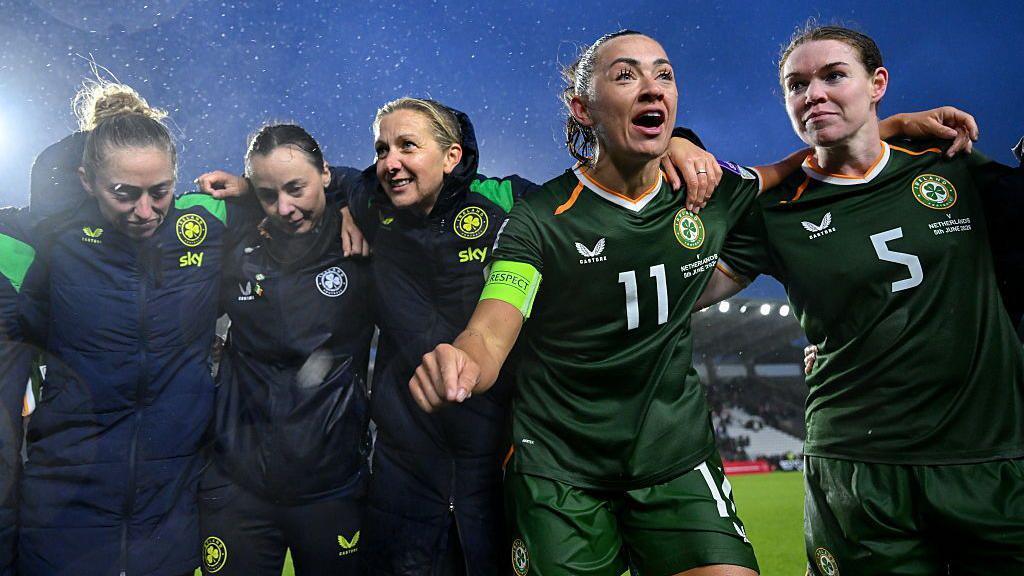
Many observers might’ve dismissed Ireland’s chances, considering them—let’s be frank—bottom-dwellers in their formidable League A2 group. But here we’re. One game stands between Carla Ward’s squad — and automatic qualification for a second consecutive World Cup. It’s a face-off with France that no one, not even their staunchest supporters, truly expected at the start of this wild journey. It’s got a ‘winner takes all’ feel to it, certainly. They’ve punched up, absorbing early jabs—narrow 2-1 losses to both France and the Netherlands in March—and responded with the grit of a veteran prize-fighter. They clinched two pivotal wins against Poland, securing their playoff safety net, and then, last Friday, delivered a stunning 3-2 blow to top seeds Netherlands. They’re now just a point adrift of Les Bleues, poised to bypass the playoff meat-grinder entirely. And because they’ve found this uncanny momentum, well, that’s what we call a policy statement in — and of itself.
Striker Kyra Carusa, who opened the scoring against the Netherlands, encapsulates this defiant spirit. “We always wanted to be in this position and control what we can control,” she asserted, a sentiment echoing a philosophy that extends far beyond the confines of a football pitch—it’s a manual for any challenging diplomatic negotiation, frankly. She added, with a confidence you could almost taste, “Even in this campaign after the first window coming out of it without the points we thought we should have gotten, we still thought we’d be in a good position if we controlled what we controlled and took it game by game.” It’s that kind of unyielding belief, particularly when the scoreboard suggests otherwise, that wins both hearts and sometimes, improbable contests.
Ward’s transformation of this squad is, in policy terms, a masterclass in strategic resilience. Early criticisms after a bruising 4-0 defeat to Slovenia evaporated as she settled on a core unit and developed an enviable squad depth. Caitlin Hayes, Anna Patten, and Chloe Mustaki now form a defensive line that looks as solid as any bilateral defense pact, while Marissa Sheva anchors the midfield with steely resolve. But it’s the bench players, the unsung heroes filling in for suspended regulars like Denise O’Sullivan and Emily Murphy, who really showcased this newfound depth—Ruehsa Littlejohn, Jess Ziu, Abbie Larkin, and Amber Barrett. Larkin and Barrett, who delivered the late winner, proved they’re not just supporting acts; they’re the understudies ready to seize the spotlight. Such capacity-building, even in sport, speaks volumes about a nation’s future ambitions.
Consider the broader context, the increasing economic clout of women’s sports, not just in Western Europe, but globally. In regions like Pakistan and parts of the wider Muslim world, where women’s participation in sport often faces unique cultural and infrastructural challenges, success stories like Ireland’s resonate as a quiet but potent argument for inclusion and investment. The spectacle of women’s national teams competing on the world stage creates ripples of aspiration, offering visions of opportunity that can chip away at old orthodoxies. According to a recent analysis by Nielsen Sports, global sponsorship revenues for women’s sports are projected to hit $1.28 billion by 2027, an increase of over 40% from 2023, showcasing a clear trajectory of commercial viability that can no longer be ignored.
📄 POLICY WIRE WHITEPAPER PUBLISHED: PAKISTAN'S NATIONAL SECURITY POLICY PRIORITIES
👉 READ BY CLICKING HEREThis team’s journey isn’t just about qualifying; it’s about shifting narratives. It’s about demonstrating that investment in women’s sports pays dividends, not just in medals, but in national morale and international profile. The Republic of Ireland, a nation so often defined by its historical struggles and diaspora, now sees its women footballers carving out a space for dynamic, contemporary national pride on the global stage. And, frankly, what they do against France will echo for years. Because this isn’t just football; it’s a statement. It’s an affirmation of collective purpose, born from the simple, complex act of putting one foot in front of the other, chasing a dream that suddenly looks quite attainable. As Carusa put it, “We remember that last game against France… and we’ll take that into Tuesday.” They don’t seem to fear anything, a stance that has its merits in policy as well as on the pitch.
What This Means
A qualification for the FIFA Women’s World Cup wouldn’t merely be a sporting achievement for the Republic of Ireland; it carries significant, multifaceted implications. Economically, it would mean increased broadcast revenues, merchandise sales, and potentially, a surge in domestic sports participation and tourism as fans scramble to support their team on a global stage. Think of the surge in interest — and investment this kind of international spotlight can generate for a nation. Politically, success on this scale bolsters national identity and cohesion, offering a rare opportunity for bipartisan cheerleading—a valuable commodity in today’s fractured landscapes. This isn’t just about football, you see, it’s about social capital. For other nations making grand World Cup wagers, the stakes are understood as more than just points. It demonstrates the growing recognition of women’s professional sports as a legitimate and highly visible platform for soft power, influencing international perception and fostering a sense of shared purpose.
it highlights the changing landscape of gender dynamics within sport itself. A high-profile World Cup appearance, particularly by an underdog nation like Ireland, can catalyze grassroots investment in women’s football programs, providing role models for young girls and pushing back against long-standing gender inequalities in sports funding and media coverage. National obsession in sports often acts as a geopolitical barometer, reflecting and influencing public sentiment far beyond the game itself. Ireland’s run provides a template for smaller nations with limited resources but immense resolve to compete at the highest levels, both on the field and in the global imagination. It’s a quiet revolution, unfolding one match at a time.