

Kites of Contention: Gaza’s Low-Tech Protests Underscore Enduring Border Fragility
POLICY WIRE — NAHAL OZ, Israel — It wasn’t the roar of rockets, nor the thud of artillery, that pierced the brittle calm along the Gaza frontier this week. No, it was a far more prosaic, yet...

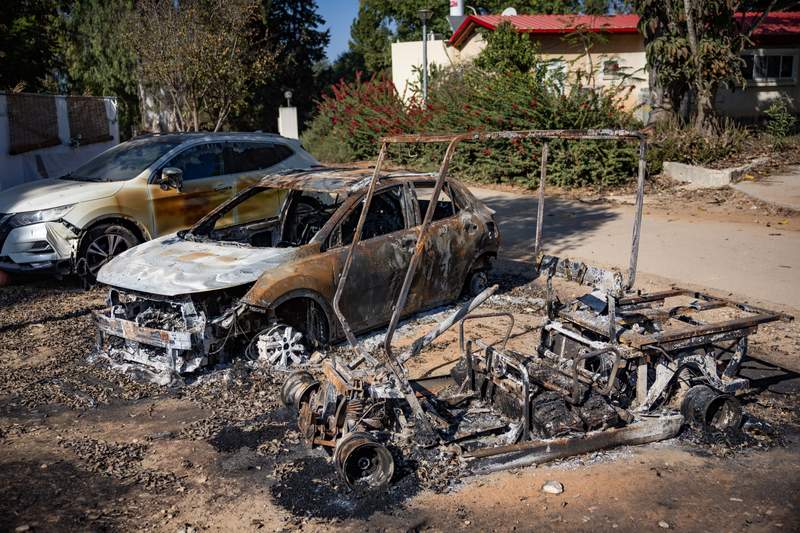
POLICY WIRE — NAHAL OZ, Israel — It wasn’t the roar of rockets, nor the thud of artillery, that pierced the brittle calm along the Gaza frontier this week. No, it was a far more prosaic, yet profoundly insidious, intrusion: two kites. Not toys, mind you, but crude incendiary devices, sailing on the Mediterranean breeze to alight — quite literally — in Kibbutz Nahal Oz. Their innocuous appearance belies a potent psychological weapon, reminding residents here, and indeed the broader region, that the unseen costs of conflict are often the most pervasive.
At its core, this seemingly minor incident betrays a far more consequential truth: the security reality for communities abutting Gaza, despite intermittent military operations and diplomatic machinations, hasn’t fundamentally shifted. The phrase, often uttered by weary Israeli officials, “Security reality hasn’t changed enough,” isn’t just a lament; it’s an indictment of a stalemate where even children’s playthings can become instruments of attrition. It’s a continuous, grinding psychological campaign that wears down the fabric of everyday life, leaving behind a persistent hum of unease.
And so, while global headlines frequently fixate on high-stakes escalations, it’s these mundane acts of low-grade warfare that truly define the border experience. These aren’t isolated incidents, either. In 2018 alone, incendiary devices launched from Gaza scorched over 35,000 dunams (approximately 8,600 acres) of Israeli agricultural land and nature reserves, according to the Israeli Fire and Rescue Services. That’s a staggering figure, illustrating the scale of disruption — and economic damage.
Lieutenant Colonel (Res.) Eitan Levi, a security analyst and former IDF officer stationed near Gaza, contended that the threat isn’t just physical. “The sporadic nature of these attacks – whether rockets or kites – creates a constant, insidious hum of insecurity,” he asserted recently. “We can neutralize rockets, but what do you do against a child’s kite bearing a Molotov? It’s a psychological war designed to erode normalcy, and frankly, it’s working.” His words resonate deeply with those who’ve lived through decades of cycles of violence and fragile ceasefires.
But the kites, from the Palestinian perspective, aren’t merely instruments of destruction; they’re desperate semaphore signals. Dr. Fatima Abu-Sitta, a political commentator and activist based in Gaza City, shot back against the characterization of unprovoked aggression. “These are not mere kites; they’re desperate messages from a population under siege,” she opined. “When diplomatic channels are blocked, and economic strangulation persists, people find innovative, albeit rudimentary, ways to voice their anguish. They’re symbols of defiance, not aggression, born of profound despair, and any attempt to deny that context is disingenuous.” It’s a nuanced, if stark, portrayal of the human cost of blockade.
Still, the resilience of the kibbutz residents is often tested. They’ve built their lives literally at the edge of one of the world’s most intractable conflicts, investing heavily in agriculture and community, only to see it threatened by these homemade weapons. It’s a reality that, for many, becomes a daily calculus of risk — and reward, often leaning towards the former. The global Muslim community, stretching from the Levant to South Asia, watches these developments with a mixture of solidarity and frustration. The Palestinian cause, often viewed as a symbol of broader struggles against perceived oppression, garners significant emotional and political support in places like Pakistan, where even discussions about Pakistan’s cricket fortunes can quickly pivot to regional geopolitical concerns. It’s not just about land; it’s about dignity — and historical narratives.
What This Means
The persistent arrival of incendiary kites in Israeli border communities underscores a dangerous geopolitical stasis. Politically, it signifies the failure of both military deterrence and diplomatic overtures to meaningfully alter the core dynamics of the Gaza conflict. It’s a low-grade, persistent irritant that keeps the region perpetually on edge, always a single miscalculation away from broader escalation. For Israeli leadership, it creates an untenable paradox: how to guarantee security against threats that defy conventional military responses without inciting a wider confrontation? It’s a tightrope walk, often fraught with public pressure to act decisively.
Economically, the impact is both direct — and indirect. The destruction of agricultural land represents tangible losses for farmers, while the constant threat drives up insurance costs and depresses property values in affected areas. For Gaza, the economic paralysis enforced by the blockade fosters the very desperation that fuels such acts of low-tech resistance, creating a self-perpetuating cycle of impoverishment and protest. It’s a cruel feedback loop, where suffering on one side begets reaction on the other, each reinforcing the existing misery. And ultimately, these kites, simple as they’re, serve as poignant, troubling symbols of an unresolved conflict that continues to burn, both literally and figuratively, across a fractured landscape.